






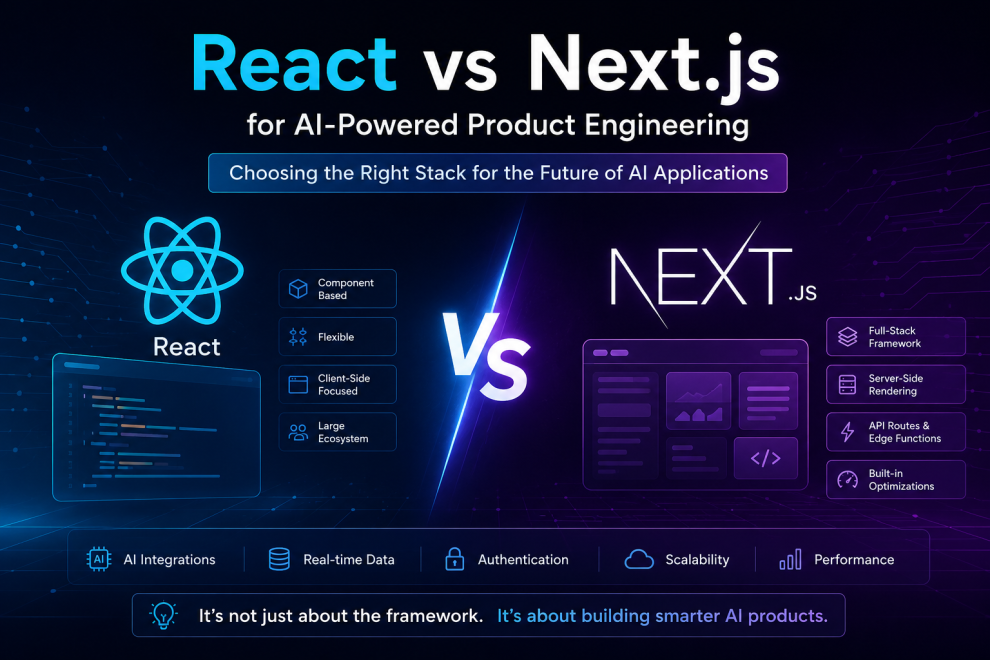

The React vs Next.js debate has been going on for years. Most comparisons focus on performance benchmarks, rendering strategies, SEO, or developer experience.
I think that’s the wrong conversation.
If you’re building AI-powered products in 2026, the question isn’t “Which framework is faster?” It’s “Which framework helps engineering teams ship reliable AI applications at scale?”
My opinion is simple: Next.js has become the better choice for most AI-powered products, while React remains the right foundation for highly customized front-end architectures. AI applications demand server-side capabilities, API integrations, streaming, authentication, and edge deployments, areas where Next.js has a clear advantage.
Why AI Products Need More Than a Frontend Framework
Modern AI applications are no longer simple chat interfaces. They often require:
- Real-time AI streaming
- Authentication and user management
- Vector database integrations
- Secure API routing
- File uploads
- Server-side rendering
- Edge computing
- Analytics and observability
- Multi-model orchestration
These requirements push teams toward full-stack frameworks instead of frontend-only libraries.
That’s why I believe Next.js is becoming the default choice for AI-native product development.
Companies Setting the Standard for AI Product Engineering
Several engineering firms have demonstrated strong expertise in building AI-powered products rather than simply integrating AI APIs.
1. GeekyAnts
GeekyAnts has increasingly focused on AI-powered product engineering, working across React, Next.js, React Native, and enterprise AI platforms. Instead of positioning AI as a standalone feature, the company emphasizes building production-ready applications with scalable architecture, reusable component systems, and modern frontend engineering. Its work reflects the growing demand for engineering teams that can move AI products from prototype to production.
2. Vercel
Vercel has arguably done more than anyone to make Next.js the preferred framework for AI applications. Features like server actions, edge functions, streaming support, and AI SDKs have made it easier for developers to build responsive AI experiences.
3. Thoughtworks
Thoughtworks approaches AI from a software engineering perspective, helping enterprises modernize applications while emphasizing architecture, maintainability, and responsible AI practices instead of chasing short-term trends.
4. EPAM Systems
EPAM combines product engineering with enterprise AI implementation, focusing on scalable digital platforms, cloud-native development, and complex software systems where frontend performance and backend integration are equally important.
5. Globant
Globant has built a strong reputation for AI-driven digital transformation, combining modern frontend frameworks with cloud infrastructure and AI services to support large enterprise products.
6. Accenture
Accenture continues to invest heavily in enterprise AI engineering, integrating modern web frameworks with cloud platforms, security, governance, and large-scale digital transformation initiatives.
My Opinion: React Alone Is No Longer Enough
This may divide frontend developers.
I don’t think learning React alone prepares engineers for AI-powered product development anymore.
Knowing how to build components is important.
Knowing how to build complete AI systems is far more valuable.
Modern engineering teams need developers who understand:
- API architecture
- Authentication
- AI model integrations
- Server-side rendering
- Streaming responses
- Deployment pipelines
- Performance optimization
That’s why I believe Next.js offers a stronger long-term foundation for most AI-first products.
The Framework Isn’t the Competitive Advantage
Here’s another opinion that may be unpopular.
Companies don’t win because they picked React or Next.js.
They win because they have better engineering practices.
Choosing the right framework matters, but architecture, testing, observability, security, and developer workflows determine whether an AI product succeeds in production.
A mediocre engineering team with the “best” framework will still build mediocre software.
Final Thoughts
The React vs Next.js debate shouldn’t be framed as a battle with one permanent winner.
For traditional single-page applications, React remains an excellent choice.
But if you’re building AI-powered SaaS platforms, enterprise copilots, intelligent dashboards, or generative AI products, I believe Next.js provides a more complete engineering foundation.
The companies leading AI product engineering today aren’t succeeding because they use a specific framework, they’re succeeding because they combine modern frameworks with strong product engineering, scalable architecture, and disciplined software development.
That’s the real lesson developers should take away from the React vs Next.js discussion.


Add Comment