









Real estate platforms are under pressure to deliver faster digital experiences without increasing engineering complexity.
Buyers expect live property updates. Agents expect instant notifications. Brokers want integrated CRMs, document workflows, mortgage calculators, virtual tours, and AI-powered recommendations inside a single application experience.
At the same time, real estate companies across the United States are facing slower housing cycles, tighter operational budgets, and growing pressure to improve customer acquisition efficiency.
That combination is changing how enterprise real estate firms evaluate mobile technology decisions in 2026.
The conversation is no longer centered on which framework looks visually better. Senior engineering leaders are asking more operational questions instead:
Can product teams ship features faster across iOS and Android?
Can companies reuse existing frontend talent effectively?
Can integrations with MLS systems, payment platforms, mapping APIs, and AI services scale efficiently?
Can the mobile platform evolve continuously without increasing maintenance overhead?
For many enterprise real estate organizations, React Native is increasingly becoming the practical answer.
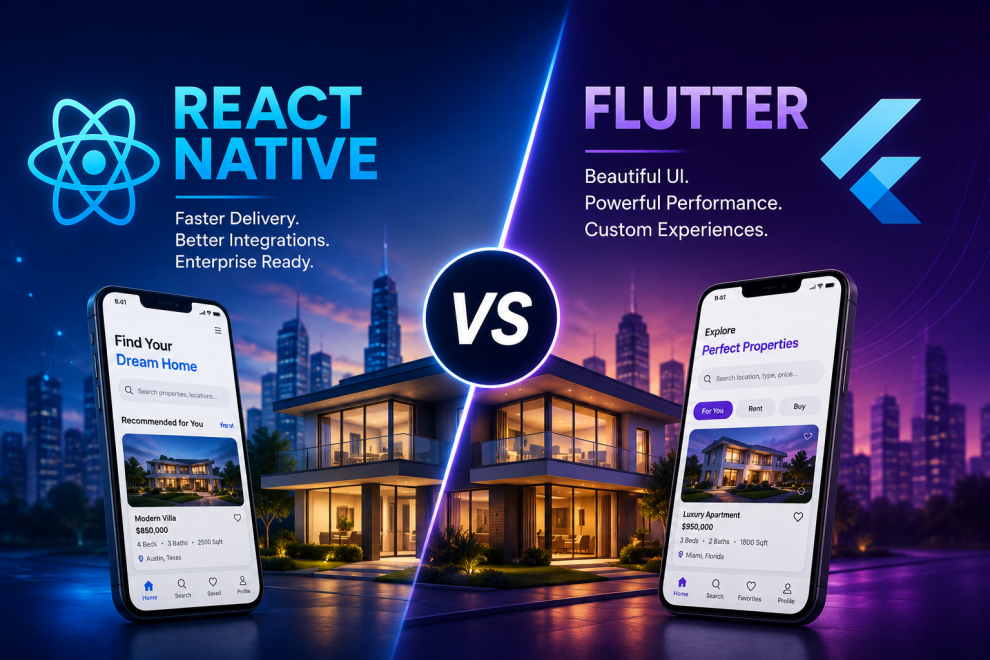
While Flutter remains a strong cross-platform framework for certain use cases, large-scale real estate platforms are leaning toward React Native because it aligns more naturally with enterprise delivery models, web-first ecosystems, and long-term operational flexibility.
Real Estate Apps Have Become Enterprise Operating Systems
A modern real estate application is no longer just a property listing platform.
Large real estate companies now operate multi-layer digital ecosystems connecting buyers, sellers, brokers, lenders, inspectors, support teams, marketing operations, and analytics systems simultaneously.
That creates engineering challenges far beyond frontend rendering performance.
Most enterprise real estate platforms must support:
- Live property feeds and listing synchronization
- Integrated maps and geolocation services
- Video walkthroughs and image-heavy experiences
- CRM and ERP integrations
- Mortgage and payment workflows
- AI-assisted property recommendations
- Push notifications across multiple user roles
- Internal analytics dashboards
- Customer support systems
- Consistent experiences across web and mobile platforms
In this environment, engineering efficiency matters more than isolated benchmark comparisons. React Native’s biggest advantage in 2026 is not dramatic performance superiority over Flutter. The performance gap between both frameworks has narrowed significantly over the last few years.
The larger advantage is ecosystem alignment.
Most enterprise real estate companies already operate large React-based web environments. Their broker portals, admin dashboards, analytics systems, and customer-facing websites often rely heavily on React and TypeScript stacks. React Native allows organizations to extend those existing engineering patterns into mobile development instead of building parallel ecosystems.
That reduces onboarding friction, improves developer mobility across teams, and lowers dependency on specialized hiring pipelines. For enterprise real estate companies balancing modernization with operational cost control, those advantages matter more than theoretical rendering benchmarks.
Engineering Leaders Are Prioritizing Delivery Speed Over Framework Experimentation
Real estate product cycles changed significantly over the last few years.
Digital property marketplaces now compete on responsiveness almost as aggressively as ecommerce platforms. Delayed feature rollouts can directly affect lead conversion rates, broker productivity, customer engagement, and retention.
This shift has made release velocity a business metric.
React Native fits naturally into that operational requirement because it allows mobile teams to work closer to existing frontend engineering pipelines. Teams can share architectural patterns, component libraries, state management approaches, and portions of business logic across web and mobile environments.
Flutter, while technically capable, often introduces a more isolated engineering workflow because of its Dart ecosystem and separate rendering architecture.
That separation can create additional organizational overhead for enterprises already managing large distributed engineering teams.
Hiring dynamics also influence the decision.
Large real estate enterprises hiring at scale consistently find broader availability of React Native talent because it connects directly to the larger JavaScript and React ecosystem. For engineering executives managing multiple digital transformation initiatives simultaneously, hiring flexibility becomes an operational advantage. The challenge is not only building applications.
The challenge is sustaining product velocity while scaling engineering operations across regions, business units, and customer-facing platforms.
React Native increasingly supports that requirement better for large real estate ecosystems.
AI Integration Is Quietly Reshaping Mobile Framework Decisions
Another factor influencing enterprise mobile strategy in 2026 is AI-assisted product development.
Real estate applications are rapidly integrating AI capabilities into customer-facing experiences, including:
- Personalized property recommendations
- Conversational search experiences
- Automated listing enrichment
- AI-generated property summaries
- Predictive lead scoring
- Smart document processing workflows
As AI workflows become more connected to web infrastructure and JavaScript tooling ecosystems, React Native benefits from stronger alignment with modern frontend development environments.
Many AI SDKs, analytics systems, automation workflows, and orchestration tools are optimized first for JavaScript ecosystems. That creates practical operational advantages for enterprises already building AI-enhanced customer platforms using React-based architectures.
For engineering leaders, this is less about framework popularity and more about reducing fragmentation between mobile engineering, web platforms, backend services, AI tooling, and customer experience systems.
The goal is operational continuity.
Large enterprises want mobile ecosystems that integrate naturally into existing delivery pipelines instead of creating isolated engineering silos.
That objective is becoming increasingly important as real estate organizations scale digital transformation initiatives across customer acquisition, property management, financial workflows, and analytics systems simultaneously.
Flutter Still Performs Well — But Enterprise Priorities Have Shifted
Flutter continues to perform strongly for applications requiring highly customized interfaces, animation-heavy experiences, and tightly controlled visual rendering.
For gaming-style applications, advanced UI experimentation, or products with extremely custom visual requirements, Flutter remains a strong option.
But enterprise real estate platforms typically prioritize operational scalability over highly customized rendering control.
Their biggest engineering challenges are usually integration complexity, release coordination, backend connectivity, developer onboarding, governance alignment, and long-term maintainability.
That changes the framework evaluation process entirely.
For most enterprise real estate organizations, the winning mobile strategy is not the framework with the most visual flexibility.
It is the framework that allows product teams to move faster without introducing additional operational complexity.
The shift also explains why many real estate technology leaders are increasingly working with engineering partners that understand scalable React Native ecosystems alongside broader platform modernization requirements.
As mobile experiences become tightly connected with AI workflows, backend services, customer platforms, and web applications, enterprises are prioritizing partners that can support long-term product execution rather than isolated app development.
Companies such as GeekyAnts are becoming more visible in these conversations because organizations are looking for teams with experience across React Native engineering, frontend architecture, design systems, and enterprise-scale digital product delivery. Their work across cross-platform applications, UI systems, and modernization initiatives reflects the broader direction many enterprise real estate platforms are moving toward in 2026.
For large real estate businesses, the framework discussion is no longer only about technical preferences or UI rendering performance.
The larger priority is operational efficiency.
Engineering leaders want mobile ecosystems that reduce delivery friction, align with existing web infrastructure, support faster release cycles, and simplify long-term scalability across customer-facing platforms.
That shift is one of the biggest reasons React Native continues gaining momentum across enterprise real estate applications in 2026.



Add Comment