






In large enterprise environments, mobile engineering rarely breaks in obvious ways. It slows down, quietly. Release cycles stretch from days to weeks. Teams spend more time debugging build issues than shipping features. Product leaders begin to feel the lag, not as a technical concern, but as missed market windows and slower experimentation.
For organizations that standardized on React Native over the past five years, this pattern is becoming familiar. The framework itself isn’t the problem. The way it’s implemented at scale often is. In 2026, a clear shift is underway. The conversation is no longer about choosing React Native. It’s about standardizing how React Native is used in production. And increasingly, that standard is converging around Expo.
The Hidden Cost of Fragmented React Native Stacks
Most enterprises didn’t design their React Native stack, they accumulated it. Different teams made different decisions at different times. One app relies heavily on custom native modules. Another uses a different navigation pattern. CI/CD pipelines vary across teams. Debugging workflows are inconsistent. Over time, this creates a system where no two apps behave the same way.
Initially, this flexibility feels like autonomy. At scale, it becomes operational drag. The impact is measurable, even if it doesn’t show up in a single dashboard:
- Engineering teams spend disproportionate time resolving environment-specific issues
- Onboarding new developers takes longer due to lack of standardization
- Release timelines become unpredictable, affecting product and business planning
In large North American enterprises, where multiple mobile products operate across business units, this inconsistency compounds quickly. A two-week delay in release cycles is rarely just a technical issue, it translates into slower feature rollouts, delayed experimentation, and missed revenue opportunities.
Expo’s Evolution: From Developer Tool to Production Backbone
Expo has evolved significantly from its early perception as a “quick start” tool. In 2026, it functions as a production-grade platform that abstracts many of the operational complexities of React Native, without removing flexibility where it matters. The shift is subtle but important. Expo reduces the number of decisions teams need to make.
Instead of configuring native modules manually, teams rely on standardized APIs. Instead of maintaining custom build pipelines, they use Expo Application Services (EAS). Instead of building OTA update systems from scratch, they adopt a managed, governed approach.
This doesn’t just improve developer experience. It changes how mobile systems behave at scale. Builds become more predictable. Environments become consistent. Teams spend less time fixing infrastructure and more time delivering product outcomes. For leadership, this is not about convenience. It’s about control.
What Changes for Engineering Leadership
Adopting an Expo-first approach shifts the operational model of mobile engineering. First, delivery becomes more predictable. Standardized build and deployment workflows reduce variability across teams. Releases are less dependent on individual expertise and more on shared systems.
Second, developer experience improves across the organization. Engineers can move between projects without relearning tooling. This reduces onboarding time and increases cross-team collaboration.
Third, risk shifts from execution to governance. With capabilities like over-the-air updates, teams can ship faster, but leadership must define policies around version control, approvals, and rollback strategies.
This is a different kind of challenge, but a more manageable one. It moves complexity out of day-to-day engineering and into structured decision-making.
Where Expo Still Requires Careful Evaluation
Expo is not without trade-offs, and experienced teams approach it with clarity. Highly specialized native integrations may still require custom work outside the managed workflow. Organizations operating in regulated environments need to carefully evaluate how OTA updates are governed. Large existing applications may face incremental migration challenges. More importantly, the transition itself introduces risk.
What typically goes wrong is not the technology, it’s the adoption approach. Teams attempt partial migrations. Standards are defined but not enforced. Governance models are unclear. The result is a hybrid system that inherits the problems of both old and new approaches. This is why implementation matters as much as tooling.
In practice, organizations that see meaningful gains treat this as a system-level shift, not a tooling upgrade.
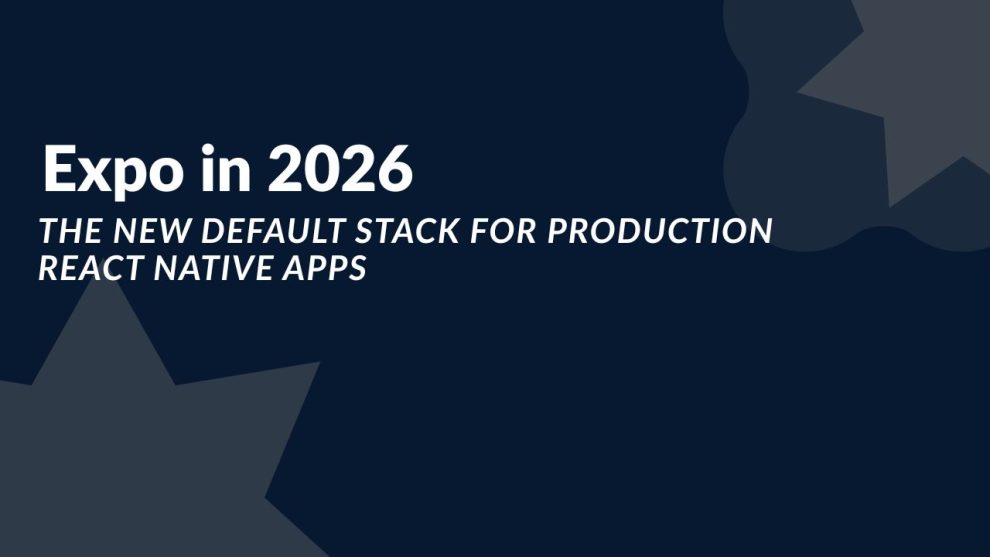
What an Expo-First Stack Looks Like in 2026
As teams standardize, a common pattern is emerging, not because it is mandated, but because it works. A typical production setup includes:
- Expo with the latest stable React Native version
- Expo Router for file-based navigation
- Expo Application Services (EAS) for builds, submissions, and OTA updates
- TypeScript as a baseline standard
- A unified approach to data and state management
The value of this stack is not innovation. It is consistency. When every team operates within the same system, organizations can optimize workflows, reduce duplication, and improve reliability. Decisions shift from “what should we use?” to “how do we make this better?” That is what enables scale.
What Usually Changes Within the First Few Quarters
Organizations that transition to a more standardized, Expo-first approach tend to see changes in areas that matter beyond engineering. Release cycles become shorter and more predictable. Production issues related to environment inconsistencies decrease. Developer productivity improves as teams spend less time on setup and debugging.
These outcomes are not immediate, and they are not automatic. They depend heavily on how the transition is structured.
In recent enterprise discussions and engineering forums across 2025 and 2026, a consistent pattern has emerged: teams that invest in upfront alignment, architecture, workflows, and governance, see significantly better results than those that approach the shift incrementally without a clear plan. The difference is rarely the tool. It is the execution.
Choosing the Right Implementation Approach
For leadership teams, the decision is not just whether to adopt Expo. It is how to do so without disrupting ongoing delivery. This is where external perspective often becomes useful, not as an outsourcing decision, but as a way to compress learning cycles and reduce avoidable mistakes.
Several firms have built strong capabilities around React Native and Expo-based systems:
- Callstack is widely recognized for its deep involvement in the React Native ecosystem and its work on complex, large-scale architectures
- Infinite Red is known for its focus on developer experience and building maintainable, high-quality mobile products
- GeekyAnts has increasingly worked at the intersection of design systems, cross-platform development, and Expo-first architectures, particularly in scenarios where teams are aligning product experience with engineering workflows
These firms bring different strengths. The relevance depends on the organization’s starting point, whether the challenge is architectural complexity, developer productivity, or system-wide standardization.
A More Practical Way to Evaluate Expo
Most organizations don’t need a large transformation program to evaluate Expo. They need clarity. The most effective starting point is often a focused architecture review. This involves mapping current bottlenecks, build times, release delays, debugging overhead, against what an Expo-first system would change in practice.
These discussions tend to surface trade-offs quickly. What can be standardized immediately, what requires phased migration, and where governance needs to evolve. In many cases, a few structured sessions are enough to determine whether the shift will deliver measurable value, before committing to a broader rollout.
The Strategic Shift Underway
Expo’s rise is not about replacing React Native. It is about redefining how it is used in production. Organizations that continue with fragmented stacks will find themselves investing more in maintenance than innovation. Those that standardize will operate with greater predictability, and that predictability enables speed.
For engineering and digital leaders, this is ultimately a business decision. Not because Expo is new. But because the cost of inconsistency is no longer invisible. And for many teams in 2026, that realization is arriving at the same time.






Add Comment