



Enterprise mobile strategy is changing faster than most organizations expected.
For years, large enterprises treated mobile apps as downstream delivery channels. Core innovation happened inside cloud platforms, backend systems, analytics pipelines, and web infrastructure. Mobile teams executed roadmaps after product decisions were already finalized.
AI has disrupted that operating model.
Today, enterprise mobile applications are becoming active intelligence surfaces. Customer apps now summarize information, automate workflows, personalize experiences, predict behavior, support employees, and integrate with enterprise knowledge systems in real time. Internal mobile platforms are also evolving into AI assisted operational tools for sales, logistics, healthcare, finance, and field operations.
That shift is forcing engineering leaders to rethink the mobile stack itself.
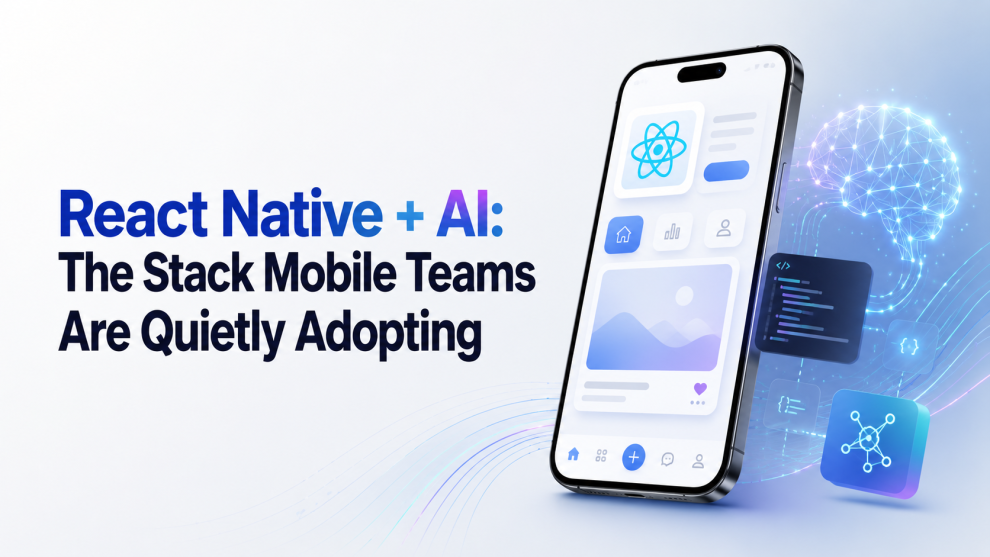
Across North American enterprises, many mobile teams are quietly converging on a combination that balances speed, scalability, and operational efficiency: React Native plus AI driven infrastructure.
This shift is not happening because React Native is suddenly new. It is happening because AI initiatives are exposing delivery bottlenecks that already existed inside large organizations.
Separate iOS and Android teams increase coordination overhead. AI features require faster iteration cycles. Governance teams demand centralized observability and model control. Infrastructure leaders want fewer duplicated engineering investments. Product teams want experiments shipped in weeks instead of quarters.
Traditional native mobile structures often struggle under those conditions.
React Native is increasingly becoming the layer enterprises use to simplify that complexity without sacrificing product velocity.
AI Is Changing the Economics of Mobile Engineering
Many enterprise AI conversations still focus heavily on models. In practice, delivery teams face a different problem.
The real operational challenge is integrating AI into products fast enough to generate measurable business impact before priorities shift again.
Large organizations rarely fail because they lack access to AI models. They fail because implementation cycles move too slowly across fragmented engineering environments.
This becomes especially visible inside enterprise mobile programs where release coordination, platform duplication, compliance reviews, and QA cycles already consume significant resources.
AI compounds that pressure.
Features such as conversational interfaces, recommendation systems, enterprise copilots, multilingual support, semantic search, intelligent onboarding, predictive workflows, and AI assisted customer support require constant iteration. Teams need rapid experimentation loops across frontend experiences, APIs, analytics, and model orchestration layers.
Maintaining separate native codebases often slows those loops down.
React Native changes the economics because it allows enterprise teams to consolidate large portions of the mobile experience into a shared development layer while integrating directly with modern AI infrastructure.
This matters for leadership teams tracking platform efficiency metrics.
A single engineering initiative can now support both iOS and Android releases while AI services operate centrally through APIs, vector databases, orchestration layers, and cloud inference pipelines. That reduces duplicated implementation work and simplifies cross platform governance.
The timing also aligns with broader enterprise priorities.
According to GitHub’s 2024 developer research, AI assisted development tooling adoption continues rising rapidly among enterprise engineering teams. Meanwhile, Deloitte and McKinsey reporting across enterprise AI programs consistently highlights execution speed and integration complexity as leading barriers to ROI realization.
Mobile teams are feeling those pressures directly.
As a result, engineering leaders are increasingly prioritizing platforms that reduce coordination friction while keeping product delivery flexible enough for continuous AI iteration.
Why Enterprise Teams Are Choosing React Native for AI Driven Products
The conversation around React Native inside enterprises has matured significantly.
A few years ago, many executives still viewed cross platform frameworks primarily as cost optimization tools. Today, the discussion is more strategic.
React Native is increasingly valued because it fits modern enterprise architecture patterns.
Most AI enabled enterprise products already rely heavily on APIs, cloud services, edge processing, analytics layers, and centralized orchestration systems. React Native aligns naturally with that ecosystem because teams can build unified interface layers while connecting into shared backend intelligence systems.
This becomes particularly valuable for organizations managing large digital portfolios.
A healthcare platform may need AI assisted patient engagement across mobile apps, clinician dashboards, and internal operational systems. A retail enterprise may require recommendation engines, conversational commerce, inventory intelligence, and loyalty personalization across multiple customer touchpoints. A logistics company may deploy predictive workflows to field operations teams using mobile devices across several regions.
In these environments, consistency matters as much as speed.
React Native allows organizations to centralize components, design systems, analytics instrumentation, and AI interaction patterns while reducing duplicated mobile engineering effort.
At the same time, improvements in the React Native ecosystem have made enterprise adoption more practical than earlier generations of cross platform frameworks.
Performance optimization has improved significantly. Native module integration is stronger. Tooling ecosystems are more mature. Developer availability is broader. Integration with modern cloud platforms is easier.
That is why organizations are no longer evaluating React Native only against native development. They are evaluating it against operational scalability.
This distinction matters for leadership teams responsible for engineering budgets, cloud governance, release velocity, and platform modernization targets.
Companies like GeekyAnts ,Callstack, and Infinite Red are actively working with enterprises building scalable React Native ecosystems tied to AI enabled product experiences. Their work reflects a broader industry movement where mobile engineering increasingly intersects with platform engineering, AI infrastructure, and digital transformation strategy.
The Real Enterprise Challenge Is Governance, Not Features
One reason this transition remains relatively quiet is that most enterprise leaders are not publicly discussing AI mobile transformation in terms of frameworks.
Internally, however, the priorities are very clear.
Leadership teams are under pressure to deliver AI capabilities without introducing governance instability.
That means solving problems such as:
- Controlling model access across business units
- Standardizing observability and monitoring
- Managing AI related compliance requirements
- Reducing infrastructure duplication
- Accelerating release cycles without increasing operational risk
React Native supports those objectives because it reduces fragmentation at the application layer.
Instead of managing multiple disconnected mobile implementations, teams can centralize development standards while integrating AI systems through shared enterprise services.
This also supports platform engineering initiatives that many large organizations are already investing in aggressively.
AI adoption is pushing enterprises toward more unified developer platforms where frontend systems, APIs, cloud infrastructure, security tooling, and AI orchestration layers operate cohesively. React Native fits naturally into that architecture because it simplifies mobile standardization.
Importantly, enterprises are not abandoning native development entirely.
Highly specialized applications involving advanced graphics, low latency hardware integrations, or platform specific optimization may still require native engineering investment. But many organizations are now reserving native development for highly differentiated functionality instead of treating it as the default for all mobile experiences.
That operational shift can significantly reduce long term engineering overhead.
What Mobile Leadership Teams Are Prioritizing Next
Over the next 24 months, enterprise mobile strategy will likely become more tightly connected to AI operational maturity.
The winning organizations may not necessarily be the ones with the most advanced models. They will more likely be the companies capable of operationalizing AI experiences across products faster than competitors.
That requires alignment between engineering velocity, infrastructure governance, cloud architecture, developer productivity, and user experience delivery.
React Native is increasingly part of that equation because it helps reduce friction between those layers.
For enterprise leaders, the strategic question is no longer whether AI belongs inside mobile products. That decision has effectively already been made across most industries.
The more important question is whether existing engineering structures can support the pace of AI driven product evolution now expected by customers, employees, and executive stakeholders.
Many organizations are discovering that they cannot scale those expectations efficiently using fragmented mobile architectures.
That realization is why React Native plus AI is quietly becoming a preferred operational stack inside large enterprises.
Engineering leaders evaluating modernization initiatives are increasingly treating mobile delivery as part of a broader platform transformation conversation rather than an isolated frontend decision.
That is also why consultation driven partnerships are becoming more valuable than pure implementation vendors. Enterprises often need guidance on architecture strategy, platform governance, AI readiness, developer workflows, and long term scalability before shipping features.
For organizations exploring this transition, reviewing how firms and others approach enterprise React Native ecosystems can provide useful perspective on how the market is evolving.


Add Comment