







How to design a human review workflow that binds approvals to the evidence reviewed, handles stale decisions, and prevents duplicate execution.
An AI assistant reviews a disputed card transaction and proposes a provisional credit of $125. An analyst opens the case on their phone. Before they tap Approve $125 credit, a colleague adds evidence that the customer already received a partial refund. The proposed credit changes to $75.
What happens if the analyst taps the button on the old screen? A reliable approval workflow rejects the stale decision, shows the revised proposal, and leaves the ledger untouched. Making that happen takes coordination between the React interface, the approval API, and the service that executes the credit.
How should the approval workflow work?
Model approval and execution as separate states. A straightforward path is draft → pending_review → approved → executing → executed. Reviewers can also reject the proposal or return it for more information. A change to the amount, destination, or material evidence should create a new revision and require fresh approval. Where bank policy requires dual control, both authorized reviewers must approve the same revision before execution can start.
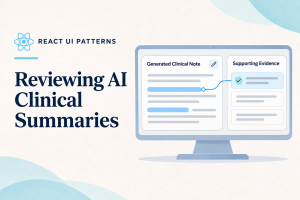
The review screen should show the proposed action, amount and currency, masked account details, supporting evidence, and missing information. Label the AI-generated explanation so the analyst can distinguish it from the underlying bank records. A reviewer who sees an unsupported claim should be able to return the case for investigation from the same screen.
U.S. regulatory context. The April 2026 interagency model-risk guidance, SR 26-2, superseded SR 11-7. It covers traditional statistical and quantitative models and non-generative, non-agentic AI models. Generative and agentic AI are outside its stated scope. In a workflow that combines a conventional fraud score with an LLM-generated case summary, the two components may call for different governance approaches. NIST’s voluntary Generative AI Profile offers a separate reference for designing oversight.
How can React bind an approval to what the analyst saw?
A React web console and a React Native app can share TypeScript types and API logic. The server owns approval state. It can return a strong ETag with the approval resource, and the client can submit it in If-Match to prevent a decision from being applied after that resource changes. HTTP defines 412 Precondition Failed for an unmet precondition.
type ApprovalSnapshot = {
  id: string;
  etag: string;
};

async function approve(
  approval: ApprovalSnapshot,
  decisionId: string,
  reason: string,
  api: typeof fetch,
) {
  const response = await api(
    `/approvals/${encodeURIComponent(approval.id)}`,
    {
      method: "PATCH",
      headers: {
        "Content-Type": "application/json",
        "If-Match": approval.etag,
        "Idempotency-Key": decisionId,
      },
      body: JSON.stringify({ decision: "approve", reason }),
    },
  );

  if (response.status === 412) return { status: "changed" } as const;
  if (!response.ok) throw new Error(`Approval failed (${response.status})`);
  return { status: "accepted" } as const;
}
Here, api is the app’s authenticated fetch wrapper. The app creates a decision ID for each deliberate submission and reuses it if a timeout leaves the outcome uncertain. A 412 should refresh the proposal and require a fresh decision. After a successful response, reload the server state so the UI can show whether another approval is required or execution is pending.
The backend checks case access, approval limits, and separation of duties. It records the decision and, when the final approval arrives, writes an execution command to a transactional outbox in the same database transaction. An authenticated retry with the same decision ID and payload can receive the original result. The downstream credit also needs a stable execution ID. If the ledger response times out, the worker should reconcile the outcome before attempting another credit.
What changes on React Native?
Refresh pending cases when the app returns to the foreground. Display the exact action and amount at confirmation, and require a connection for consequential approvals. A push notification can tell an analyst a case needs review while keeping case details out of the notification. React Native’s security documentation identifies Async Storage as unencrypted, so sensitive case evidence belongs elsewhere.
Before release, test two reviewers acting at once, a timeout after the server saves a decision, and a worker retry after the ledger accepts a credit. The audit trail should let an authorized investigator reconstruct the proposal revision, evidence reviewed, reviewer identity and role, rationale, policy version, and execution outcome.
How are five companies approaching human oversight?
The examples below cover published engineering guidance, deployed systems, and documented platform capabilities.
| Company | Published practice and its relevance |
|---|---|
| GeekyAnts | Its AI audit checklist describes approval thresholds, override logs, and suspension tests for consequential decisions. Its published fraud-engine example describes a challenge outcome that can trigger additional verification. These are reference points for designing reviewer controls and deciding when a transaction needs another check. |
| Microsoft | Its Citadele Banka case study documents internal AI agents used for tasks such as credit memo preparation. Separately, Power Automate lets assigned reviewers act on approval requests. The examples illustrate distinct steps for preparing evidence and authorizing an action. |
| IBM | IBM documents digital bank Inter’s move from conversational AI to agent orchestration with watsonx Orchestrate. The product supports workflow steps that collect user input, a capability teams can use to request an operator’s response before a process continues. |
| Amazon Web Services | Amazon Bedrock Agents can ask for user confirmation before invoking selected functions. That provides an interaction point for confirmation, while the bank’s approval service can enforce reviewer authority, limits, and dual control. |
| Accenture | A published insurance example describes an agentic workflow that reviews claims, requests missing information from brokers, and routes completed cases for approval and payment. It illustrates how evidence collection can hand off to an approval step in a neighbouring financial services workflow. |
The $125 dispute provides a concrete acceptance test. Change the proposed credit to $75 while the analyst is reviewing it, submit the old approval, and verify that the app presents the revised evidence. The ledger should record a single $75 credit only after the current proposal receives the required approvals.





Add Comment