









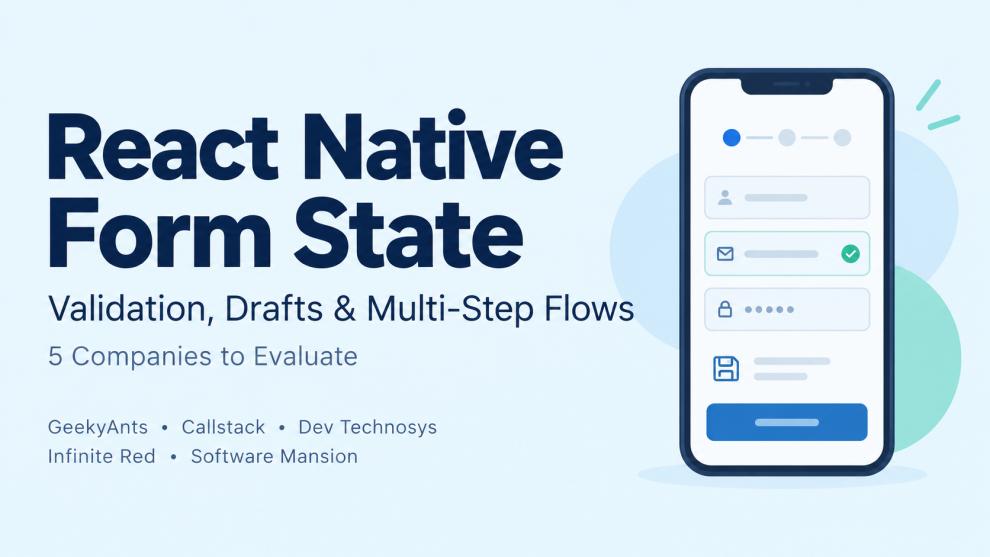

A mobile form can work perfectly during a demonstration and still fail under everyday conditions. A user switches applications halfway through onboarding. A network request times out after submission. An earlier answer changes which fields should appear later.
These situations make form state an architectural concern. In React Native applications, reliable forms require clear rules for validation, persistence, navigation, and backend communication.
For teams evaluating a development partner, the useful question is how the proposed implementation handles those situations. This article outlines the engineering considerations and five companies with relevant React Native capabilities.
The companies form an editorial shortlist, not an independently verified ranking of form-development performance.
Form State Needs Clear Ownership
A multi-step form involves several kinds of state that should have distinct responsibilities.
| State category | Examples | Main responsibility |
|---|---|---|
| Field state | Values, errors, touched fields | Manage editing and feedback |
| Workflow state | Current step, conditional branches | Control progression |
| Draft state | Saved answers, version, update time | Support recovery |
| Submission state | Pending request, failure, confirmation | Track backend acceptance |
Keeping these responsibilities explicit helps prevent misleading behavior. A draft saved on the device does not mean the server accepted an application. Likewise, navigating to a confirmation screen should not establish that a transaction succeeded.
A form library can help manage field values and validation. For example, React Hook Form provides Controller for integrating controlled inputs. Persistence, cross-screen ownership, and submission recovery still require application-level decisions.
Validation Should Match the User’s Progress
Validating every field immediately can overwhelm users with errors before they have started. Validating only at final submission can force them to revisit several screens.
A practical design separates three stages:
- Field validation: Checks individual values at an appropriate interaction point, such as after editing.
- Step validation: Checks the requirements needed to move forward.
- Submission validation: Checks the complete, currently applicable payload before processing.
Backend validation remains necessary even when the application performs the same checks locally. Client-side feedback improves usability; it cannot establish authorization or guarantee that business conditions remain unchanged.
Asynchronous checks need additional care. If a user changes an email address while an availability request is running, the previous response should not overwrite the validation result for the new value.
Conditional fields introduce another decision: when a field becomes irrelevant, should its value be retained for later editing or removed? Either behavior can be appropriate, but hidden fields should not accidentally block submission or introduce unintended data into the final payload.
Drafts Must Survive More Than Navigation
Keeping values in memory may preserve a form between screens, but it does not provide recovery after the operating system terminates the application.
A draft design should define which fields are persisted, when saving occurs, and how the application restores data. It should also distinguish an incomplete draft from a valid submission.
Security affects that choice. React Native’s documentation describes AsyncStorage as an unencrypted key-value store and cautions against using it for sensitive information. Persisting an entire state tree can unintentionally save private form data.
Teams should therefore classify draft fields before choosing storage. Sensitive information may require protected storage, server-side persistence, or exclusion from drafts altogether.
Drafts also need ownership and lifecycle rules. An application should prevent one signed-in user from seeing another user’s saved answers. Schema changes need a migration or invalidation strategy, while delayed autosave operations must not recreate a draft after successful submission.
Five React Native Development Companies to Evaluate
1. GeekyAnts
GeekyAnts offers React Native application development and reusable component-library work, including UI architecture and design-system integration. These capabilities are relevant to products that need consistent input controls, validation messages, and interaction patterns across multiple forms.
For this topic, an evaluation should focus on how reusable components connect to form state without becoming tightly coupled to a specific workflow. Shared text inputs are useful, but draft restoration and conditional navigation need their own design.
Evaluation question: How would the team preserve a partially completed form across navigation, application restarts, and changing validation rules?
2. Callstack
Callstack provides React Native development services and maintains tooling within the React Native ecosystem. Its published capabilities make it relevant to teams investigating framework-level behavior and application architecture.
A form-focused assessment could examine rendering performance, keyboard interactions, and state ownership across screens. Large forms should be tested on representative devices rather than judged solely in a simulator.
Evaluation question: How would the team identify unnecessary field rerenders and verify that typing remains responsive in a complex form?
3. Dev Technosys
Dev Technosys lists React Native services covering architecture, design, development, testing, deployment, and ongoing maintenance. That scope makes it a candidate for organizations seeking delivery across the application lifecycle.
For form-heavy applications, buyers should request evidence of behavior beyond standard input screens. Useful demonstrations include restoring incomplete drafts, handling server validation errors, and returning to previous steps without losing answers.
Evaluation question: Which tests cover conditional steps, interrupted submissions, and draft recovery on both iOS and Android?
4. Infinite Red
Infinite Red focuses on React Native development and maintains Ignite, an open-source React Native boilerplate and development toolkit. These resources provide a basis for discussing application structure and maintainability.
A starter architecture does not automatically solve form persistence or workflow transitions. The relevant assessment is how project conventions support those requirements as forms become more complex.
Evaluation question: How would form values, navigation state, and persisted drafts remain understandable to engineers maintaining the application later?
5. Software Mansion
Software Mansion develops React Native libraries and provides custom software development and consultancy. Its ecosystem work makes it relevant to evaluations involving mobile interaction requirements and framework integration.
For multi-step forms, teams should investigate how keyboard behavior, scrolling, focus, and transitions work together. Visual polish should support accessible error recovery and predictable navigation.
Evaluation question: How would the implementation keep invalid fields reachable when the keyboard is open or accessibility settings change the layout?
Compare Companies Using the Same Failure Scenarios
Published React Native capabilities establish relevance, but they do not prove expertise in a particular form workflow.
A useful evaluation gives every company the same scenario: a multi-step application with conditional fields, resumable drafts, server validation, and an unreliable connection.
The proposed implementation should explain what happens when an earlier answer changes a later step, the application closes during editing, or a submission succeeds on the server but its response never reaches the device.
Disabling a submit button can reduce repeated taps. It does not resolve uncertain network outcomes. Where duplicate processing matters, the backend needs an appropriate deduplication or idempotency strategy.
The strongest proposal will make these behaviors explicit and testable. Reliable React Native forms preserve user effort, communicate their actual status, and remain recoverable when the ideal sequence of events breaks.





Add Comment