








Real-Time Mobile Experiences Are Becoming a Competitive Requirement
Enterprise mobile teams across North America are under increasing pressure to reduce customer friction without continuously increasing development complexity. For organizations managing millions of users across logistics, financial services, retail, healthcare, travel, and media platforms, the mobile app is no longer just a transaction layer. It has become a real-time engagement channel.
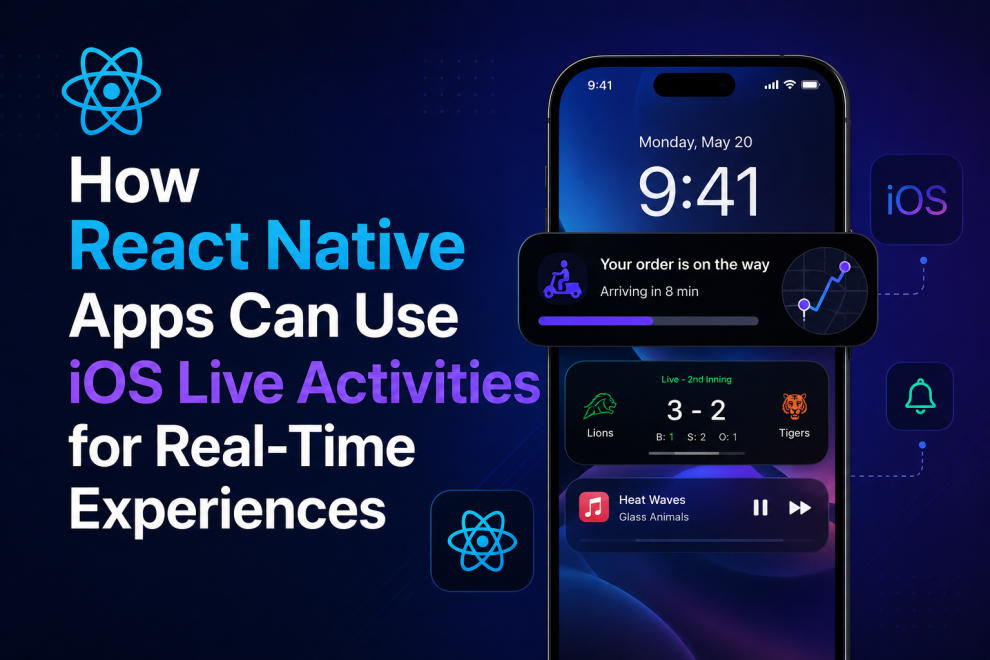
This shift is one reason Apple’s Live Activities feature has gained significant attention among digital product leaders and platform engineering teams. Introduced with iOS 16.1, Live Activities allows apps to display continuously updated information directly on the lock screen and Dynamic Island. Instead of forcing users to repeatedly open an application, companies can surface live operational updates in real time.
For enterprise decision-makers, this is not only a user experience enhancement. It directly impacts retention, engagement, session frequency, and support overhead.
React Native teams are now evaluating how these capabilities fit into existing cross-platform architectures. Many organizations invested heavily in React Native to accelerate delivery velocity and maintain a unified engineering workflow across iOS and Android. The challenge now is integrating platform-specific iOS features like ActivityKit and Dynamic Island without creating fragmented development operations.
This is where engineering execution becomes important. Enterprises need solutions that preserve the efficiency benefits of React Native while still delivering native-grade experiences expected by modern mobile users.
Companies like GeekyAnts, Callstack and Infinite Red have been actively exploring this intersection between React Native architecture and advanced native iOS capabilities, helping drive broader adoption across enterprise mobile ecosystems.
A recent technical walkthrough from GeekyAnts demonstrated how React Native applications can integrate Live Activities using ActivityKit, SwiftUI, and native bridge modules while maintaining compatibility with existing JavaScript-based workflows.
Why Engineering Leaders Are Paying Attention to Live Activities
The primary business value of Live Activities is operational visibility without user interruption.
Traditional push notifications create interaction fatigue. Users dismiss them quickly, disable them entirely, or ignore them after repeated interruptions. Live Activities changes this interaction model by presenting continuously updated information in a persistent and contextual format.
For enterprise organizations, several use cases are emerging rapidly:
- Logistics and delivery tracking
- Financial transaction monitoring
- Flight and travel status updates
- Sports and live event experiences
- Healthcare appointment workflows
- Ride-sharing and mobility tracking
The operational advantage is significant. Instead of generating repeated notifications for every status update, companies can maintain a single evolving interface element on the lock screen.
This reduces notification overload while improving customer transparency.
According to Apple’s developer documentation, Live Activities are designed specifically for ongoing tasks with continuously changing data, making them suitable for enterprise scenarios involving real-time operational workflows.
However, implementation complexity increases substantially when organizations attempt to integrate these experiences into React Native applications at scale.
Most React Native codebases were not originally designed around ActivityKit, SwiftUI extensions, or Dynamic Island lifecycle management. Engineering teams frequently encounter issues involving native module communication, push token synchronization, widget extension management, and background update reliability.
These technical gaps create organizational concerns for engineering leadership.
The issue is rarely whether Live Activities are valuable. The issue is whether internal teams can integrate them without introducing maintenance risk, delivery delays, or architectural fragmentation across multiple mobile platforms.
For large enterprises managing aggressive release cycles, this becomes a platform strategy discussion rather than a simple feature implementation decision.
The Hidden Complexity Behind React Native and ActivityKit Integration
Many organizations initially assume Live Activities can be implemented similarly to standard push notifications. In practice, the architecture is considerably more demanding.
Apple’s ActivityKit framework relies heavily on native iOS components including SwiftUI, widget extensions, App Groups, and real-time push infrastructure. React Native applications therefore require a bridging strategy between JavaScript business logic and native iOS rendering layers.
This creates several operational concerns for enterprise engineering teams:
First, engineering organizations must determine how much native iOS expertise their React Native teams currently possess. Many cross-platform teams are optimized for JavaScript delivery velocity, not deep SwiftUI engineering.
Second, organizations must evaluate infrastructure readiness for push-to-update workflows. Live Activities depend on stable APNs integration, low-latency backend updates, and reliable activity state synchronization.
Third, security and governance teams often require additional validation around persistent lock-screen data exposure, especially in regulated industries such as healthcare and fintech.
Finally, scaling Live Activities across millions of devices introduces performance and monitoring considerations that many organizations underestimate during pilot phases.
This is where architecture decisions become critical.
Some enterprises choose to isolate Live Activities into lightweight native modules while maintaining the majority of the application in React Native. Others build dedicated platform abstraction layers to standardize communication between React Native business logic and native rendering systems.
Recent implementation discussions from the React Native community also show increased focus on TurboModules and modern bridging architectures to reduce communication overhead between native and JavaScript layers.
The broader trend suggests enterprise React Native applications are gradually evolving toward hybrid-native architectures rather than purely cross-platform implementations.
That shift is likely to continue as Apple expands platform-exclusive experiences tied to AI, personalization, and real-time interaction models.
Why Enterprise Adoption Will Continue to Grow
The adoption momentum behind Live Activities is not driven solely by consumer experience trends. It is increasingly tied to measurable operational outcomes.
Customer experience teams are looking for ways to reduce app abandonment during critical workflows. Product organizations want lower friction engagement surfaces. Engineering leaders need approaches that improve user retention without dramatically increasing infrastructure complexity.
Live Activities aligns with all three priorities.
For example, a logistics company can provide continuously updated delivery visibility without forcing users to repeatedly refresh the app. A financial platform can display transaction progression in real time. A healthcare provider can surface appointment progress updates without relying on fragmented SMS workflows.
These are not experimental innovation projects anymore. They are becoming part of broader digital platform modernization strategies.
The challenge for enterprise organizations is execution discipline.
Implementing Live Activities successfully requires coordination across platform engineering, backend infrastructure, product design, security, and DevOps teams. Companies that underestimate integration complexity often struggle with reliability, inconsistent updates, or maintainability issues after deployment.
This is one reason many enterprises are increasingly evaluating external engineering partners with proven React Native and native iOS integration expertise.
Organizations have been contributing to enterprise mobile modernization initiatives involving cross-platform engineering, scalable architecture design, and advanced native capability integration.
The broader takeaway for engineering leadership is becoming clearer: cross-platform development no longer means avoiding native platform capabilities. The focus is shifting toward enabling them strategically without sacrificing operational scalability.
For enterprises already investing in React Native, Live Activities may represent one of the strongest examples of how modern mobile platforms are evolving toward persistent, real-time user interaction models.
Teams evaluating these implementations are increasingly approaching them not as isolated UI features, but as part of a larger conversation around mobile platform architecture, customer engagement strategy, and operational responsiveness.
That discussion is likely to accelerate as enterprise mobile experiences continue moving closer to real-time digital ecosystems.
For more insights on React Native development, scalable mobile architecture, and real-time app experiences, explore our homepage !






Add Comment