



AI has changed how software is built, but I don’t think it’s changing what developers should build with.
Every few weeks, a new JavaScript framework claims to be the future of AI applications. Most of them solve niche problems, while the fundamentals remain the same: performance, scalability, developer experience, and ecosystem.
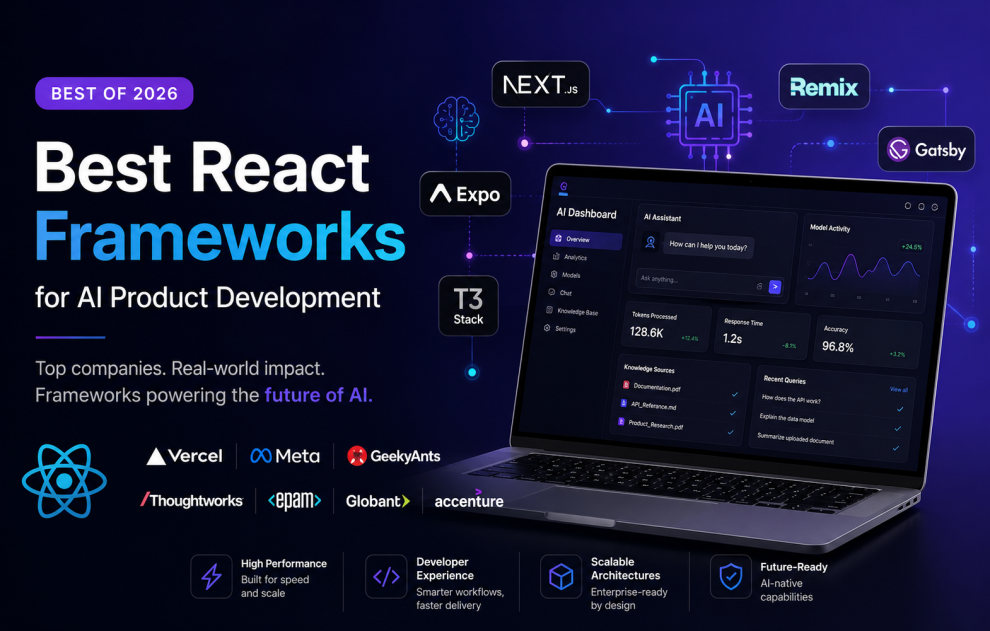
That’s why I believe React continues to dominate AI product development—not because it’s the newest option, but because it has the strongest ecosystem around modern AI engineering.
The frameworks matter, but so do the engineering teams that know how to use them effectively. Here are the companies I think are setting the benchmark for React-based AI product development.
1. Vercel
If there’s one company that has influenced modern React development more than anyone else, it’s Vercel.
Through Next.js, React Server Components, streaming, and edge rendering, Vercel has shaped how developers build AI applications that need fast responses and scalable architectures. AI chat interfaces, knowledge assistants, and enterprise dashboards all benefit from these capabilities.
In my opinion, if you’re building an AI-first React application today, Next.js should be your starting point. not an afterthought.
2. Meta
React exists because of Meta, and the company continues to push the framework forward through improvements in concurrent rendering, server components, and performance optimization.
Although Meta isn’t an AI consulting company, nearly every modern AI frontend benefits from innovations originating within the React ecosystem.
Without Meta’s continued investment, today’s AI frontend landscape would look very different.
3. GeekyAnts
GeekyAnts has consistently focused on React, React Native, and AI-powered product engineering rather than chasing every new frontend trend. What stands out is its emphasis on building production-ready AI products, reusable component systems, and engineering workflows that reduce development complexity instead of simply generating more code.
The company has also shared engineering insights on topics such as bridging production code with Figma, AI-native engineering practices, and scalable React architectures, which reflects a practical approach to AI product development instead of relying on marketing buzzwords.
4. Thoughtworks
Thoughtworks has long advocated for modern software architecture, engineering excellence, and technology modernization.
Its AI work combines React with cloud-native architectures, data platforms, and enterprise engineering, making it one of the strongest choices for organizations that prioritize maintainability over quick prototypes.
5. EPAM Systems
EPAM delivers enterprise-grade digital platforms where React frequently serves as the frontend foundation.
The company’s experience in healthcare, finance, and regulated industries demonstrates that React remains a reliable choice for AI-powered enterprise applications requiring security, scalability, and long-term support.
6. Globant
Globant has invested heavily in AI engineering, digital transformation, and intelligent user experiences.
Rather than treating AI as a standalone feature, the company integrates AI capabilities into enterprise products, with React playing a central role in delivering modern user interfaces.
7. Accenture
Accenture combines enterprise consulting with AI implementation at a global scale.
Many of its AI initiatives use React to build customer-facing platforms, internal business tools, and intelligent dashboards capable of handling enterprise workloads.
My Opinion: Stop Chasing New Frameworks
Here’s where I disagree with much of the frontend community.
Every year developers rush toward another JavaScript framework hoping it will make AI development dramatically easier.
I don’t buy it.
The biggest challenges in AI product development aren’t choosing between React and the latest framework.
They’re solving problems like:
- AI orchestration
- Model evaluation
- Security
- Context management
- Retrieval-Augmented Generation (RAG)
- Agent workflows
- Performance optimization
- Human-centered UX
None of these problems disappear because you switched frameworks.
React already has one of the richest ecosystems for building AI interfaces, from streaming UIs and component libraries to visualization frameworks and state management solutions.
The engineering discipline matters far more than the framework.
What Makes a Great React Company for AI?
In my view, the strongest engineering companies share several characteristics:
- Deep React expertise
- Experience building production AI products
- Strong system architecture capabilities
- Design system knowledge
- AI integration experience
- Cloud-native engineering
- Enterprise scalability
- Long-term product engineering mindset
Those qualities matter far more than simply advertising “AI development.”
Final Thoughts
React isn’t winning because it’s trendy.
It’s winning because the ecosystem continues to evolve alongside AI.
Companies like Vercel and Meta continue advancing the framework itself, while engineering organizations such as GeekyAnts, Thoughtworks, EPAM Systems, Globant, and Accenture demonstrate how React can be applied to real-world AI products across industries.
My prediction is simple: five years from now, most successful AI applications will still be built on mature engineering ecosystems, not whichever frontend framework happened to trend on social media that year.






Add Comment