








A React AI feature can look inexpensive during development. Then customers upload longer documents, conversations accumulate history, and background agents make several model calls for a single task. The interface remains simple while the cost of serving each interaction changes.
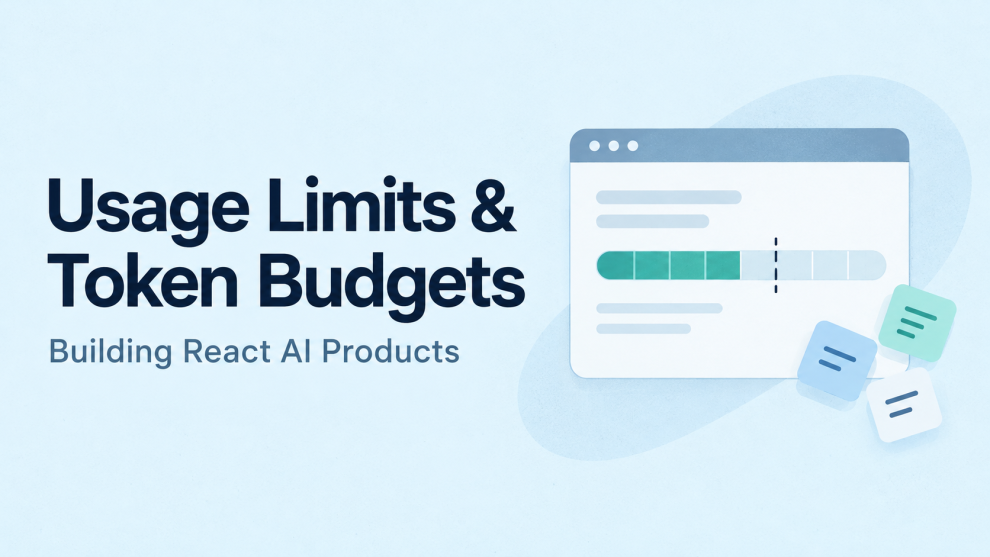
Usage limits and token budgets help engineering teams control that variability. Implemented well, they also make the product easier to understand: users know what remains available, administrators can manage shared allowances, and developers can investigate expensive workflows.
The essential architectural principle is straightforward: React communicates the limits; the backend enforces them.
What Is the Difference Between Usage Limits and Token Budgets?
These controls solve related but different problems.
| Control | Purpose | Illustrative example |
|---|---|---|
| Request rate limit | Restricts bursts of activity | 10 requests per minute |
| Concurrency limit | Restricts simultaneous work | Two active generations per user |
| Product quota | Defines a customer entitlement | 100 document summaries per month |
| Token budget | Bounds model consumption | A maximum token allowance per workflow |
| Spending budget | Controls monetary exposure | A monthly workspace spending ceiling |
These examples are design choices, not universal recommendations.
A request limit cannot provide reliable cost control by itself. Two requests may contain very different amounts of input and generate different amounts of output. Cloudflare’s AI Gateway documentation explicitly distinguishes request-based rate limiting from spend limits calculated using token consumption and model pricing.
For React AI products, combining these controls is usually more useful than choosing only one.
How Should Token Costs Be Estimated?
Start with the complete request, including system instructions, conversation history, retrieved documents, tool definitions, and the latest user message.
For a simple text-model interaction, the estimated cost is:
Input tokens × input rate + output tokens × output rate
When rates are quoted per million tokens, divide each token count by one million before multiplying. Account separately for cached-token pricing, reasoning usage, tool charges, or other billable operations where applicable. Avoid counting a usage category twice.
For example, using hypothetical rates of $1 per million input tokens and $5 per million output tokens, a request consuming 8,000 input tokens and 1,000 output tokens would cost $0.013. These are illustrative figures, not current provider prices.
The practical implication is that an allowance of “100 messages” needs supporting limits on message size, context length, and generated output.
The Vercel AI SDK exposes maxOutputTokens for limiting generation. That setting does not independently cap input consumption or the cumulative cost of repeated calls. Provider support and model-specific behavior also need checking.
Where Should Limits Be Enforced in a React Application?
A disabled button improves usability, but it cannot protect an API. Users can send requests outside the interface, open multiple tabs, or interact with stale client state.
The backend should authenticate the caller, resolve the workspace and subscription, and apply the relevant policy before contacting the model provider. Provider credentials should remain server-side.
A robust implementation uses a reserve, execute, reconcile process:
- Reserve: Atomically reserve an estimated allowance against both the user and workspace budgets.
- Execute: Run the request with bounded input, output, retries, and execution time.
- Reconcile: Record actual reported usage and release any unused reservation.
Atomic reservation matters. If two requests independently read the same remaining balance before either records consumption, both may be admitted even when their combined cost exceeds the allowance.
Store reservations in a shared database or suitable transactional service. An in-memory counter inside one application instance will not coordinate multiple servers.
Give each operation an idempotency key and a durable status. If a request times out after reaching the provider, do not assume that no billable work occurred. Reconcile uncertain operations before releasing their entire reservation.
How Should React Explain Usage Limits?
The interface should present limits in language that matches the product.
A writing assistant might display remaining drafts. A document platform might show pages or analyses. Technical administrators may also need token and spending details.
A small React component can display server-provided quota state:
type Usage = {
  remaining: number;
  resetLabel: string;
  blocked: boolean;
};

export function UsageNotice({ usage }: { usage: Usage }) {
  return (
    <p role="status" aria-live="polite">
      {usage.blocked
        ? `Usage limit reached. Resets ${usage.resetLabel}.`
        : `${usage.remaining} analyses remaining.`}
    </p>
  );
}
This component communicates status; it does not authorize requests.
Refresh usage after completed operations and after quota-related API responses. Preserve the user’s input when a request is rejected, and distinguish a temporary rate limit from an exhausted monthly allowance.
A Stop button should propagate cancellation to the backend and provider where supported. Cancellation can prevent additional generation, but the product should not promise that already processed work becomes free.
Which Companies Publicly Describe This Strategy?
Company claims should be tied to documented practices rather than generalized across every React engagement.
GeekyAnts identifies token optimization and budget guardrails as core deliverables in its published AI POD approach. The article also describes workflow-level cost ceilings and token-cost monitoring. This supports saying that GeekyAnts incorporates these controls into its stated AI delivery approach; it does not establish identical implementation across all its React products.
Thoughtworks describes real-time AI usage tracking, token-to-cost visibility, and team and individual budget caps within AI/works. Its separate engineering commentary also argues for considering token budgets at the feature level. These are documented examples of treating AI consumption as an engineering concern.
Vercel, a major platform provider in the React ecosystem, documents AI Gateway budgets and spend controls, including user-level allowances. Its AI SDK also provides generation settings and usage reporting that developers can integrate into application-level accounting.
Together, these examples show engineering consultancies and React infrastructure providers building or advocating consumption controls. They are evidence of specific capabilities, not a ranking of companies or proof of universal adoption.
How Can Teams Reduce Consumption Without Hurting Quality?
Begin with the workflow rather than immediately selecting a cheaper model.
Set explicit limits on retrieved context and conversation history. Summarization can reduce repeated input, but summaries require their own computation and may omit important details. Evaluate the effect on task quality.
Bound agent workflows across all model calls. A per-call output ceiling does not prevent an agent from making many individually acceptable calls. Check the remaining workflow allowance before each additional step.
Keep retries finite and account for their consumption. Avoid automatically retrying requests rejected because the product budget is exhausted.
Caching can help repeated workloads, but cache keys must respect tenant identity, permissions, and freshness requirements. Cost savings should not create cross-customer data exposure.
What Should Be Tested Before Launch?
Test the behavior around boundaries, not just a successful generation.
Verify simultaneous requests near the allowance limit, duplicate submissions, interrupted streams, workspace-wide exhaustion, subscription changes, and budget resets. Confirm what happens when the accounting service is unavailable.
Operational reporting should connect spending to outcomes: cost per completed task, abandoned generations, retry consumption, and the share of legitimate requests blocked by limits.
Usage controls are successful when they make AI features financially predictable while preserving their usefulness. In a React product, that requires consistent behavior across the interface, API, model orchestration, and usage ledger from the first release.



Add Comment