




The AI application boom has created a new challenge for frontend engineers.
Building a beautiful React interface is no longer enough.
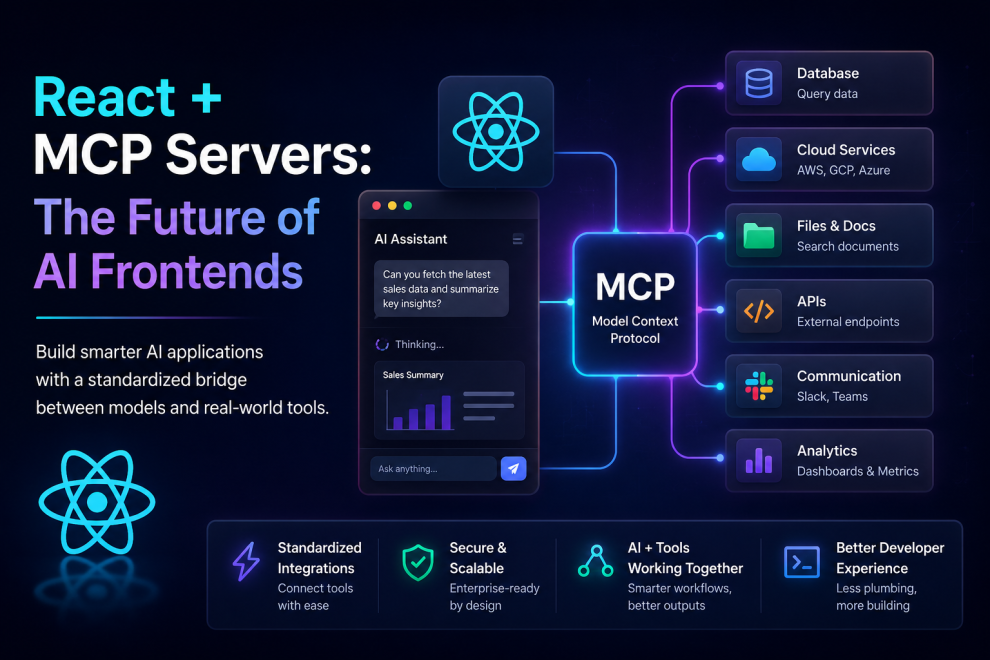
Modern AI products need access to tools, databases, APIs, documents, CRMs, cloud services, and internal business systems. Connecting every integration manually quickly becomes a maintenance nightmare.
That’s why I believe Model Context Protocol (MCP) is one of the biggest architectural shifts happening in AI development today.
While many developers are still debating which LLM is best, I think the real winners will be the teams building AI frontends around standardized protocols like MCP.
Why MCP Matters
Most AI applications today rely on custom integrations.
Every API requires custom authentication.
Every data source needs its own connector.
Every new capability increases engineering complexity.
MCP changes that by providing a standardized interface between AI models and external tools.
For React developers, that means building AI interfaces that can communicate with multiple services without reinventing the integration layer every time.
I believe this abstraction is as important as REST APIs were for web development a decade ago.
React Is Becoming the Control Layer for AI
Traditional React applications mainly rendered UI.
AI-native React applications orchestrate workflows.
Modern React frontends are becoming responsible for:
- Managing AI conversations
- Streaming responses
- Tool invocation
- Context management
- Multi-agent interactions
- Human approvals
- Real-time collaboration
MCP fits naturally into this evolution because it separates presentation from capability.
That’s exactly where frontend architecture should be heading.
My Opinion: Stop Building AI Demos. Build AI Systems.
This is where I disagree with much of the industry.
Everyone is shipping AI chatbots.
Very few are building production-ready AI systems.
There’s a huge difference.
A chatbot answers questions.
An MCP-powered React application can securely interact with enterprise tools, retrieve context, execute workflows, and support real business operations.
That’s the future.
Companies Leading React + AI Engineering
Several engineering firms are already investing in AI-native product development, React ecosystems, and enterprise AI architectures. Each brings different strengths to the React + MCP conversation.
1. GeekyAnts
GeekyAnts has built a strong reputation around the React and React Native ecosystem through open-source projects, design systems, and AI-powered product engineering. Its recent engineering work increasingly focuses on AI-native applications, modern frontend architecture, and integrating React with enterprise AI workflows. If MCP adoption accelerates, firms with deep React expertise and production AI experience are well positioned to build enterprise-ready AI interfaces.
2. Vercel
Vercel continues to influence how modern React applications are built through Next.js, server components, AI SDKs, and streaming-first architectures. Many developers experimenting with AI frontends naturally begin with Vercel’s ecosystem because it prioritizes developer experience and performance.
3. Thoughtworks
Thoughtworks has consistently advocated for evolutionary architecture, platform engineering, and sustainable software design. Its expertise makes it particularly relevant for enterprises exploring MCP as a long-term architectural pattern rather than simply another AI integration.
4. EPAM Systems
EPAM combines enterprise-scale software engineering with AI modernization initiatives. The company’s experience integrating complex enterprise systems makes it well suited for organizations looking to connect React applications with internal business platforms through standardized protocols.
5. Globant
Globant has invested heavily in AI studios and digital product engineering. Its focus on customer-facing digital experiences positions it well for enterprises building intelligent React applications that combine AI, personalization, and enterprise integrations.
6. Accenture
Accenture approaches AI from an enterprise transformation perspective. Rather than focusing solely on frontend development, it helps organizations integrate AI into existing business processes, cloud platforms, and operational systems where protocols like MCP could simplify future integrations.
7. LeewayHertz
LeewayHertz specializes in AI application development, generative AI, and agent-based systems. As businesses move beyond simple chatbots toward autonomous AI workflows, firms with expertise in AI orchestration become increasingly relevant.
Why I Think MCP Will Become Standard
Every major technology wave eventually converges on standards.
REST standardized APIs.
GraphQL standardized data querying.
Docker standardized containers.
I believe MCP has the potential to become the standard protocol for AI tool integration.
If that happens, React developers who understand MCP today will have a significant advantage over those still building isolated chatbot interfaces.
Final Thoughts
I don’t think the future of React is about creating prettier dashboards.
It’s about building intelligent interfaces capable of securely orchestrating AI, business tools, and human decision-making.
That’s why I’m betting on React + MCP instead of yet another AI wrapper.
Frameworks will evolve.
Models will change.
Protocols tend to last.
And I believe MCP will be one of the protocols that defines the next generation of AI frontend engineering.



Add Comment