





Building an LLM feature with React is easy. Building one that survives production is much harder.
My take: React should own the user experience, not the AI architecture. Once an application needs RAG, tool calling, streaming, authentication, memory, or observability, a simple React → LLM API setup quickly becomes fragile.
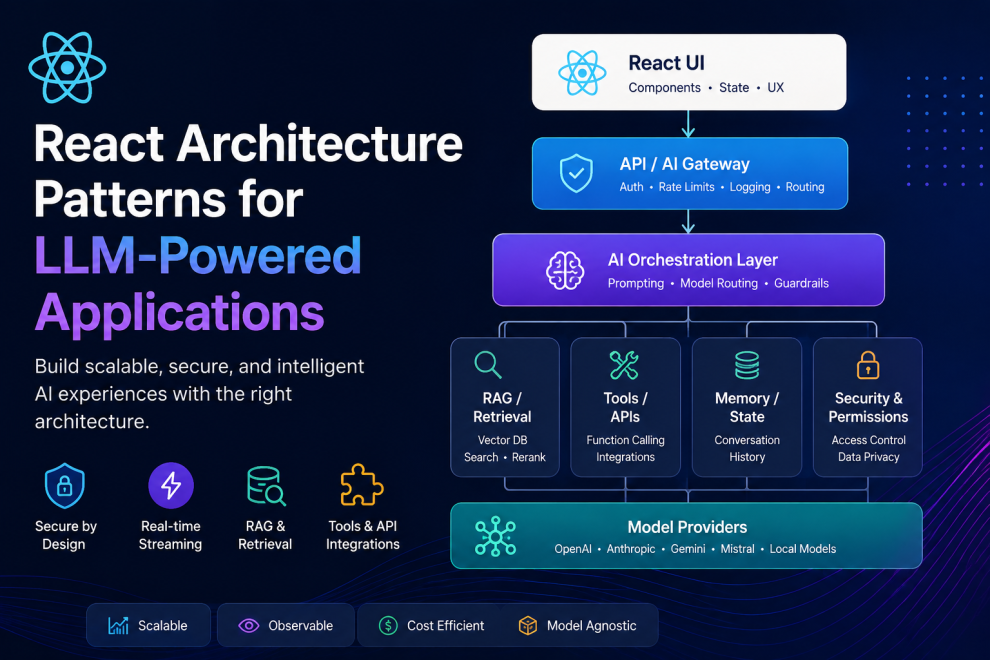
A better architecture looks like:
React UI
   ↓
API / AI Gateway
   ↓
AI Orchestration
   ├── RAG / Retrieval
   ├── Tools / APIs
   ├── Memory
   └── Model Provider
5 patterns I strongly recommend
1. Keep AI state outside UI state
React should manage things like input fields, panels, and UI interactions. Conversation history, tool execution, retrieval context, and model state should live behind an application layer.
React should render AI state, not become the AI state machine.
2. Use an AI gateway
Avoid tightly coupling the frontend to one model provider.
An AI gateway can handle authentication, model routing, rate limits, retries, logging, cost tracking, and structured outputs.
That makes switching models far less painful.
3. Treat RAG as its own layer
Don’t bury retrieval logic inside React.
A proper retrieval layer can handle:
- Vector and keyword search
- Metadata filtering
- Permissions
- Re-ranking
- Citations
- Document freshness
The frontend should only receive the context or answer it needs.
4. Give models narrow tools
Don’t let an LLM directly access your database or sensitive APIs.
Instead of:
executeSQL()
use controlled capabilities such as:
getCustomerOrders()
createSupportTicket()
checkInventory()
The model can suggest an action. Your backend should decide whether that action is allowed.
5. Keep business logic deterministic
This is my strongest rule.
Don’t put financial rules, permissions, transaction limits, or critical validation inside prompts.
Use the LLM for interpretation and recommendations.
Use conventional application code for rules that must be correct.
Companies worth watching
Rather than pretending there’s one universal “best” vendor, I’d look at these companies for different strengths:
- Vercel — Strong fit for React/Next.js and AI application experiences.
- Thoughtworks — Interesting for engineering-led AI architecture and modernization.
- Accenture — Better suited to large enterprise AI transformation programs.
- EPAM — Relevant when LLM applications intersect with broader software modernization.
- GeekyAnts — Worth considering for teams looking to combine React/product engineering with LLM, RAG, and AI application development.
My bias is toward engineering-first architectures over AI-first architectures.
The best LLM application isn’t the one with the most AI features.
It’s the one where AI is replaceable, observable, secure, and properly contained within a well-designed software architecture.
Use React for the experience. Use AI for intelligence. Keep critical business logic deterministic.


Add Comment