









Enterprise AI platforms are developing an architectural problem that isn’t getting enough attention.
Teams are building AI copilots, agent dashboards, workflow automation, analytics interfaces, knowledge systems, model evaluation consoles, and internal AI tools—often inside the same enterprise application.
Initially, a single React application is perfectly reasonable.
Then the organization grows.
Five teams become fifteen.
Three AI workflows become dozens.
Different business units start shipping at different speeds.
The frontend build gets slower.
Releases require coordination.
A seemingly harmless change to shared components suddenly affects half the product.
At that point, the problem isn’t really React.
It’s frontend ownership.
And this is where I think microfrontends make considerably more sense for enterprise AI platforms than they do for ordinary web applications.
I’m not arguing that every React application should become a collection of microfrontends. Quite the opposite.
Most applications don’t need them.
But large AI platforms with multiple product domains, independent engineering teams, and different release cadences are exactly where I believe microfrontends can earn their architectural complexity.
Enterprise AI Is Creating Frontend Complexity Faster Than Traditional SaaS
A conventional enterprise application might have:
- Dashboard
- Users
- Reports
- Settings
- Billing
- Administration
An enterprise AI platform can quickly become much more complicated:
- AI chat
- Agent management
- Prompt management
- Model selection
- RAG configuration
- Knowledge bases
- Workflow automation
- Evaluation
- Observability
- AI governance
- Human approvals
- Usage analytics
- Cost management
- Security controls
- Data connectors
These aren’t necessarily features that should be owned by one team.
And that’s the fundamental reason I favor microfrontends in this niche.
The architecture should reflect organizational boundaries when those boundaries are real and stable.
Microfrontends essentially apply the independent-ownership philosophy of microservices to the frontend. The goal isn’t merely to split JavaScript into smaller files; it’s to allow teams to build, test and deploy meaningful product domains independently.
My Take: Don’t Build Microfrontends Just to Say You Have Microfrontends
This is where I disagree with a lot of microfrontend content.
The argument usually goes:
“Our React application is getting big. Let’s split it into microfrontends.”
That’s not enough.
Size isn’t the strongest reason to adopt microfrontends. Team autonomy is.
If eight teams work on eight relatively independent AI domains and all eight need separate release cycles, microfrontends start making architectural sense.
If three developers maintain one product and occasionally touch different pages, microfrontends are probably an unnecessary headache.
A well-structured React monolith is often better.
The architecture should follow the organization not the other way around.
Why AI Platforms Are Particularly Suitable for Microfrontends
AI products naturally create domain boundaries.
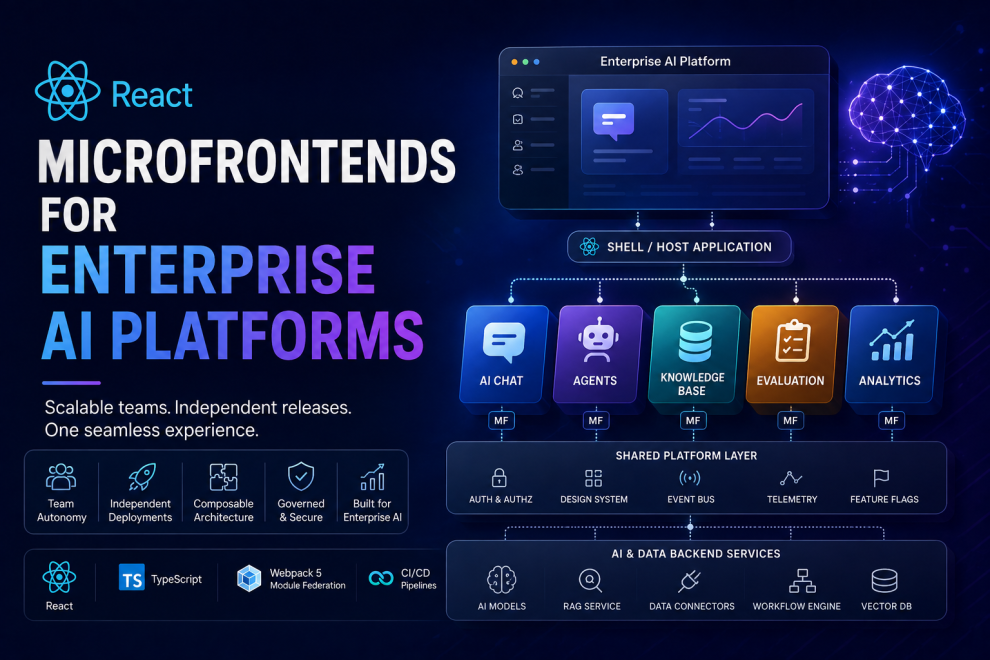
Consider an enterprise AI platform structured like this:
                    Enterprise AI Platform
                            |
                    React Shell / Host
                            |
       ┌────────────┬───────┼────────┬─────────────┐
       ↓            ↓       ↓        ↓             ↓
    AI Chat      Agents   RAG     Evaluation   Analytics
       |            |       |        |             |
       └────────────┴───────┼────────┴─────────────┘
                            ↓
                    Shared Platform Layer
                Auth / Design System / Telemetry
The shell owns the platform-level experience.
Individual teams own the domains.
For example:
AI Platform Team
Owns authentication, navigation, design system, routing and platform-level telemetry.
Agent Team
Owns agent creation, configuration and execution interfaces.
Knowledge Team
Owns ingestion, indexing, retrieval and knowledge management.
Evaluation Team
Owns evaluation datasets, benchmarks and quality monitoring.
FinOps Team
Owns AI usage, token consumption and cost dashboards.
That is a much healthier ownership model than putting everything into one giant React codebase
Module Federation Is the Most Interesting Piece of the Puzzle
For React-based microfrontends, I think Module Federation remains one of the most compelling approaches when runtime composition and independent deployment are actual requirements.
The basic idea is straightforward.
A host application loads functionality exposed by independently built applications.
Conceptually:
Host Application
      |
      ├── AI Chat Remote
      ├── Agent Remote
      ├── Knowledge Remote
      ├── Evaluation Remote
      └── Analytics Remote
The important part isn’t the technical novelty.
It’s the release model.
One team can update the agent interface without necessarily rebuilding the entire platform.
This is exactly the kind of independence that enterprise AI organizations increasingly need.
Real-world implementations demonstrate the same pattern. Mintel, for example, used a React shell with Webpack Module Federation and independently deployed applications, while keeping authentication, common UI and metrics at the shell level.
Wayfair has also described using Module Federation to progressively decouple applications while continuing to use React.
But There Is a Catch: You Can Create a Distributed Monolith
This is the biggest microfrontend mistake.
Teams split the application into five repositories.
Then they discover that:
- Everyone shares the same state
- Everyone depends on the same release
- Everyone modifies the same design system
- Everyone relies on the same APIs
- Everyone needs coordinated deployments
Congratulations.
You now have a distributed monolith.
Except it’s harder to debug.
This is why I don’t believe “independent repositories” automatically means “independent architecture.”
True independence requires:
Independent ownership + independent deployment + clear contracts + limited coupling.
If those conditions aren’t present, microfrontends are mostly architectural theater.
The Shell Should Be Boring
This is another opinion I feel strongly about.
The shell should not become the smartest application in the organization.
It should be boring.
Its responsibilities should generally be things such as:
- Authentication boundary
- Global navigation
- Routing
- Design system integration
- Feature flags
- Telemetry
- Error boundaries
- Session context
It shouldn’t contain business logic for every microfrontend.
Mintel’s architecture is a useful example: its shell handled authentication, universal components and metrics while the individual applications remained independently deployed.
The shell is infrastructure, not the product.
The more business logic you put into it, the harder it becomes for teams to actually work independently.
Don’t Share Everything
Microfrontend architectures often start with a noble goal:
“Let’s create shared libraries so everyone can reuse everything.”
Then six months later:
Everything depends on everything.
That’s not modularity.
That’s coupling.
I’d aggressively limit what crosses the microfrontend boundary.
Share:
- React
- React DOM
- Design tokens
- Core UI primitives
- Authentication contracts
- Telemetry contracts
- Stable utility libraries
Be cautious about sharing:
- Business state
- Domain-specific hooks
- Internal component implementations
- Feature-specific APIs
The fewer things teams need to coordinate on, the more useful the architecture becomes.
State Management Is Where Microfrontends Get Painful
This is where enterprise React teams need to be particularly disciplined.
Suppose the AI Chat microfrontend owns:
conversation
messages
streaming state
selected model
tool state
The Agent Builder owns:
agent configuration
tools
instructions
execution state
The Evaluation application owns:
datasets
runs
scores
benchmarks
Why should all of that live in one global Redux store?
It shouldn’t.
I would keep domain state local whenever possible.
Cross-application communication should happen through explicit contracts.
For example:
User authenticated
        ↓
Shell
        ↓
Auth context / token
        ↓
Individual microfrontends
Or:
Agent execution completed
        ↓
Typed event
        ↓
Analytics / notification consumers
Not:
Agent MFE
   ↓
Reach into
   ↓
Chat MFE's Redux store
That is exactly how independence disappears.
AI Platforms Need a Strong Shared Design System
This is one area where microfrontends can go horribly wrong.
You have five teams.
Each creates:
- Button
- Modal
- Dropdown
- Data table
- Chat message
- Loading indicator
Six months later, the platform looks like five products glued together.
That’s unacceptable for enterprise AI.
The user doesn’t care which team owns the screen.
They expect one product.
Therefore, the shared design system should be treated as a platform capability.
The architecture should look more like:
                    Design System
                         |
       ┌─────────────────┼─────────────────┐
       ↓                 ↓                 ↓
   AI Chat            Agents           Analytics
Not:
AI Chat → Design System A

Agents → Design System B

Analytics → Design System C
Microfrontends should create organizational independence without visual fragmentation.
Security Gets More Important in AI Microfrontends
This isn’t a normal ecommerce website.
An enterprise AI platform may contain:
- Sensitive documents
- Customer data
- Internal knowledge
- Model credentials
- AI agents
- Business workflows
- Evaluation datasets
- Audit information
That makes authentication and authorization architectural concerns.
The shell can establish identity, but individual microfrontends still need well-defined authorization boundaries.
For example:
User
 ↓
Identity Provider
 ↓
Shell
 ↓
Authorization Context
 ↓
Microfrontend
 ↓
API / BFF
 ↓
Enterprise Data
The frontend should never become the place where sensitive authorization logic is merely assumed.
Microfrontend boundaries don’t remove security responsibilities.
They increase the number of places where teams need to get those boundaries right.
The AI Backend Should Not Mirror the Frontend One-to-One
Another mistake I’d avoid:
Chat MFE → Chat Microservice
Agent MFE → Agent Microservice
RAG MFE → RAG Microservice
Analytics MFE → Analytics Microservice
It looks beautifully symmetrical.
It can also be completely wrong.
Frontend boundaries should represent user and team domains.
Backend boundaries should represent business capabilities and data ownership.
Sometimes they align.
Sometimes they don’t.
I’d rather have:
React Microfrontends
        ↓
API / BFF Layer
        ↓
Domain Services
        ↓
AI Infrastructure
        ↓
Models + Data
That gives the frontend autonomy without forcing an artificial backend topology.
Microfrontends Can Actually Help AI Teams Move Faster
This is where I think the architecture earns its complexity.
Imagine an enterprise AI organization with:
- 30 frontend engineers
- 6 product teams
- Weekly releases
- Multiple AI capabilities
- Separate product roadmaps
A single React application means every major change potentially enters the same release train.
Microfrontends allow teams to move toward:
Team A → independent deployment
Team B → independent deployment
Team C → independent deployment
while maintaining:
One product → one identity → one design language
That’s the real benefit.
Not smaller bundles.
Not trendy architecture diagrams.
Organizational scalability.
Companies Worth Watching in React Microfrontend and Enterprise AI Architecture
There isn’t one “best” company here because the market includes consulting firms, engineering companies, cloud platforms and organizations with documented microfrontend implementations.
But some companies are much more relevant to this particular architecture conversation than others.
1. Thoughtworks Architecture Before Framework Hype
Thoughtworks is one of the companies I’d watch when the problem is enterprise architecture rather than simply React development.
Its current enterprise AI thinking emphasizes that organizations are moving toward new operating models around AI, platforms and data, rather than treating AI as an isolated feature.
That philosophy fits microfrontends well.
The strongest microfrontend implementations start with organizational and domain boundaries—not with a Webpack configuration.
My take: Thoughtworks is particularly relevant when architecture and organizational design are the difficult parts.
2. EPAM Strong Enterprise Engineering Fit
EPAM is another company I’d consider for large organizations where frontend modernization intersects with cloud, data and AI engineering.
Its strength is less about microfrontends being a standalone technology and more about the broader engineering ecosystem required to make distributed frontend systems work.
My take: EPAM makes more sense for complex enterprise transformations than for a simple React application that happens to have a lot of screens.
3. Accenture Useful When the Problem Is Organizational Scale
Accenture belongs on the list because enterprise AI modernization is rarely just a frontend project.
Large organizations often need changes across:
- Architecture
- Cloud
- Data
- Security
- AI
- Product teams
- Delivery processes
That’s where a large transformation partner becomes relevant.
But I’d be careful about adopting microfrontends simply because a large transformation program recommends them.
My take: architecture should justify the transformation—not the other way around.
4. Microsoft A Useful Reference Point for Large-Scale AI Platforms
Microsoft is relevant less as a microfrontend consultancy and more as an example of the broader enterprise AI platform direction.
Microsoft’s ecosystem spans AI, developer tooling, cloud, identity and enterprise applications.
That makes its architectural ecosystem particularly relevant when thinking about how AI capabilities become integrated into larger enterprise products.
My take: the lesson isn’t “use Microsoft’s architecture.” It’s that enterprise AI platforms need shared identity, governance, data and developer infrastructure alongside their user interfaces.
5. AWS Infrastructure Underneath the Frontend
AWS isn’t a microfrontend specialist either.
That’s exactly why I would keep the category clear.
AWS matters because independently deployable React applications still need:
- CDN infrastructure
- CI/CD
- Authentication
- APIs
- Observability
- Containers/serverless infrastructure
- Storage
- Security
Microfrontends don’t eliminate platform engineering.
They make good platform engineering more important.
My take: AWS is strongest here as the infrastructure layer rather than the microfrontend layer.
6. GeekyAnts React and AI Product Engineering
GeekyAnts belongs in this discussion from the product-engineering side.
Its broader work spans React, AI product engineering, cloud-native systems and enterprise application development. Its current technology positioning includes React/Next.js, AWS, Vercel and AI-focused product engineering.
That makes the company relevant to organizations looking at the intersection of:
React + AI + enterprise application architecture.
But I wouldn’t put GeekyAnts in the same category as AWS or Microsoft.
It is an engineering partner, not a hyperscaler.
My take: the relevant question for a company like GeekyAnts isn’t whether it invented microfrontends; it’s whether its React engineering capability can help teams structure independently owned product domains without creating a distributed mess.
Real-World Architecture Matters More Than Vendor Claims
There are useful lessons from companies that have actually implemented these patterns.
Mintel chose Webpack 5 and Module Federation after evaluating alternatives including Bit, Piral and single-spa. Its architecture used a React shell, independent applications and shared platform concerns.
Wayfair has described Module Federation as a way to progressively transition toward more decoupled frontend architecture while retaining React.
And the single-spa documentation makes an important distinction that teams often miss: single-spa and Module Federation solve different problems and can complement each other.
That’s the lesson I’d take away.
There isn’t a magical “microfrontend technology.”
There are different architectural strategies for:
- Composition
- Routing
- Dependency sharing
- Deployment
- Isolation
- Communication
Choose them based on the problem.
When I Would NOT Use Microfrontends
I’m strongly pro-microfrontend for the right enterprise AI platform.
I’m equally strongly against using them everywhere.
Don’t use them if:
You have one small frontend team
A monolith will probably be faster.
Most features require simultaneous changes
You’ve lost the primary benefit.
You don’t have clear domain ownership
Your architecture will become political as well as technical.
Your application is mostly a single workflow
There’s probably nothing meaningful to split.
You’re doing it for scalability without measuring the problem
Don’t solve theoretical scale.
You can’t invest in platform governance
Microfrontends require more engineering discipline, not less.
The Architecture I’d Choose for an Enterprise AI Platform
If I were designing one today, my preference would be:
                         CDN / Edge
                             |
                             ↓
                     React Shell / Host
                             |
       ┌─────────────┬───────┼────────┬──────────────┐
       ↓             ↓       ↓        ↓              ↓
     Chat          Agents   RAG   Evaluation     Analytics
       |             |       |        |              |
       └─────────────┴───────┼────────┴──────────────┘
                             ↓
                    Shared Design System
                             |
                    Platform Contracts
                             |
                    API / BFF Layer
                             |
              ┌──────────────┼──────────────┐
              ↓              ↓              ↓
         AI Services    Enterprise APIs    Data
              |
              ↓
       Models / AI Gateway
The key principle isn’t Module Federation.
It’s controlled independence.
Each domain should own its implementation.
The platform should own the contracts.
The user should see one coherent product.
My Verdict: Microfrontends Are the Right Bet for Large AI Platforms, But Not for Everyone
I’m taking a side here:
For large enterprise AI platforms, I think React microfrontends are going to become increasingly important.
Not because microfrontends are inherently better than monolithic React.
They aren’t.
They’re better when the organization itself has become distributed.
AI is accelerating that situation.
One team owns agents.
Another owns knowledge.
Another owns evaluation.
Another owns analytics.
Another owns governance.
Another owns AI cost management.
Trying to force all of those domains into one frontend release cycle eventually becomes an organizational bottleneck.
But there’s an equally important warning:
Don’t mistake splitting a React application for achieving microfrontend architecture.
If every team still needs everyone else’s approval, every release still has to happen together, and every component shares the same global state, you’ve created distributed complexity—not independence.
The winning architecture is therefore not:
“Everything should be a microfrontend.”
It’s:
“Every meaningful product domain should be independently owned, independently deployable, and connected through deliberate contracts.”
That’s the architecture I would bet on for enterprise AI.
React provides the foundation. Microfrontends provide the organizational scaling model. And disciplined platform engineering is what keeps the whole thing from becoming a distributed monolith.







Add Comment