




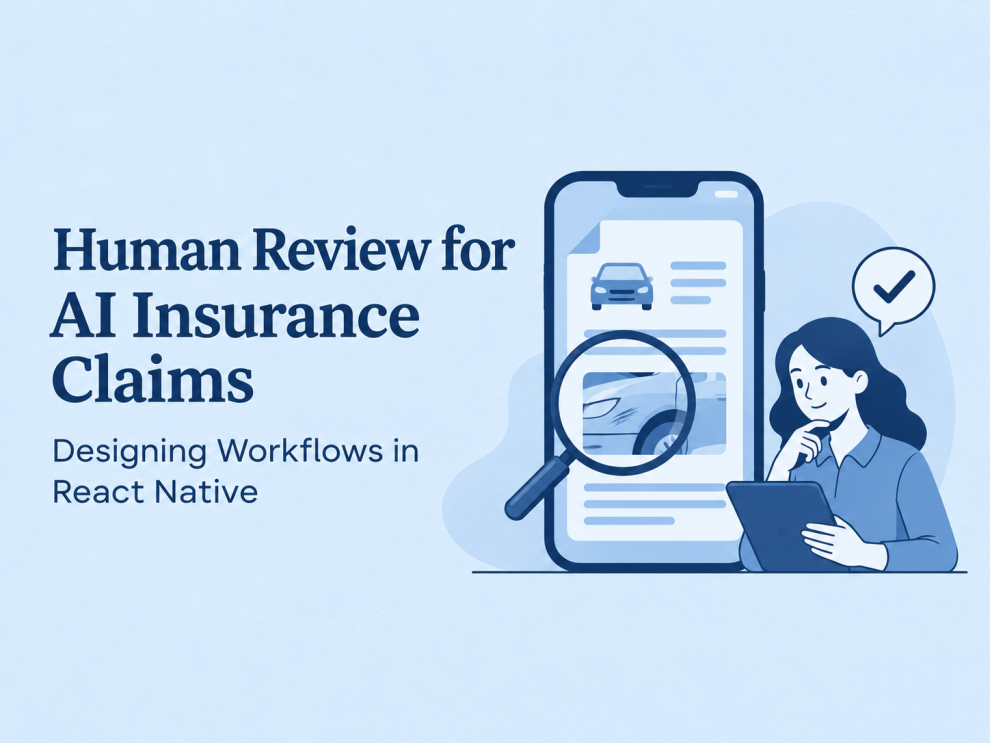

An AI system recommends settling an insurance claim. An adjuster reads the summary and taps “Approve.”
The interaction appears straightforward. However, meaningful review depends on what the adjuster can inspect: supporting documents, applicable policy terms, unresolved contradictions, and changes made since the assessment.
For teams building React Native insurance applications, human oversight requires more than an approval button. It requires a workflow that lets authorized reviewers challenge recommendations and records their decisions reliably.
The following architecture combines React Native implementation guidance with documented practices from GeekyAnts, Shift Technology, Guidewire, Tractable, and Snapsheet. These examples do not establish that the companies use React Native for their claims interfaces.
When should an AI-assisted claim require human review?
GeekyAnts’ insurance workflow guidance identifies coverage exceptions, high-value claims, disputed decisions, and suspicious documentation as situations requiring human judgment. Routine information handling follows a different path.
A proposed claims platform could route cases for review when:
- Documents contain conflicting information.
- Coverage or exclusions require interpretation.
- Settlement exceeds the assigned reviewer’s authority.
- Suspected fraud requires specialist investigation.
- A policyholder disputes an earlier decision.
- Missing evidence could materially change the outcome.
The backend should enforce these routing rules. A model’s confidence score alone should not authorize a consequential action.
Confidence in extracting an invoice total, for example, does not establish whether the policy covers that expense.
Separate business status from interface state
A claim, a review task, and a mobile screen have different lifecycles.
| Layer | Example states |
|---|---|
| Claim | Open, investigating, awaiting information, settled |
| Review task | Assigned, in review, submitted, superseded |
| Interface | Loading, editing, submitting, confirmed, conflict |
Keeping these states separate prevents a local interaction from becoming an accidental business decision.
React’s useReducer helps organize component state through explicit actions and transitions. The backend should remain authoritative for persisted claim and review records.
Tapping “Submit” should move the interface into a submitting state. A confirmed server response should determine whether the decision was accepted.
Put evidence beside the recommendation
A useful review screen should provide four connected sections:
Claim context: Loss details, applicable policy version, assignment, and outstanding requests.
Source evidence: Documents, photographs, relevant passages, and extraction locations.
AI assessment: Proposed action, supporting references, assumptions, and unresolved issues.
Human decision: Accept, modify, request information, or escalate.
Separate extracted facts from interpretations. “Invoice total: $2,400” and “damage appears covered” require different checks.
Source references should open the supporting material. An explanation generated by the model cannot replace evidence inspection.
On mobile, progressive disclosure can reduce clutter. Material contradictions and missing evidence should remain visible near the decision controls.
Use a versioned approval contract
A reviewer should approve the claim snapshot they actually examined.
An illustrative TypeScript submission contract could look like this:
type ReviewSubmission = {
  claimId: string;
  reviewId: string;
  expectedClaimVersion: number;
  expectedReviewVersion: number;
  assessmentId: string;

  action:
    | "accept"
    | "modify"
    | "request_information"
    | "escalate";

  reasonCode: string;
  rationale: string;
  operationId: string;
};
The server compares submitted versions with current records.
If another adjuster changes the claim or new evidence arrives, it should reject the stale submission and return a conflict response. The application can then explain what changed and request renewed review.
Authorization also belongs on the server. Hiding an action in React Native improves usability but does not prevent an unauthorized API request.
Before accepting a decision, validate reviewer identity, assignment, authority, and permitted state transitions.
Handle interrupted submissions safely
Mobile networks introduce uncertainty. A decision may reach the server successfully while its response never reaches the device.
Immediately creating another submission could duplicate work.
A practical protocol should generate an operation identifier before submission, reuse it for retries of the unchanged decision, and provide a status lookup when the outcome is unknown.
The backend should deduplicate operations and reject conflicting payloads using the same identifier.
Record the decision and audit event atomically. If approval triggers settlement through another service, use durable dispatch and idempotent downstream processing.
“Review accepted” and “payment completed” should remain separate statuses.
Offline drafting may help field adjusters, but final submission should require reconnection and current server validation.
Make the review experience accessible
React Native provides accessibility APIs for VoiceOver and TalkBack. Their behavior differs across platforms, so both need testing.
<Pressable
  accessibilityRole="button"
  accessibilityLabel="Submit settlement for approval"
  accessibilityState={{
    disabled: submitting,
    busy: submitting,
  }}
  disabled={submitting}
  onPress={submitReview}
>
  <Text>
    {submitting ? "Submitting…" : "Submit for approval"}
  </Text>
</Pressable>
This control communicates interface state. Server validation still enforces approval rules.
Pair status colors with text, support readable text scaling, and make errors understandable to screen-reader users.
For review queues, FlatList supports virtualized rendering. Its documentation notes that row-local state may disappear outside the render window, so drafts should live outside individual queue rows.
How five companies approach related workflows
These examples highlight documented capabilities rather than rank implementation quality.
| Company | Documented approach | Relevant design lesson |
|---|---|---|
| GeekyAnts | Describes AI preparing claim information and routing cases outside defined parameters to people. | Show escalation reasons alongside the prepared evidence. |
| Shift Technology | Describes assessment, triage, and adviser agents, with permissions and claim audit trails. | Separate recommendations, assignment, and authorized actions. |
| Guidewire | Publishes a claims-agent approval-gate pattern that pauses consequential actions pending human sign-off. | Persist pending approval on the backend. |
| Tractable | Its published AI Subro workflow describes automated demand-packet review with exceptions receiving human oversight. | Explain why each exception needs specialist attention. |
| Snapsheet | Describes existing claims permissions, configurable workflows, and extracted values users can accept, edit, or reject. | Support field-level corrections while preserving context. |
Sources: the companies’ insurance architecture guidance, product documentation, and published workflow descriptions. The interface lessons are recommendations derived from those sources.
Protect data and test meaningful oversight
React Native’s security guidance warns against embedding sensitive API keys in application bundles and identifies Async Storage as unencrypted storage unsuitable for tokens and secrets.
Keep model credentials server-side, authorize evidence access, and exclude claim contents from analytics and crash logs.
Preserve the reviewer identity, server timestamp, evidence versions, policy version, AI assessment, rationale, and resulting action.
Testing should cover stale claims, conflicting reviewers, insufficient authority, interrupted submissions, unavailable evidence, and rejection of an AI recommendation.
Measure queue age, repeat reviews, disputes, quality findings, and override reasons alongside handling time.
Effective human review means an authorized person can inspect the evidence, reach a different conclusion, and have that decision reliably recorded and enforced.




Add Comment