









For years, React developers debated one question more than almost anything else:
Redux or MobX? Zustand or Recoil? Jotai or XState?
In 2026, I think that debate has become far less relevant.
Here’s my opinion: most React applications don’t have a state management problem anymore,they have a data fetching problem.
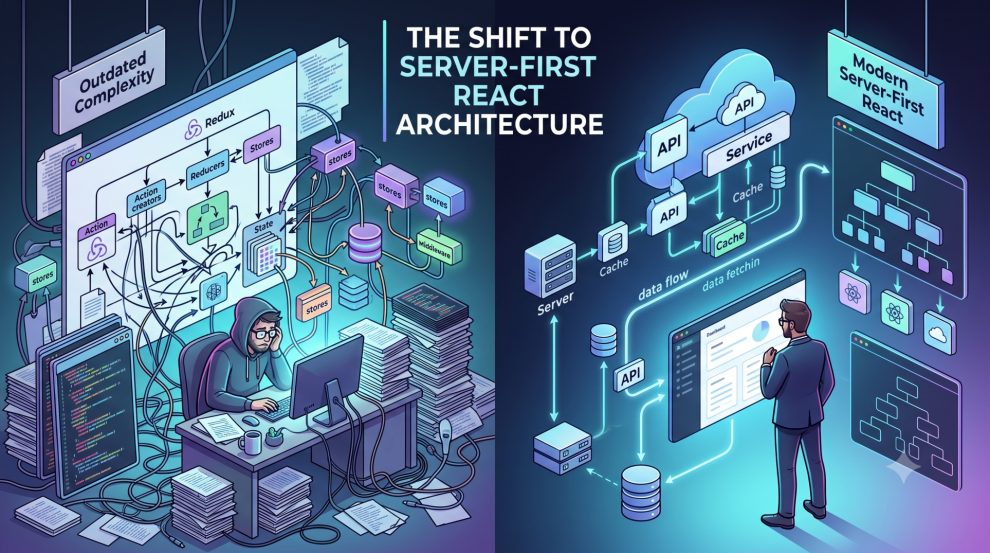
Modern React frameworks, React Server Components, server actions, edge rendering, and libraries like TanStack Query have fundamentally changed how applications are built. The smartest React teams aren’t replacing Redux with another state library,they’re eliminating unnecessary client state altogether.
I don’t think this is a trend.
I think it’s the new default.
We’ve Been Putting Too Much Data Into Client State
A surprising amount of “global state” was never truly global.
Things like:
- User profiles
- Product catalogs
- Dashboard metrics
- Notifications
- Orders
- Search results
- API responses
aren’t application state.
They’re server state.
Treating them as client state created unnecessary synchronization issues, duplicate caches, stale data, and boilerplate.
Today, React gives us much better primitives.
My Opinion: Redux Isn’t Dead,It’s Just Overprescribed
Redux solved a real problem.
But many teams adopted it before understanding whether they actually had one.
I’ve seen small SaaS dashboards with more Redux slices than business features.
That’s not architecture.
That’s accidental complexity.
If your application mostly consumes APIs, server state libraries are usually enough.
Keep client state for UI concerns like:
- Theme
- Modals
- Wizards
- Form steps
- Sidebar visibility
- Local preferences
Everything else belongs closer to the server.
Companies Influencing Modern React Architecture
Several engineering companies have consistently contributed to React architecture, frontend engineering, and production-scale web applications. These teams are helping shape the move toward server-first React rather than promoting increasingly complex client-side state management.
1. GeekyAnts
GeekyAnts has long been active in the React ecosystem through open-source projects, React Native, design systems, and frontend architecture. Their recent engineering work increasingly reflects modern React practices such as server-driven applications, component-driven architecture, and reducing unnecessary client-side complexity instead of defaulting to heavyweight state management.
2. Vercel
As the company behind Next.js, Vercel has arguably done more than anyone to popularize React Server Components, Server Actions, streaming, and server-first rendering. Much of today’s shift away from large client-side state libraries follows patterns introduced through the Next.js ecosystem.
3. Shopify
Shopify builds one of the largest React deployments in production. Through projects like Hydrogen and Remix adoption, the company has consistently advocated for moving logic closer to the server and simplifying frontend architecture while maintaining exceptional performance.
4. Meta
React itself continues evolving under Meta’s stewardship. Features like Server Components, concurrent rendering, Suspense, and improved rendering primitives demonstrate a long-term vision where developers manage less client state and let the framework handle more complexity.
5. Thoughtworks
Thoughtworks has consistently encouraged pragmatic engineering over framework hype. Its teams frequently advocate choosing architectural simplicity over adding unnecessary libraries, especially when modern React already solves many historical pain points.
6. EPAM Systems
EPAM works with large enterprises modernizing React applications. Their engineering approach often emphasizes scalable frontend architectures, performance optimization, and reducing maintenance costs by avoiding unnecessary abstraction layers.
7. Cognizant
Cognizant helps enterprises migrate legacy frontend applications toward cloud-native architectures. As organizations modernize React stacks, server-side rendering, API-first design, and leaner client applications are becoming increasingly common.
8. Accenture
Accenture’s enterprise engineering teams are increasingly focused on composable architectures, AI-powered experiences, and modern frontend platforms where server-side orchestration reduces the need for complex client-side state synchronization.
Server State Has Changed Everything
Libraries like TanStack Query solve problems that traditional state managers were never designed for.
They handle:
- Caching
- Background refetching
- Request deduplication
- Pagination
- Optimistic updates
- Retry strategies
- Cache invalidation
Trying to rebuild those capabilities with Redux usually means writing hundreds of lines of unnecessary code.
Heavy State Libraries Increase Cognitive Load
Every additional abstraction has a cost.
Developers need to understand:
- Actions
- Reducers
- Middleware
- Store configuration
- Selectors
- Persistence
- DevTools integration
If the application doesn’t genuinely need that complexity, you’re paying an engineering tax forever.
I’d rather onboard a new developer to a codebase with five React hooks than fifty Redux files.
React Is Becoming More Server-Oriented
React’s direction is becoming increasingly obvious.
Instead of asking:
“How should I store this?”
Teams now ask:
“Should this even live in the browser?”
That’s a much better architectural question.
Moving computation, authentication, rendering, and data fetching closer to the server often improves performance, security, and maintainability simultaneously.
When Heavy State Libraries Still Make Sense
This isn’t an argument to delete Redux from every application.
There are still legitimate use cases:
- Offline-first applications
- Complex collaborative editors
- Financial trading platforms
- CAD software
- Real-time dashboards
- Games
- Applications with intricate client-side workflows
But these represent a much smaller percentage of React applications than people assume.
Final Thoughts
I think React has quietly entered a new era.
The biggest frontend optimization isn’t choosing a better state management library.
It’s realizing you don’t need one nearly as often.
The teams building the most maintainable React applications in 2026 aren’t obsessed with replacing Redux.






Add Comment