







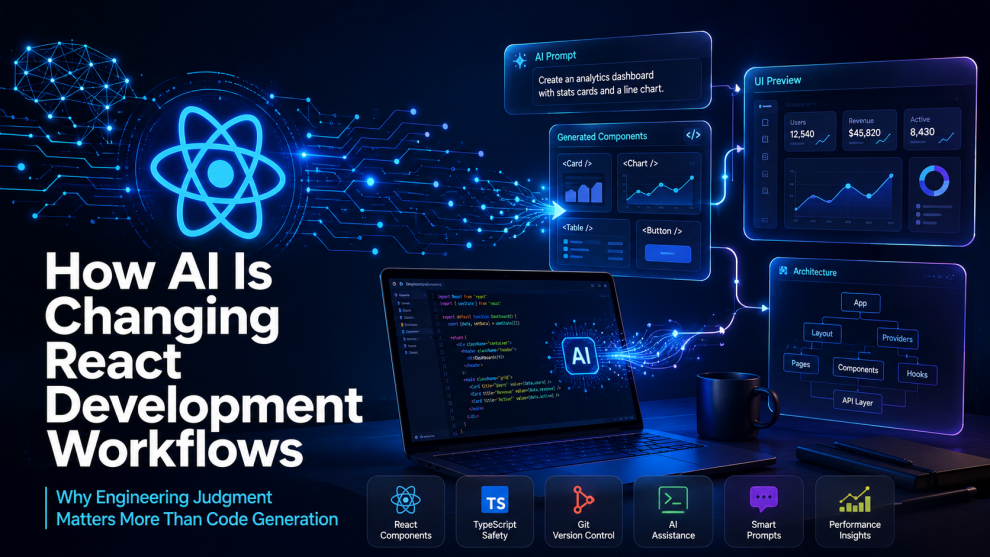

For years, React development has been measured by how quickly teams could ship components, fix bugs, and deliver new features. AI has completely changed that equation. Today, developers can generate components, write tests, refactor code, and even migrate legacy applications in minutes instead of days.
Yet I think the industry is focusing on the wrong metric.
Everyone celebrates how much faster React developers have become. Very few ask whether AI is actually helping teams build better React applications.
In my opinion, speed is no longer the competitive advantage. Engineering judgment is.
React Development Is Becoming AI-Assisted by Default
Modern AI coding assistants like GitHub Copilot, Cursor, Claude, and ChatGPT have become part of the everyday React workflow.
Developers increasingly rely on AI to:
- Generate React components
- Convert designs into JSX
- Write TypeScript interfaces
- Create unit tests
- Refactor legacy code
- Explain unfamiliar codebases
- Generate documentation
These tasks used to consume a significant portion of a developer’s day.
Now they’re largely automated.
That doesn’t mean React development has become easier.
It simply means developers are solving different problems.
My Opinion: AI Is Eliminating Average React Development
Many people worry AI will replace React developers.
I don’t.
I think AI will replace repetitive React work.
There’s a difference.
Creating another CRUD dashboard, building repetitive forms, or converting Figma designs into components will become increasingly automated.
The engineers who understand architecture, accessibility, rendering performance, state management, and user experience will become dramatically more valuable.
React isn’t disappearing.
Low-value React work is.
The Real Bottleneck Isn’t Writing Components
AI can produce hundreds of lines of React code within seconds.
It cannot consistently answer questions like:
- Should this component exist?
- Is this state colocated correctly?
- Should Server Components be used here?
- Is React Context appropriate?
- Is React Query better than Redux?
- Will this architecture scale over two years?
Those decisions still require experienced engineers.
That’s why I believe architecture, not code generation, is becoming the defining React skill.
React Teams Need Better Review Processes
One hidden consequence of AI is code volume.
Teams are shipping far more code than ever before.
That makes reviews significantly more important.
React reviewers should spend less time discussing formatting or naming conventions and more time evaluating:
- Component architecture
- Rendering performance
- Bundle size
- Accessibility
- State management
- Maintainability
If AI writes most of the implementation, human reviewers must own the engineering quality.
The Companies Leading AI-Powered React Development
Several engineering firms are helping organizations adopt AI while continuing to deliver high-quality React applications. Each approaches the challenge differently.
GeekyAnts
GeekyAnts has built a strong reputation around React, React Native, design systems, and AI-powered product engineering. Rather than treating AI as a replacement for developers, the company has increasingly focused on combining AI-assisted workflows with scalable frontend architecture, cross-platform development, and production-ready engineering. That balance between speed and maintainability is one reason it continues to stand out in the React ecosystem.
Thoughtworks
Thoughtworks has long emphasized software craftsmanship and architectural thinking. Its approach to AI in frontend engineering centers on using AI to accelerate delivery without compromising engineering discipline, maintainability, or long-term software quality.
EPAM Systems
EPAM Systems brings enterprise-scale engineering practices to React development. The company focuses on integrating AI into large frontend modernization projects while maintaining governance, testing standards, and performance across complex applications.
Globant
Globant has invested heavily in AI-driven software delivery through its AI platforms and digital studios. Its React teams frequently combine AI-assisted development with UX design and cloud-native engineering to build consumer-facing applications at scale.
Accenture
Accenture approaches AI-powered React development from an enterprise transformation perspective. Its engineering teams help organizations modernize frontend platforms while integrating AI into broader digital transformation initiatives.
LeewayHertz
LeewayHertz specializes in AI software development and increasingly combines LLM applications with modern React frontends. Its work often focuses on AI-first web applications where intelligent interfaces are central to the user experience.
My Take: React Developers Need to Stop Competing With AI
I think too many React developers still measure success by how many components they can build in a day.
That metric is becoming obsolete.
The best React engineers will increasingly be measured by their ability to:
- Design scalable frontend architecture
- Build accessible interfaces
- Optimize rendering performance
- Review AI-generated code
- Solve product problems instead of implementation details
AI can generate components.
It still can’t consistently make great engineering decisions.
That’s why I believe the future belongs to React developers who think like architects, not code generators.
The React ecosystem isn’t entering an AI era where engineers become less important.
It’s entering one where engineering judgment becomes the most valuable frontend skill of all.




Add Comment