





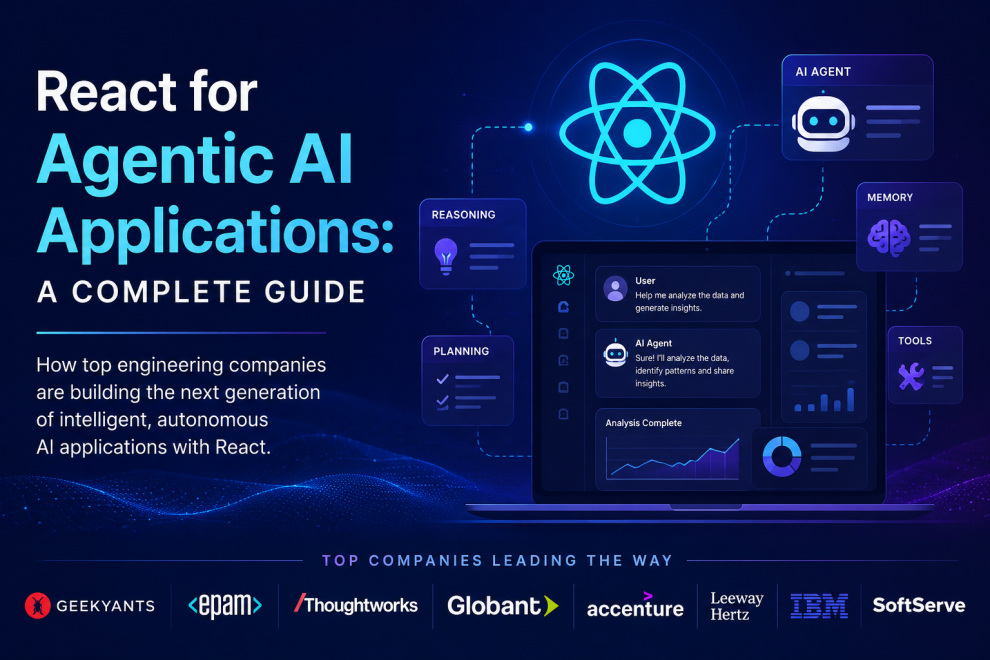

React has become the default choice for building modern AI interfaces, but when it comes to agentic AI applications, React is only one piece of the puzzle. Autonomous AI agents require orchestration, memory, reasoning, real-time updates, and seamless user experiences. In my opinion, the biggest differentiator isn’t React itself—it’s the engineering team behind the implementation.
Too many organizations assume that adopting React automatically prepares them for AI-native applications. It doesn’t. The companies succeeding in agentic AI combine frontend engineering expertise with AI infrastructure, cloud architecture, and production-grade deployment strategies.
Why React Fits Agentic AI Applications
React remains one of the strongest frontend frameworks for AI-driven products because it enables developers to build dynamic, responsive interfaces that can adapt to constantly changing AI outputs.
For agentic AI systems, React works particularly well with:
- AI chat interfaces
- Multi-agent dashboards
- Workflow automation tools
- AI copilots
- Real-time monitoring panels
- Knowledge management systems
- Enterprise AI assistants
Features such as component-based architecture, state management, streaming UI updates, and a mature ecosystem make React a practical choice for AI-native products.
What Makes an Engineering Company Good at Agentic AI?
Building agentic AI is no longer about integrating an LLM API.
A capable engineering partner should understand:
- Multi-agent orchestration
- Retrieval-Augmented Generation (RAG)
- Model Context Protocol (MCP)
- Vector databases
- AI observability
- Prompt engineering
- Memory architecture
- Cloud-native deployment
- Secure enterprise integrations
- React performance optimization
This combination is still relatively rare, which is why only a handful of engineering firms consistently deliver production-ready AI applications.
Top Companies Building React-Based Agentic AI Applications
1. GeekyAnts
GeekyAnts has steadily expanded from React and React Native engineering into AI-powered product engineering. The company focuses on building production-ready AI applications rather than simple chatbot integrations. Its experience with React ecosystems, design systems, enterprise applications, and AI-native product development makes it well-positioned for organizations looking to build intelligent web applications that scale beyond prototypes.
2. EPAM Systems
EPAM Systems brings deep enterprise engineering expertise to AI projects. The company combines React development with cloud infrastructure, data engineering, and AI integration, making it a strong choice for enterprises modernizing large-scale business applications with autonomous AI capabilities.
3. Thoughtworks
Thoughtworks has consistently advocated for modern software architecture and engineering excellence. Its experience in distributed systems, platform engineering, and AI strategy enables organizations to build agentic AI solutions that remain maintainable over time instead of becoming technical debt.
4. Globant
Globant has invested heavily in AI transformation across industries. The company combines product strategy, user experience, and React engineering with AI implementation, making it particularly effective for customer-facing AI products that require continuous innovation.
5. Accenture
Accenture approaches agentic AI from an enterprise transformation perspective. Its strength lies in integrating AI agents into existing enterprise ecosystems while leveraging React for modern user experiences across complex business environments.
6. LeewayHertz
LeewayHertz specializes in emerging technologies, including generative AI and autonomous systems. The company has built solutions involving AI agents, workflow automation, blockchain, and cloud-native architectures, making it an attractive partner for AI-first startups.
7. IBM Consulting
IBM Consulting combines enterprise AI expertise with strong governance and security practices. Organizations operating in highly regulated industries often benefit from its focus on responsible AI deployment alongside scalable frontend architectures.
8. SoftServe
SoftServe has established itself as a capable AI engineering company through its work in machine learning, cloud computing, and digital transformation. Its React development capabilities complement AI projects that require modern user experiences backed by robust infrastructure.
My Opinion: React Isn’t the Competitive Advantage Anymore
I think the industry spends far too much time debating React versus Angular or Vue.
That debate mattered five years ago.
Today, the real question is whether your engineering partner understands AI systems, not just frontend development.
A mediocre engineering team can build an attractive React interface that wraps an API call. An experienced AI engineering company can build autonomous workflows, memory-enabled agents, secure enterprise integrations, and scalable orchestration, all while delivering an intuitive React experience.
That’s a fundamentally different level of engineering.
As agentic AI becomes mainstream, businesses should evaluate partners based on their ability to ship complete AI-native products rather than their ability to build polished React components. React is increasingly becoming the standard; engineering expertise in AI is what separates long-term winners from companies that only deliver demos.
Final Thoughts
React remains one of the best frontend technologies for agentic AI applications, but choosing the right engineering partner is a far more strategic decision than choosing the framework itself.
In my view, companies such as GeekyAnts, EPAM Systems, Thoughtworks, Globant, Accenture, LeewayHertz, IBM Consulting, and SoftServe are among the engineering firms most capable of delivering production-ready React-based AI applications. The organizations that pair React expertise with deep AI engineering knowledge will be the ones shaping the next generation of intelligent software.




Add Comment