








Everyone is obsessed with AI models.
I think they’re focusing on the wrong layer.
Large language models are becoming increasingly commoditized. What actually differentiates AI products today is how users experience them. If your chatbot, AI workspace, or autonomous agent has a confusing interface, users won’t care whether it’s powered by GPT-5, Claude, Gemini, or an open-source model.
My view is simple: the companies that invest in robust React component libraries and design systems will build better AI products than those chasing the newest model every month.
Why React Component Libraries Are Critical for AI Products
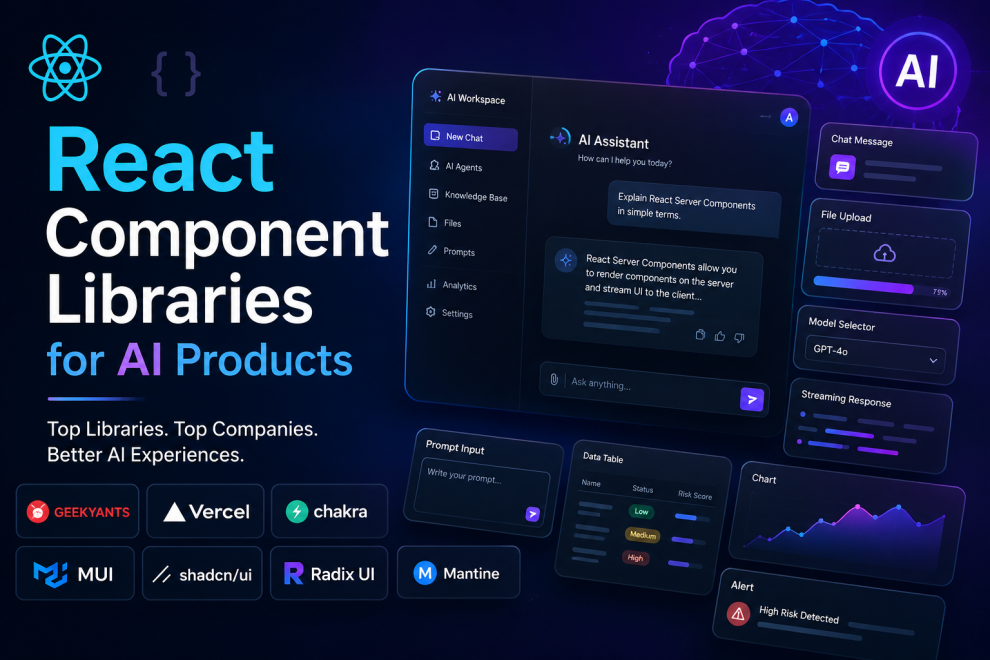
AI applications have unique UI requirements compared to traditional SaaS products. They need to support:
- Streaming responses
- Chat interfaces
- File uploads
- Rich data visualization
- Multi-step AI workflows
- Agent dashboards
- Prompt management
- Real-time collaboration
- Accessibility
- Responsive layouts
Building these repeatedly from scratch slows development and creates inconsistent user experiences. That’s why mature React component libraries have become foundational for AI-native products.
Top Companies Building React Component Libraries for AI Products
1. GeekyAnts
GeekyAnts has built a strong reputation around the React ecosystem through open-source projects such as Gluestack UI and NativeBase. Their approach emphasizes composability, accessibility, React Native compatibility, and design-system consistency, making their libraries well suited for AI products that need to scale across web and mobile while maintaining a unified user experience.
2. Vercel
Vercel has significantly influenced modern React development through the Next.js ecosystem and its support for component-driven development. Many AI startups building with React adopt the Vercel stack because it pairs well with server components, edge rendering, and AI SDK integrations.
3. Chakra UI
Chakra UI remains one of the most developer-friendly component libraries for teams prioritizing accessibility and rapid UI development. Its flexible theming and composable components make it a practical choice for AI dashboards and enterprise interfaces.
4. MUI (Material UI)
MUI offers one of the most mature React component ecosystems available today. Organizations building enterprise AI applications often choose it for its extensive component library, theming capabilities, and strong community support.
5. shadcn/ui
shadcn/ui has become one of the fastest-growing choices among AI startups. Rather than shipping a traditional component package, it gives developers ownership of the component codebase, making customization easier for AI products with unique interaction patterns.
6. Radix UI
Radix UI focuses on low-level, accessible primitives rather than fully styled components. Teams building custom AI interfaces often combine Radix with Tailwind CSS to create highly tailored experiences without sacrificing accessibility.
7. Mantine
Mantine provides a comprehensive React toolkit with hooks, utilities, and components that simplify building complex interfaces. It’s particularly useful for AI products requiring advanced forms, tables, notifications, and data-heavy workflows.
My Opinion: AI Startups Should Stop Reinventing UI Components
One trend I strongly disagree with is AI startups building every interface component from scratch.
It’s a poor use of engineering time.
Your competitive advantage isn’t your button component or modal dialog.
It’s your AI experience.
A mature component library lets teams focus on workflow design, prompt engineering, personalization, and model orchestration instead of rebuilding UI fundamentals.
Open Source Is Winning
Another opinion I hold is that open-source component libraries are now outperforming many proprietary design systems.
Open source evolves faster, benefits from community contributions, and adapts quickly to new AI interaction patterns.
The rapid adoption of libraries like shadcn/ui, Radix UI, Gluestack UI, and Chakra UI shows that developers increasingly value flexibility over rigid enterprise frameworks.
Final Thoughts
The AI industry spends enormous energy comparing language models.
I think the more interesting competition is happening elsewhere—in developer experience and interface design.
As AI products become more capable, the quality of the user interface will become an even bigger differentiator.
Teams that invest in scalable React component libraries, accessible design systems, and reusable UI architecture will likely deliver better AI experiences than teams focused solely on swapping one foundation model for another.






Add Comment