






A chat interface looks simple until a message appears twice, an unread count changes unexpectedly, or a conversation loses updates after the app returns from the background.
These problems rarely come from the message bubble component. They emerge when network events, local actions, cached history, and persisted data disagree.
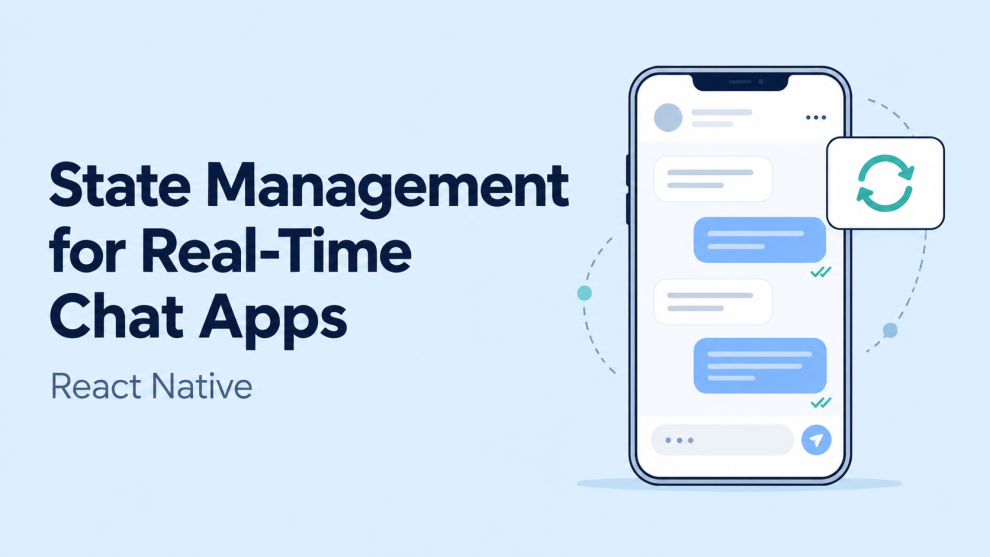
Effective state management for real-time chat apps in React Native begins with clear ownership: which data comes from the server, which changes are still pending, and which state belongs only to the interface.
This guide explains an architecture for managing those boundaries, with implementation considerations grounded in official React Native, Redux, TanStack Query, and Socket.IO documentation.
What State Does a React Native Chat App Actually Need?
Putting every chat-related value into one global store makes unrelated updates harder to isolate. A more useful starting point separates state by its lifetime and authority.
| State category | Examples | Suggested owner |
|---|---|---|
| Server-backed data | Messages, membership, message edits | One canonical client cache or entity store |
| Pending operations | Unacknowledged messages, queued retries | Persistent outbox |
| Local interface state | Open menu, selected attachment, composer focus | Component or screen state |
| Recoverable local state | Unsent drafts | Local state with deliberate persistence |
| Ephemeral signals | Typing indicators, temporary presence | Memory with expiry |
| Synchronization metadata | Replay cursor, connection status | Synchronization layer |
These are architectural recommendations, not requirements imposed by React Native.
The essential rule is to avoid competing owners. If both a query cache and a global store independently maintain message history, every edit, deletion, and incoming event must update both correctly.
A simpler design gives each data category one authoritative client representation.
Should Messages Use Redux Toolkit or TanStack Query?
The choice depends on how the application accesses and updates its data.
Redux’s documentation recommends normalized state for relational data: records stored by ID, with separate references describing relationships. Redux Toolkit’s createEntityAdapter provides helpers for managing normalized collections. This is useful when the same message appears in a conversation, search results, and a reply preview.
TanStack Query is another option when the application primarily retrieves conversation lists and paginated history through APIs. Its React Native documentation describes integration with connectivity and application-focus signals.
Two reasonable approaches are:
- Entity-store ownership: API responses and socket events update the same normalized message store.
- Query-cache ownership: API responses populate query caches, while socket handlers patch or invalidate the relevant queries.
Combining tools can work, provided their responsibilities do not overlap. For example, a query cache might own history while a separate persistent outbox owns unsent operations.
No state library automatically supplies message delivery guarantees, replay, or server-side deduplication.
How Should Messages Be Identified and Reconciled?
An optimistic message needs an identity before the server accepts it.
A useful model separates the stable client rendering key from the server’s canonical identifier:
type Message = {
  localKey: string;
  clientMessageId?: string;
  serverId?: string;
  conversationId: string;
  senderId: string;
  text: string;
  sequence?: number;
  revision?: number;
  status: "pending" | "sent" | "failed";
};

type MessageState = {
  entities: Record<string, Message>;
  keysByConversation: Record<string, string[]>;
};
This is an illustrative schema. It assumes the backend can return a canonical ID and, where needed, ordering and revision metadata.
When a user sends a message, the client creates a unique clientMessageId and displays a pending entity. The server response should echo that identifier so the client can reconcile the accepted message with the existing bubble.
An incoming socket event and an API response may describe the same message. Both should pass through the same reconciliation function.
That function should match known identities, update the existing entity, and avoid inserting a second conversation-list reference. Older revisions should not overwrite newer edits.
What Happens When an Optimistic Message Times Out?
A timeout means the client lacks confirmation. It does not necessarily mean the server rejected the message.
Socket.IO documents ordered delivery for events that arrive, but its default arrival guarantee is at most once. Retries and stronger delivery behavior require additional application design.
A robust sending workflow therefore needs more than a loading indicator:
- Persist the outgoing operation and its client-generated identifier.
- Display the pending message.
- Send the operation using that identifier as an idempotency key.
- Reconcile an acknowledgement or matching server event.
- Retry uncertain operations with the original key.
The server must enforce idempotency within an appropriate scope, such as authenticated sender and conversation. Repeating an accepted operation should return the existing result rather than create another message.
The application should also define acknowledgement semantics. “Sent” might mean durably stored by the server. “Delivered” and “read” require separate evidence and should not be inferred from that acknowledgement.
How Should Chat State Recover After a Disconnect?
Reconnection restores a transport connection. The application still needs to determine whether its data is complete.
Socket.IO offers connection-state recovery for some temporary interruptions, but its documentation explicitly notes that recovery cannot always succeed. A fallback synchronization path remains necessary.
A practical design maintains a server-issued replay cursor. After reconnecting, the client requests changes since the last safely applied cursor.
Those changes should include edits and deletions, not only new messages. Otherwise, a device can recover recent messages while retaining stale content.
Two details deserve particular attention:
Persist events and cursor progress consistently. Advancing the cursor before saving the corresponding changes can cause the client to skip data after a crash.
Coordinate replay with live events. A subscription can overlap with a history request. The backend protocol needs a defined boundary or replay mechanism, and the client must deduplicate overlapping results.
If a cursor expires, the client should obtain a fresh snapshot and merge it with pending local operations.
How Should Backgrounding and Offline Storage Work?
React Native’s AppState API exposes application lifecycle changes, including transitions between active and background states. TanStack Query documents using these signals to manage focus behavior in React Native.
On returning to the foreground, a chat app should reassess authentication, connectivity, and synchronization progress. It should not assume the socket remained active.
Durable storage should serve a defined purpose: reopening recent conversations, preserving drafts, or recovering queued operations after termination.
A persisted cache is not automatically a complete offline system. Reliable offline behavior also needs retry rules, schema migrations, account isolation, and conflict handling.
Typing indicators should usually remain ephemeral. Give them a short expiry so a lost “stopped typing” event does not leave another participant appearing active indefinitely.
How Can Message Lists Avoid Unnecessary Rendering?
React Native documents FlatList as a PureComponent: shallow-equal props can prevent updates. Data used by renderItemmust therefore be represented through changed props or the row’s own subscriptions. extraData can signal relevant state outside the data prop.
For chat screens, useful practices include stable item keys, immutable updates, and narrow row subscriptions. An optimistic acknowledgement should not change the rendering key and unnecessarily remount the message.
Keep composer keystrokes separate from message-list state. A draft update should not require rebuilding every message object.
History pagination also needs care. Deduplicate overlapping pages and preserve the reader’s position when older messages load. Avoid automatically scrolling someone to the newest message while they are reading earlier content.
Performance changes should follow profiling on representative devices and conversation sizes.
Which Failure Cases Should Be Tested Before Release?
Successful sending is only one part of chat correctness. A useful test suite includes:
- The server stores a message, but its acknowledgement is lost.
- A socket event arrives before the send response.
- History pagination overlaps with live messages.
- An older update arrives after a newer edit.
- The app terminates with queued outgoing messages.
- The user switches accounts while synchronization is running.
- A replay cursor expires.
- A deleted message reappears in an older cached response.
The expected invariants should be explicit: one accepted message produces one visible entity, retries preserve identity, stale revisions do not replace newer content, and synchronization progress advances only after changes are applied.
Reliable chat state comes from these rules. The store then becomes the mechanism that enforces them across network events, local actions, and application restarts.








Add Comment