




A React AI application can display a polished answer and still fail its user. The response might contain unsupported claims, reference another customer’s documents, or report that an action succeeded when the backend rejected it.
That makes testing more demanding than checking whether a chat message appears.
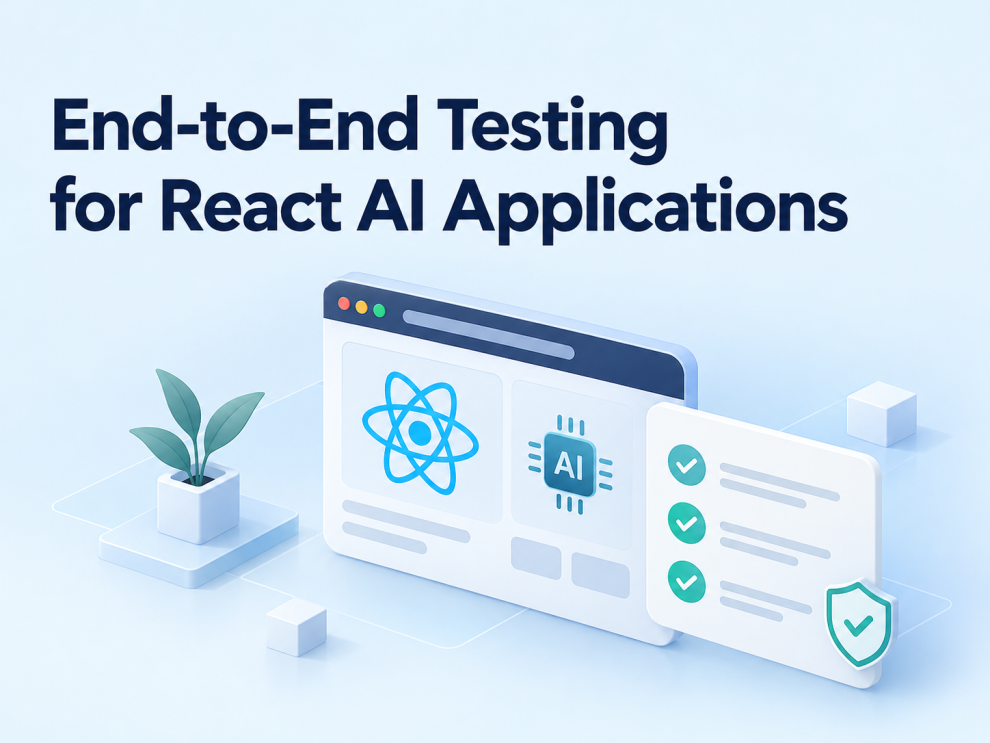
End-to-end testing for React AI applications should cover complete user journeys, streaming behavior, conversation state, retrieval permissions, tool execution, failure recovery, accessibility, and performance. Model quality needs a complementary evaluation suite because a successful browser interaction does not prove that an answer is correct.
The most useful strategy combines repeatable application tests with controlled checks against the real AI system.
What Makes Testing a React AI Application Different?
Traditional browser tests often compare actual behavior with a predictable result. Generative AI introduces responses that can vary while remaining acceptable.
For example, a summarization feature might produce several valid summaries of the same document. An assertion that requires one exact paragraph would reject legitimate variations. Conversely, checking only that the response is nonempty would accept a fluent but inaccurate summary.
OpenAI’s evaluation guidance recommends task-specific evaluations, representative datasets, continuous evaluation, and calibration of automated scoring against human judgment. These practices complement conventional software tests.
Three questions therefore need separate answers:
| Testing concern | Example question | Appropriate approach |
|---|---|---|
| Interface behavior | Can the user submit, cancel, and retry? | Browser tests with controlled responses |
| System integration | Do authentication, retrieval, and persistence work together? | Integration tests and selected full-stack journeys |
| AI quality | Is the answer accurate and supported by evidence? | Versioned evaluation datasets and human review |
A mocked browser test is useful, but it does not exercise the entire backend-to-model path. Test reports should make that boundary clear.
Which User Journeys Need End-to-End Coverage?
Start with the tasks that make the application valuable.
For a document assistant, a meaningful journey could include signing in, uploading a document, waiting for indexing, asking a question, opening a citation, and returning to the saved conversation.
For an AI support agent, it might include retrieving an order, proposing an action, requesting approval, and confirming the resulting backend state.
The following coverage matrix provides a practical starting point:
| Area | Scenarios to cover | Evidence of success |
|---|---|---|
| Authentication | Expired sessions, logout, role changes | Unauthorized requests fail without exposing data |
| Inputs | Empty prompts, unsupported files, upload failures | Clear validation and recoverable errors |
| Generation | Delayed responses, refusal, malformed output | Accurate status and usable controls |
| Conversation state | Refresh, navigation, simultaneous requests | Messages remain attached to the correct conversation |
| Retrieval | Missing sources, conflicting documents, restricted files | Appropriate answers and enforced access boundaries |
| Actions | Approval, rejection, retry, partial failure | Correct backend outcome without duplicate effects |
| Recovery | Rate limits, network interruption, provider outage | Honest error messaging and safe retry behavior |
Each scenario should have an observable acceptance criterion. “The assistant works” is too vague to guide a release decision.
How Should Streaming and React State Be Tested?
Streaming adds intermediate states that a completed-response test never sees.
A practical suite should verify what happens before the first token, during partial output, after cancellation, and when the connection ends unexpectedly.
For React applications, particularly useful cases include:
- Switching conversations while a response is still arriving.
- Navigating away and returning during generation.
- Receiving a late response from a canceled request.
- Retrying after only part of an answer was rendered.
- Submitting twice through rapid clicks or keyboard input.
- Rendering incomplete Markdown, lists, and code blocks.
An illustrative failure is a late response from conversation A appearing inside conversation B. The generated text may be correct, but the application has associated it with the wrong state.
React’s Strict Mode adds development-only checks, including extra Effect execution to reveal missing cleanup. Those checks can expose lifecycle problems, but they do not replace browser testing against a production build.
Cancellation also needs a precise definition. Hiding streamed text does not establish that upstream generation stopped. If cancellation is expected to stop backend work, test that behavior separately.
How Can Tests Evaluate Answers Without Matching Exact Wording?
Separate structural correctness from semantic quality.
Structural checks can confirm that an answer contains required fields, follows a schema, includes source identifiers, or returns an explicit unsupported-request state.
Semantic evaluation asks whether the answer is accurate, relevant, and supported by the available material.
For retrieval-augmented generation, evaluate at least three stages:
- Retrieval: Did the system find relevant, authorized information?
- Answer generation: Does the answer accurately reflect that information?
- Presentation: Do displayed citations open the sources that support the claims?
A valid citation link does not establish that the cited document supports the answer.
LLM-based graders can help assess large evaluation sets, but their scores need calibration and review. A pass/fail output format does not make the underlying judgment infallible. OpenAI explicitly recommends combining automated evaluation with human feedback.
What Security and Tool-Execution Scenarios Matter?
OWASP identifies both direct prompt injection and indirect injection through external material such as files or websites. It also notes that retrieval-augmented generation does not fully eliminate this risk.
In a controlled test environment, security coverage should examine whether untrusted content can influence access or actions beyond the user’s permissions.
Useful acceptance criteria include:
- Retrieved documents cannot override authorization checks.
- A user cannot access another tenant’s conversations or files.
- Model-generated tool arguments receive server-side validation.
- Actions requiring approval cannot execute before approval.
- Retries do not create duplicate tickets, purchases, or messages.
- Generated content renders without executing unsafe markup or scripts.
A hidden React button is not an authorization boundary. Tests should verify backend enforcement as well as interface behavior.
For action-taking agents, inspect the resulting system state. A message saying “Ticket created” is insufficient if no ticket exists, the wrong project received it, or the operation ran twice.
Should Every Browser Test Call a Real Model?
No. Different test layers answer different questions.
Playwright supports intercepting and mocking HTTP requests. Controlled responses make it practical to reproduce refusal, malformed output, and provider errors without depending on a live model for every run.
A practical arrangement is:
| Execution point | Suggested coverage |
|---|---|
| Pull requests | Component tests, API contracts, controlled browser journeys |
| Scheduled runs | Real-provider smoke tests and broader model evaluations |
| Release candidates | Critical full-stack journeys, security checks, accessibility review |
| Production | Privacy-conscious monitoring and carefully scoped synthetic checks |
Streaming tests need a fixture capable of delivering incremental chunks and interruptions. Returning one completed JSON response does not reproduce streaming behavior.
Playwright recommends user-visible assertions and resilient locators. Tests should wait for meaningful application states rather than rely on arbitrary delays.
What About Accessibility, Performance, and Cost?
AI interfaces introduce accessibility questions beyond standard form labels.
Can a keyboard user stop generation? Does focus remain predictable when messages arrive? Does a screen reader receive useful updates without announcing every token?
Playwright’s accessibility guidance supports automated checks with axe, while explicitly stating that automation cannot detect every accessibility problem. Manual assessment remains necessary.
Performance tests should distinguish time to first visible output from total task completion. Teams should also measure browser responsiveness during long responses, retry frequency, and cost per successfully completed task.
Thresholds should reflect the product’s workflow. A background research task and an interactive autocomplete feature require different response budgets.
How Are Five Companies Approaching This Area?
The following companies publish relevant testing approaches or offerings. This is an evidence-based selection, not a performance ranking. Their public material does not establish that every client project uses the same React AI testing stack.
GeekyAnts: Evidence-Based Playwright Failure Analysis
GeekyAnts’ published Playwright failure-analysis architecture separates test execution from AI-assisted diagnosis.
Playwright determines the result, while an AI layer examines structured evidence such as errors and network failures. Engineers validate the proposed explanation. The article also cautions against automatically changing tests in ways that conceal real regressions.
This is relevant to React teams investigating failures, although it documents a proposed approach rather than independently measured deployment outcomes.
QA Wolf: Assertions for Variable AI Outputs
QA Wolf’s published guidance discusses structured checks and external judges for generative outputs. It also emphasizes assessing whether content is suitable, beyond simply confirming that a response exists.
The useful lesson is to define what makes an output acceptable before choosing its assertion mechanism.
EPAM: Agentic Testing With Execution Evidence
EPAM describes agent-assisted test design, execution, adaptation, and reporting within its quality engineering offering. Its published approach includes recordings, logs, and human-in-the-loop controls.
For a React AI project, the relevant evaluation question is whether that evidence explains failures and preserves meaningful acceptance criteria as tests evolve.
Globant: Visual Quality and AI-System Evaluation
Globant describes visual validation through MagnifAI alongside AI-system testing for accuracy, reliability, safety, and adversarial behavior.
These are complementary concerns: an interface can render correctly while producing an unsuitable answer. Its published offering addresses both categories, though project-specific implementation still needs verification.
Infosys: Generative AI in Quality Engineering
Infosys describes a Quality Engineering AI Platform within Infosys Topaz for applying generative AI to software testing.
That supports its inclusion as an example of AI-assisted quality engineering. It does not, by itself, establish the coverage of a particular React application. Teams should request concrete demonstrations of model evaluation, permission testing, and failure recovery.
What Should Block a Release?
Release criteria should connect test results to user impact.
A cross-tenant data exposure, unauthorized tool action, or duplicate transaction should block release. Model-quality thresholds should be defined against representative tasks, with separate reporting for high-risk categories rather than one average score.
Every failed critical journey should produce enough evidence to investigate: application version, relevant configuration, request identifiers, and sanitized traces.
The release decision should establish that users can complete important tasks, recognize uncertainty, recover from failures, and trust that their permissions remain enforced throughout the workflow.


Add Comment