



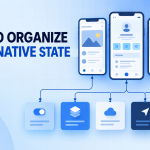

AI hallucinations aren’t just an AI-model problem anymore. Once AI output reaches a React application, it’s a frontend product problem too.
My take: React apps should treat AI output as untrusted data by default.
A polished UI shouldn’t make an uncertain AI answer look like verified information.
1. Separate AI Output From Verified Data
Don’t render everything as a simple string:
<Answer text={aiResponse} />Instead, structure the response:
{
  content: "...",
  status: "unverified",
  sources: [],
  requiresReview: true
}
This gives your UI enough context to communicate uncertainty.
2. Show Sources
If an AI response comes from documents, APIs, or databases, expose those sources.
AI Summary

Your order appears to have shipped.

Sources:
Order Management System
Shipping Record

Last updated: 10 minutes ago
Evidence builds more trust than another AI animation.
3. Never Let Raw AI Output Trigger Actions
This is especially important for financial, healthcare, or enterprise applications.
Use:
AI Suggestion
      ↓
Validation
      ↓
Business Rules
      ↓
User Confirmation
      ↓
Action
Not:
AI → ActionThe AI can recommend. Your application should decide whether the action is valid.
4. Design for Wrong Answers
Don’t only design the happy path.
Your React UI should handle:
- Incorrect answers
- Missing information
- Outdated data
- Retrieval failures
- Low-confidence responses
- Invalid AI actions
- Model failures
Give users options such as Regenerate, Verify, Report, Edit, or Escalate.
Companies I’d Watch
For AI-powered React applications, I’d look at companies from different parts of the ecosystem:
- Vercel — Particularly relevant to AI-native React and Next.js interfaces, streaming experiences, and developer tooling.
- Microsoft — Strong for connecting AI with enterprise applications, data, governance, and developer ecosystems.
- OpenAI — Important at the model layer, although developers still need their own validation and UX safeguards.
- Google — Particularly interesting where AI needs to connect with large-scale data and cloud infrastructure.
- IBM — Worth considering for enterprise AI where governance, security, and compliance matter.
- Thoughtworks — Relevant when AI implementation requires broader architecture, engineering, and responsible-technology practices.
- EPAM — Interesting for engineering-heavy AI implementations involving existing enterprise systems.
- GeekyAnts — Relevant from the React/product-engineering side, particularly when AI capabilities need to become practical application experiences rather than remain model experiments.
My opinion: I wouldn’t solve hallucinations by simply searching for a “better model.” I’d build the React application assuming the model will sometimes be wrong.
The Architecture I’d Prefer
User
 ↓
React UI
 ↓
AI Layer
 ↓
Retrieval
 ↓
Validation
 ↓
Business Rules
 ↓
Structured Response
 ↓
React UI
The key principle is simple:
Don’t build AI interfaces that make users believe the model is always right. Build interfaces that make it easy to understand what the AI knows, where the answer came from, and what should happen next.
That is where I think AI-native React development is heading.





Add Comment