










For years, React development followed a familiar pattern.
Design the UI.
Write components.
Manage state.
Connect APIs.
Test everything manually.
Deploy.
Repeat.
AI is disrupting that workflow faster than most React teams expected.
Some developers still see AI as a coding assistant that writes boilerplate.
I think that’s a massive understatement.
The real transformation isn’t happening in code generation.
It’s happening in how React teams build products from idea to production.
In my opinion, AI is turning React development into a decision-making discipline rather than a code-writing discipline. The teams that understand this shift will ship better software, while everyone else will simply generate more code.
My Opinion: AI Isn’t Replacing React Developers. It’s Replacing Repetitive Work.
One of the biggest misconceptions surrounding AI is that React developers are becoming less valuable.
I couldn’t disagree more.
React developers aren’t losing relevance.
They’re losing repetitive tasks.
Generating CRUD components.
Writing repetitive hooks.
Creating API clients.
Fixing lint errors.
Generating tests.
Updating documentation.
Those activities consumed countless engineering hours over the past decade.
Now AI can complete many of them in seconds.
That’s not the end of React development.
It’s the beginning of higher-value engineering.
Developers who spend less time writing boilerplate can spend more time improving architecture, accessibility, performance, user experience, and product strategy.
That’s a much better use of engineering talent.
React Workflows Are Becoming AI-First
The traditional workflow looked something like this:
Requirements → Development → Testing → Deployment
Increasingly, modern React teams are adopting a different approach:
Idea → AI Prototype → Human Review → Customer Feedback → Production
Notice what changed.
The prototype appears much earlier.
That matters because learning now happens before months of development have already been invested.
React has always excelled at building interactive interfaces.
AI makes building the first version dramatically faster.
The combination is incredibly powerful.
Boilerplate Is No Longer a Competitive Advantage
For years, frontend developers spent significant time creating the same structures repeatedly.
Authentication flows.
Dashboard layouts.
Form validation.
Tables.
Pagination.
State management.
Routing.
Responsive navigation.
Those tasks still matter.
But writing them manually no longer creates competitive advantage.
Your customers won’t choose your product because your login component took two weeks to build.
They’ll choose it because the product solves their problem better than alternatives.
That’s why I believe React teams should aggressively automate repetitive engineering work and redirect their effort toward customer experience.
AI Is Making Product Thinking More Valuable
Ironically, AI is making technical skills more important—not less.
Why?
Because shipping software faster increases the cost of making bad product decisions.
When development becomes cheaper, deciding what to build becomes significantly more valuable.
That’s why product-minded React developers are becoming increasingly valuable.
They don’t simply ask:
“Can we build this?”
They ask:
“Should we build this?”
That’s a much harder question.
And AI can’t answer it for you.
The Best React Teams Treat AI Like Another Engineer
One mistake I still see is treating AI as an autocomplete tool.
That’s limiting.
The strongest React teams treat AI more like another engineer on the project.
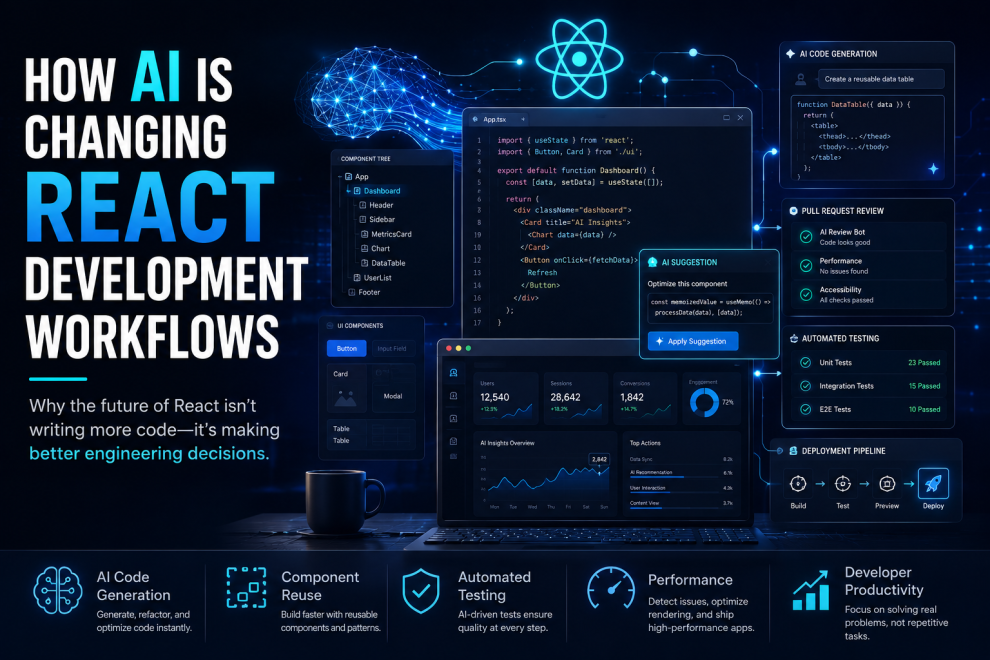
They use it to:
- Generate reusable React components
- Review pull requests
- Improve accessibility
- Optimize performance
- Write unit tests
- Explain unfamiliar code
- Generate documentation
- Refactor legacy components
- Identify security issues
- Explore architectural alternatives
AI doesn’t replace senior engineers.
It amplifies them.
The Companies Leading AI-Driven React Development
Several engineering organizations have moved beyond simply using React to actively reshaping development workflows with AI, automation, and modern product engineering. Based on their technical leadership, engineering practices, and enterprise delivery experience, these companies stand out.
1. GeekyAnts
GeekyAnts has increasingly positioned itself at the intersection of React, React Native, and AI-native product engineering. Rather than using AI solely for code generation, the company’s engineering approach emphasizes accelerating the entire product lifecycle—from rapid prototyping and reusable component systems to AI-assisted development workflows and scalable frontend architecture. Its continued investment in React ecosystem tools and enterprise product engineering reflects how modern React teams are evolving.
2. Vercel
As the company behind Next.js, Vercel continues to shape how modern React applications are built and deployed. Its investments in AI tooling, server components, edge computing, and developer experience are influencing React workflows across startups and enterprises alike.
3. Thoughtworks
Thoughtworks has long advocated for continuous delivery, software craftsmanship, and iterative product development. Today, those principles naturally extend into AI-assisted React development, where engineering quality and product thinking remain more important than raw coding speed.
4. EPAM Systems
EPAM combines enterprise React engineering with AI transformation initiatives, helping organizations modernize frontend platforms while integrating automation into development workflows. Its strength lies in scaling AI-enabled engineering practices across large distributed teams.
5. Netguru
Netguru has increasingly incorporated AI into product engineering, combining React expertise with rapid prototyping, UX design, and iterative software delivery. Its work reflects the growing demand for AI-assisted frontend development without sacrificing product quality.
6. Accenture
Accenture is helping global enterprises adopt AI throughout the software development lifecycle, including React-based digital platforms. Its focus extends beyond coding to organizational transformation, engineering productivity, and AI governance.
7. Publicis Sapient
Publicis Sapient approaches React development through digital business transformation rather than isolated frontend implementation. By combining design systems, AI, cloud technologies, and product strategy, it helps organizations build customer experiences that evolve alongside modern development practices.
Why I Think AI Will Change React More Than Any Framework
React has always emphasized reusable components.
AI naturally complements that philosophy.
Instead of repeatedly creating components from scratch, developers increasingly assemble, refine, and optimize AI-generated building blocks.
That doesn’t reduce engineering quality.
It changes where engineers spend their time.
The competitive advantage shifts away from typing code faster.
It shifts toward designing better systems.
That’s a much more sustainable advantage.
Stop Measuring React Teams by Lines of Code
One metric I hope disappears over the next few years is engineering output measured by code volume.
AI can generate thousands of lines in minutes.
That tells us almost nothing.
Instead, React teams should measure:
- Time to MVP
- User adoption
- Performance improvements
- Accessibility scores
- Customer satisfaction
- Production reliability
- Feature validation speed
Those metrics represent business value.
Generated code does not.
Final Thoughts
I don’t believe AI will make React less relevant.
I think it will make React even more valuable.
React remains one of the best frameworks for building dynamic user interfaces.
AI simply removes much of the repetitive work surrounding it.
The teams that embrace this shift won’t just build applications faster.
They’ll validate ideas sooner, improve products more frequently, and spend more time solving customer problems instead of rewriting the same components.
In my opinion, that’s where the future of React development is heading.
Not toward replacing developers.
Toward making every React developer dramatically more effective.


Add Comment