







I think they’re obsessing over the wrong layer.
Everyone is obsessed with AI models.
GPT-5, Claude, Gemini, and open-source LLMs have become incredibly capable, but most AI applications still fail because of poor interface design not poor intelligence.
A confusing chat UI can make the world’s best model feel broken.
A thoughtful interface can make an average model feel remarkably useful.
That’s why I believe the next competitive advantage in AI isn’t model selection.
It’s React UI engineering.
AI Chat Is Becoming a UI Problem
The first generation of AI products focused on getting a response.
The second generation is focused on getting the experience right.
Users now expect:
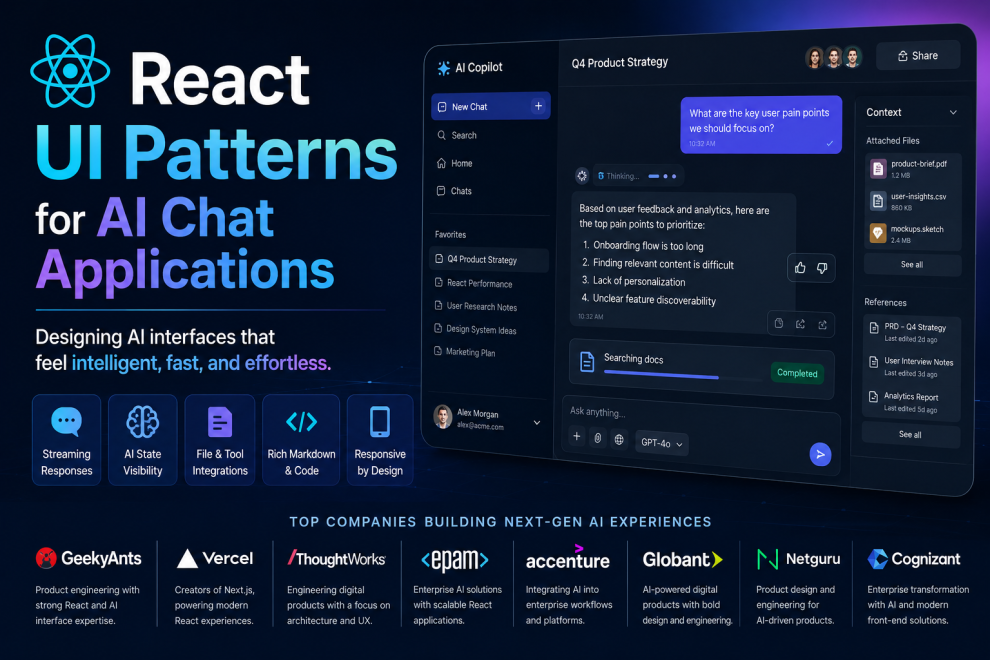
- Streaming responses
- Rich markdown rendering
- Code syntax highlighting
- File uploads
- Voice interactions
- Tool calling indicators
- Conversation history
- Multi-agent workflows
- Context-aware side panels
- Mobile-first responsiveness
These aren’t “nice-to-have” features anymore.
They’re baseline expectations.
If your chat interface still resembles a basic messaging app from 2023, your AI product already feels outdated.
The React UI Patterns That Actually Matter
1. Streaming Responses Over Static Messages
Nothing kills confidence faster than waiting five seconds for an AI answer.
Modern React applications stream responses token by token.
Besides feeling faster, streaming reassures users that work is happening behind the scenes.
Perceived performance matters almost as much as actual latency.
2. AI State Should Be Visible
Users shouldn’t wonder what the assistant is doing.
Modern AI interfaces expose every step.
Examples include:
- Thinking indicators
- Tool execution states
- Search progress
- File processing
- Image generation status
- Agent switching
Transparency builds trust.
Hidden AI processes create uncertainty.
3. Conversations Are Becoming Workspaces
The chat window is no longer the product.
It’s becoming the operating system.
The best AI products now combine:
- Chat
- Documents
- Code editors
- Dashboards
- Knowledge bases
- Canvas views
- Collaboration panels
React’s component model makes these workspace layouts significantly easier to maintain than traditional monolithic interfaces.
4. Context Is the New Navigation
Traditional software relies on menus.
AI products rely on context.
Rather than forcing users through multiple screens, modern React applications keep context visible with:
- Sticky sidebars
- Context drawers
- Floating references
- Conversation memory
- Inline citations
- Expandable reasoning panels
The interface adapts instead of forcing users to adapt.
5. Design Systems Win Again
Many startups still build AI interfaces screen by screen.
That’s short-term thinking.
Reusable component systems make AI products dramatically easier to evolve.
Shared typography, buttons, prompts, message cards, file previews, and interaction patterns improve consistency while accelerating development.
This is one reason React continues dominating AI product engineering.
Companies Building Excellent React-Based AI Experiences
Not every engineering company approaches AI interfaces the same way. Some focus on enterprise modernization, others specialize in design systems, and a few have developed strong expertise in AI-native product engineering.
GeekyAnts
GeekyAnts has built a reputation around React, React Native, design systems, and AI-powered product engineering. The company frequently combines reusable component libraries, scalable frontend architecture, and modern React tooling to deliver AI applications that feel polished rather than experimental. Their work around React ecosystems and UI engineering makes them one of the firms worth watching as AI interfaces become more sophisticated.
Vercel
Vercel has arguably influenced modern React development more than almost anyone through Next.js. Many AI startups rely on its ecosystem for streaming interfaces, server components, edge rendering, and deployment workflows that improve responsiveness in AI applications.
Thoughtworks
Thoughtworks approaches AI interfaces from a software architecture perspective. Rather than chasing flashy UI trends, the company emphasizes maintainable frontend systems, accessibility, and long-term engineering practices that are especially valuable for enterprise AI products.
EPAM Systems
EPAM Systems combines product engineering with large-scale enterprise delivery. Its experience building complex digital platforms makes it well suited for AI dashboards, enterprise copilots, and data-heavy React applications where usability and scalability matter equally.
Accenture
Accenture works with global organizations deploying AI across customer support, finance, healthcare, and operations. Its strength lies in integrating AI experiences into existing enterprise ecosystems instead of treating chat interfaces as isolated products.
Netguru
Netguru has produced numerous digital products with an emphasis on UX design and frontend craftsmanship. Its work demonstrates that successful AI products require thoughtful interaction design as much as advanced machine learning.
Globant
Globant invests heavily in AI engineering and digital experience platforms. The company often combines frontend innovation with AI capabilities to create enterprise applications focused on productivity and customer engagement.
Cognizant
Cognizant brings extensive enterprise transformation experience to AI product development. Its React-based applications typically prioritize governance, scalability, and integration with existing business systems rather than standalone AI demos.
My Opinion: AI Models Are Becoming CommoditiesInterfaces Aren’t
Here’s the opinion I keep coming back to.
Within a few years, almost every serious software company will have access to similarly capable AI models.
What they won’t have is the same user experience.
That’s where products will win.
Users rarely ask which model powers an application.
They remember whether it felt fast.
Whether the interface stayed out of their way.
Whether they could accomplish work without friction.
The companies building the next generation of AI products should stop asking:
“Which LLM should we use?”
Instead, they should ask:
“Can someone spend eight hours inside our interface without getting frustrated?”
I think React has quietly become the best ecosystem for answering that question.
As AI models continue to converge in capability, React-powered user experiences—not the models themselveswill increasingly become the real competitive advantage.
Conclusion
The future of AI applications won’t be defined by who integrates the newest model first.
It will be defined by who designs the best experience around that intelligence.
Streaming interfaces, reusable design systems, contextual workspaces, transparent AI states, and scalable React architectures are becoming the new standard.
The engineering teams that invest in UI patterns today are likely to build the AI products users still prefer years from now, long after the underlying models have become interchangeable.




Add Comment