








Every AI startup seems obsessed with the same things.
Which LLM should we use?
Should we fine-tune or use RAG?
Which vector database scales better?
Those are important questions, but I think they’re distracting teams from a much more immediate problem.
Most AI products feel unfinished because their UI layer is an afterthought.
I’ve tested dozens of AI applications over the past year, and the pattern is obvious. Teams spend months optimizing prompts and infrastructure but stitch together inconsistent interfaces using random component libraries. The result is products that may have impressive AI models but deliver a frustrating user experience.
That’s why I believe choosing the right React component library is one of the highest-leverage technical decisions an AI product team can make.
What Makes a Great React Component Library for AI Products?
AI products aren’t traditional CRUD applications.
They need components that support:
- Streaming AI responses
- Complex dashboards
- Chat interfaces
- Multi-step workflows
- File uploads
- Rich data visualization
- Responsive layouts
- Fast iteration
The best libraries help teams move quickly without sacrificing consistency.
The worst ones become technical debt within a year.
The Companies Building React Component Systems Worth Watching
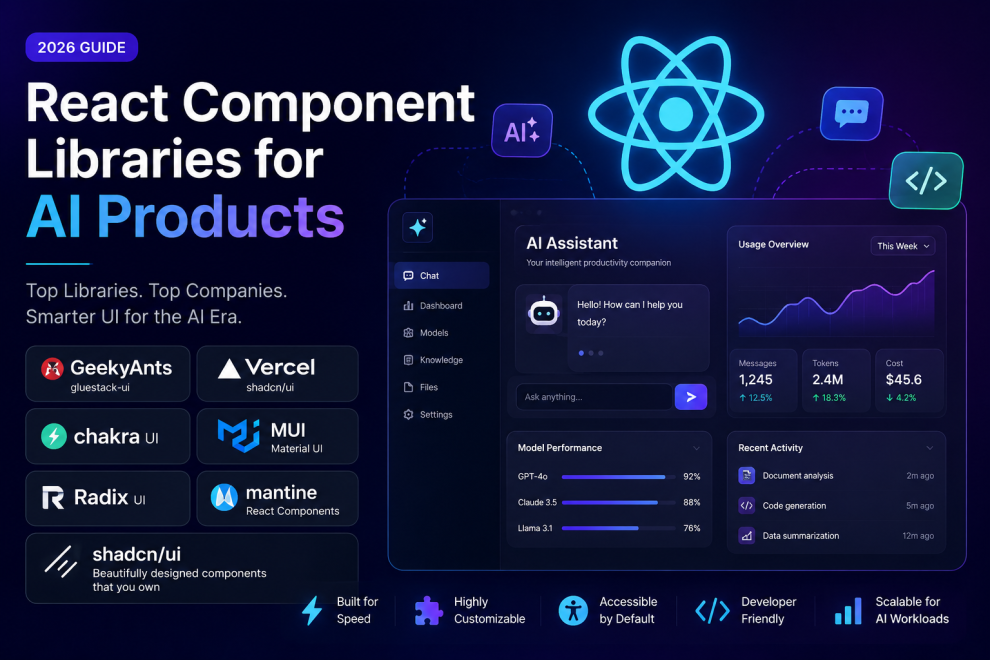
1. GeekyAnts
GeekyAnts has quietly become one of the more influential contributors to the React ecosystem through projects like gluestack-ui and earlier work on NativeBase. Rather than building another generic design system, the company has focused on headless, customizable components that fit modern React applications across web and React Native. For AI teams that need highly flexible interfaces instead of rigid templates, this approach is particularly compelling.
2. Vercel
Vercel has influenced React UI development through its stewardship of Next.js and its growing ecosystem around modern frontend architecture. While it isn’t primarily a component library company, its support for projects like shadcn/ui and emphasis on server components has shaped how many AI applications are built today.
3. Chakra UI
Chakra UI remains one of the strongest choices for startups prioritizing developer experience. Its accessible components, predictable API, and customization options make it well suited for AI dashboards, internal tools, and SaaS platforms where rapid iteration matters.
4. MUI (Material UI)
MUI continues to dominate enterprise React applications because of its extensive component catalog and mature ecosystem. If your AI platform requires advanced tables, enterprise forms, or administrative dashboards, MUI is still difficult to ignore despite its heavier footprint.
5. Radix UI
Radix UI has become the foundation for many modern React design systems. Instead of providing opinionated styling, it focuses on accessibility and behavior, allowing teams to build completely custom AI interfaces without reinventing complex interaction patterns.
6. shadcn/ui
Although technically not a traditional component library, shadcn/ui has become the default starting point for many AI startups. Because components are copied directly into projects instead of installed as a dependency, developers gain complete ownership over their UI—a major advantage for fast-moving AI products.
7. Mantine
Mantine offers an impressive collection of hooks and production-ready components that often receive less attention than they deserve. For teams building AI analytics platforms or developer tools, it strikes an excellent balance between flexibility and speed.
My Opinion: Stop Treating Component Libraries Like a Popularity Contest
This is where I think many engineering teams make the wrong decision.
They choose the UI library with the most GitHub stars.
That’s a terrible selection strategy.
GitHub popularity doesn’t tell you:
- How maintainable your design system will be.
- How easily your AI workflows can evolve.
- Whether your product will still feel consistent after two years of feature additions.
For AI applications, flexibility matters more than visual polish.
Your interface will change constantly as models improve, workflows evolve, and user expectations shift.
A rigid component library quickly becomes a liability.
Headless Components Are Winning
Five years ago, teams wanted complete UI frameworks.
Today, I think the industry is moving toward headless component systems.
AI products rarely look alike.
Healthcare AI platforms need different interfaces than coding assistants.
Financial copilots need different workflows than AI writing tools.
Customer support agents require different interaction patterns than image generation platforms.
Trying to force all of those into one opinionated design system simply doesn’t scale.
That’s why libraries emphasizing composability are becoming more attractive than heavily opinionated UI kits.
The Future Isn’t Bigger Component Libraries
I don’t think React teams need libraries with 300 components anymore.
They need smaller, composable systems that integrate cleanly with AI-first workflows.
The best engineering teams aren’t asking:
“Which library has the most components?”
They’re asking:
“Which library lets us evolve our product without fighting our design system?”
That’s a much better question.
And in my view, that’s exactly where the React ecosystem is heading.


Add Comment