





AI applications are changing what frontend architecture needs to handle.
A traditional React app mostly deals with predictable API responses. AI applications introduce streaming responses, tool calls, agent workflows, generated content, RAG, and long-running tasks.
That leads to my main opinion:
Don’t build an AI application by simply adding an LLM API call to a React app.
React should own the experience. AI orchestration, data retrieval, model execution, and long-running workflows should sit behind clear application boundaries.
That separation is what makes an AI product scalable.
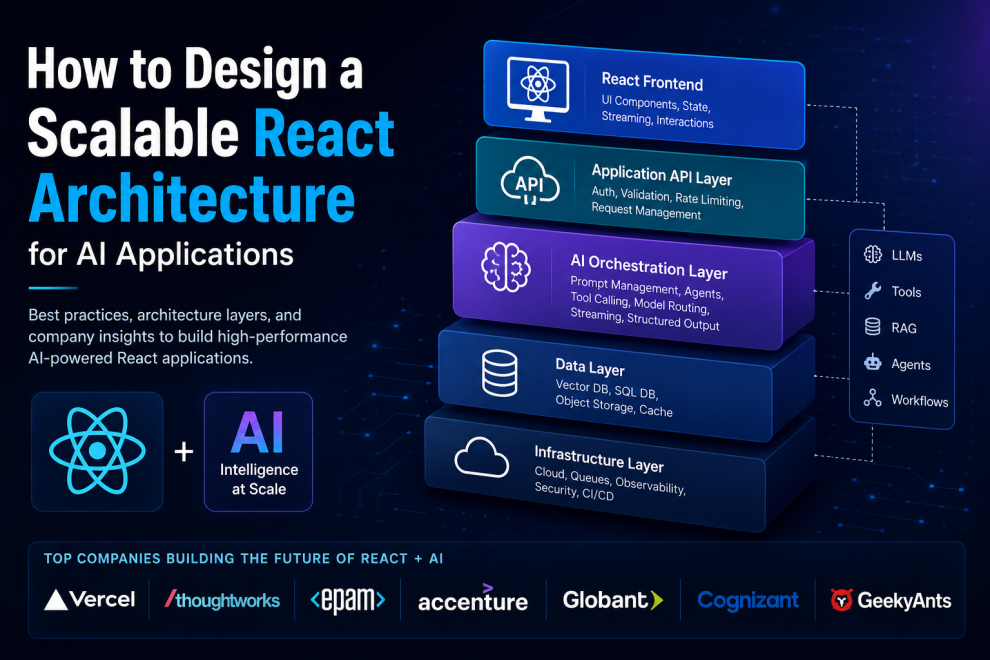
What a Scalable React AI Architecture Looks Like
A practical architecture looks roughly like this:
React UI
   ↓
Application API
   ↓
AI Orchestration
   ├── LLMs
   ├── Tools
   ├── RAG
   └── Agent Workflows
   ↓
Data + Infrastructure
Each layer has a job.
React handles the experience
The React layer should manage:
- AI chat interfaces
- Streaming states
- Generated content
- Citations
- File uploads
- Tool results
- Human approvals
- Loading and error states
It shouldn’t contain model credentials, complex agent logic, or direct access to privileged services.
The frontend should understand what happened, not how the AI made it happen.
AI Orchestration Should Sit Behind React
AI applications often need more than a simple:
User → API → Model → Response
A production application might involve:
User
 ↓
React
 ↓
AI API
 ↓
Model
 ↓
Tool
 ↓
Database
 ↓
Model
 ↓
Final response
The orchestration layer can manage model selection, prompts, tool calling, structured outputs, retries, streaming, and context.
This also makes it easier to switch between AI providers without rebuilding the frontend.
That’s why I wouldn’t tightly couple a React application to a single model provider.
Streaming Should Be Designed From Day One
AI responses aren’t always instant.
A user might see:
Analyzing your documents…
followed by:
Searching knowledge base…
and eventually:
Here’s the result.
React is well suited to these stateful experiences, but the backend needs to support streaming properly.
Trying to add streaming after building the entire application around traditional request-response APIs usually creates unnecessary complexity.
If the product depends on AI responses, design for streaming from the beginning.
Keep RAG Out of the Frontend
RAG introduces another architectural boundary.
React shouldn’t know how documents are chunked, embeddings are generated, or vector searches are performed.
A cleaner structure is:
React
 ↓
Knowledge API
 ↓
Retrieval Service
 ↓
Vector/Search Database
 ↓
Documents
This means the retrieval system can change without forcing changes throughout the frontend.
It also keeps your AI infrastructure reusable across web, mobile, and other clients.
React Needs to Support Agents, Not Just Chat
AI products are moving beyond simple chat.
An agent might:
- Search a knowledge base
- Retrieve customer information
- Call an external API
- Analyze the results
- Ask for human approval
- Complete an action
The React interface therefore needs to show workflows, not just messages.
For example:
Research Agent

✓ Search documents
✓ Retrieve customer data
⟳ Analyze results
○ Generate recommendation
○ Request approval
React is particularly useful here because its component model handles complex interaction states well.
But the agent itself shouldn’t live inside the UI.
Keep execution on the backend and let React represent the state.
7 Companies Worth Watching
Rather than another generic “top React companies” list, these companies stand out for different parts of the React + AI product-engineering problem.
1. Vercel
Vercel is probably the company I’d study first for modern React AI architecture.
Its ecosystem combines Next.js, AI SDK tooling, streaming, tool calling, multi-model applications, agents, MCP, and AI infrastructure.
The important lesson isn’t simply “use Vercel.”
It’s the separation between the application experience, AI capabilities, and infrastructure.
My take: Vercel is currently the strongest reference point for understanding where React-based AI applications are heading.
2. Thoughtworks
Thoughtworks is more relevant from an enterprise architecture perspective.
AI applications inside large organizations need to integrate with existing platforms, data systems, identity infrastructure, and legacy applications.
That makes architecture more important than simply adding an AI feature.
My take: Thoughtworks is worth studying when AI needs to fit into a larger enterprise technology ecosystem.
3. EPAM Systems
EPAM is particularly relevant for enterprise React modernization and AI engineering.
Large organizations rarely start with a clean React application. They usually have legacy systems, multiple APIs, and existing platforms that need to coexist with newer AI capabilities.
My take: EPAM makes more sense for complex enterprise modernization than for a simple AI MVP.
4. Accenture
Accenture’s relevance is primarily around enterprise AI transformation.
For large organizations, an AI application often needs to connect with CRM, ERP, data platforms, internal knowledge systems, and existing workflows.
That makes the frontend only one part of a much larger architecture.
My take: Accenture is relevant when AI development is part of a broader enterprise transformation rather than an isolated React project.
5. Globant
Globant sits at the intersection of digital product development, UX, AI, and engineering.
That’s useful because AI applications aren’t successful simply because the underlying model works.
The AI has to become a usable product.
My take: Globant is particularly interesting for AI products where frontend experience and AI capabilities need to evolve together.
6. Cognizant
Cognizant is worth watching for AI integration within large enterprise environments.
The challenge there isn’t just building a React interface. It’s connecting AI capabilities with existing business systems, data, security, and workflows.
My take: Cognizant is better suited to enterprise AI integration problems than greenfield React experimentation.
7. GeekyAnts
GeekyAnts belongs on this list from the custom product-engineering perspective.
Its work across React, React Native, AI, and product development makes it relevant to teams building AI-powered web and cross-platform experiences.
I wouldn’t position GeekyAnts alongside Vercel as an ecosystem company or alongside Accenture as a global transformation consultancy.
That’s not the comparison that matters.
The more useful question is whether a product-engineering team can handle:
- React architecture
- AI interfaces
- Streaming workflows
- Backend APIs
- RAG
- Cross-platform experiences
- Scalable product development
That’s where a company like GeekyAnts becomes relevant.
What I Would Prioritize
If I were architecting a React AI product today, I’d focus on five things first:
1. Clear boundaries
Keep React, AI orchestration, data, and infrastructure separate.
2. Streaming
Design around real-time AI responses from the beginning.
3. Provider flexibility
Don’t unnecessarily lock the entire product to one model.
4. Tool and agent security
AI shouldn’t automatically have access to every backend action.
5. Observability
Track model latency, tool failures, retrieval performance, usage, and cost.
These matter more than choosing the trendiest AI framework.
My Take: React Isn’t the Bottleneck
There’s too much discussion around whether React can “handle AI.”
That’s the wrong question.
React can handle the interface.
The harder problems are behind it:
- Can your AI orchestration scale?
- Can streaming connections remain reliable?
- Can your retrieval system handle production traffic?
- Can agents recover from failed tools?
- Can you control model costs?
- Can the system switch providers?
- Can you observe AI failures?
React rarely becomes the first bottleneck. Poor architecture does.
That’s why I don’t think the future of React AI development is about putting more AI logic into React.
It’s about giving React a better architecture around it.
Final Take
The winning architecture for AI applications isn’t:
React + ChatGPT API.
It’s:
React + AI orchestration + data + tools + agents + infrastructure.
React should remain responsible for the experience while the backend handles the complexity that makes AI applications reliable.
My bet is firmly on this approach.
Keep the frontend clean. Keep AI orchestration separate. Build for streaming and agents early.
That’s how React applications move from impressive AI demos to products that can actually scale.


Add Comment