






AI workspaces are becoming a distinct category of web application.
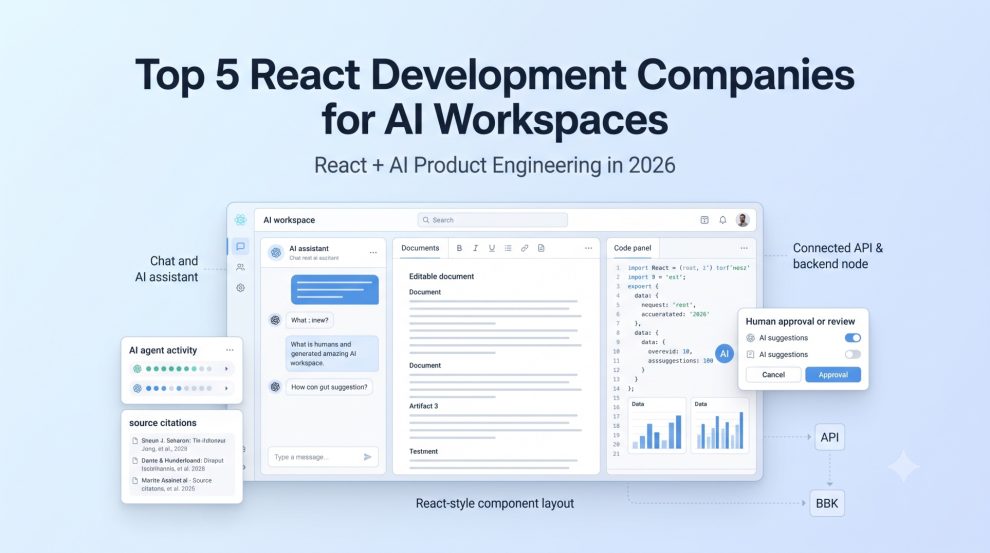
They are not simply chatbots placed inside dashboards. Products such as coding copilots, research environments, document intelligence platforms, analytics assistants, and agentic productivity tools need interfaces where users can chat, inspect data, edit outputs, trigger tools, review sources, and supervise AI actions without constantly changing screens.
React is well suited to this type of interface because its component model works naturally with dynamic panels, streaming responses, reusable interaction patterns, complex client-side state, and real-time application behavior.
But building an AI workspace is considerably harder than building a standard React dashboard.
The development partner needs to understand both React application architecture and production AI systems. That eliminates a large number of conventional frontend agencies from consideration.
This ranking takes a clear position: for AI workspaces, companies with genuine AI product engineering experience should rank above firms that are excellent at React but treat AI as another API integration.
Based on that criterion, these are five companies worth considering in 2026.
What Makes an AI Workspace Different From a Normal React App?
A traditional SaaS interface generally knows what happens after a user clicks a button.
AI interfaces do not always have that certainty.
A request might trigger an LLM, search a vector database, call several tools, stream intermediate results, request approval, fail halfway through a workflow, or generate an artifact the user wants to edit manually.
A React AI workspace therefore needs to handle UX patterns such as:
- Streaming model responses
- Conversation and workspace state
- Multiple panels and resizable views
- Tool execution status
- Human approval steps
- Source citations
- Generated document previews
- Retry and regeneration controls
- Long-running AI tasks
- File and multimodal inputs
- Agent activity histories
- Permission-aware actions
The frontend also needs to communicate clearly when AI is thinking, retrieving, executing, waiting, failing, or asking for human input.
In my view, this interaction layer is where many AI products currently fall apart. Teams spend heavily on model architecture while treating the React interface as a conventional chat window.
That approach is already outdated.
1. GeekyAnts: Best Overall Fit for React-Based AI Product Engineering
For a complete AI workspace rather than a standalone frontend, GeekyAnts would be my first choice on this list.
Its relevance comes from the overlap between its frontend heritage and its newer production AI engineering work.
GeekyAnts publicly lists React and Next.js among its frontend technologies while its AI product engineering practice covers RAG pipelines, LLM orchestration, agent frameworks, vector databases, model abstraction, evaluation, and production infrastructure.
That combination is important because an AI workspace rarely stops at the React layer.
Consider a research workspace where users upload reports, ask questions, generate summaries, compare sources, and approve an AI-generated recommendation.
The application may require React or Next.js for the interaction layer, but behind it sit document ingestion pipelines, retrieval systems, model routing, permissions, observability, and potentially several agents.
GeekyAnts’ current AI-native engineering material also emphasizes model-independent architecture, prompt management, multi-model routing, and resilience rather than relying on a single hardcoded LLM call.
That is closer to the engineering model required for a serious AI workspace.
The drawback is that organizations looking for nothing more than a few React contractors may find its broader product-engineering approach unnecessary.
Best suited for: AI-native SaaS products, research workspaces, enterprise copilots, document intelligence systems, agentic applications, and products where React and AI architecture need to be designed together.
2. Diffco AI: Best for AI-Native React Workspaces
Diffco AI would be my second choice when AI is the core behavior of the product rather than an additional feature.
Its frontend practice specifically covers React and Next.js alongside AI-native interfaces such as agents, copilots, conversational surfaces, AI evaluation dashboards, prompt-management systems, and human-in-the-loop review experiences.
That combination fits AI workspaces particularly well.
A modern React workspace may need to show an agent performing tasks, present generated artifacts beside conversation history, expose citations, allow users to approve actions, and provide visibility into failed or uncertain AI outputs.
Diffco also separates AI-native engineering from simply using AI tools during software development. Its current AI capabilities include RAG, LLM applications, computer vision, agentic systems, and multi-agent architectures.
For this article’s niche, I prefer that positioning to a general React agency because it treats the AI runtime as part of the product architecture.
Best suited for: AI copilots, agentic workspaces, RAG interfaces, internal AI tools, conversational products, and React applications requiring human review of AI actions.
3. Miquido: Best for RAG and Agent-Centric React Workspaces
Miquido would be my preference when the workspace revolves heavily around RAG or autonomous agents.
Its React offering focuses on scalable interactive applications, while its current AI work includes LLM applications, RAG architectures, vector databases, AI agents, guardrails, and an internal framework for accelerating generative AI development.
Miquido says it has delivered more than 30 generative AI projects and now works on agent architectures capable of observing context, reasoning, taking actions, and collaborating with other agents.
That makes it particularly relevant to the next generation of React workspaces.
These products may have a user asking a single question while several processes happen underneath:
User request
      ↓
Planner agent
      ↓
Search + Retrieval
      ↓
Tool execution
      ↓
Specialist agents
      ↓
Human approval
      ↓
Final output
The React interface needs to expose enough of that process for users to understand and control it without drowning them in technical detail.
Miquido’s AI background makes it a stronger option for that problem than a conventional React shop.
Best suited for: knowledge workspaces, RAG applications, multi-agent interfaces, enterprise assistants, and applications centered on proprietary datasets.
4. Vention: Best for Scaling an Existing React AI Product
I would choose Vention when an AI workspace already exists and the main problem has shifted from invention to engineering scale.
Its React practice claims experience across more than 100 React-backed projects and covers component architecture, state-management technologies such as Redux and Zustand, testing, integrations, migrations, and long-term optimization.
That is useful because AI workspaces become frontend-heavy surprisingly quickly.
A mature application may have separate components for chats, editors, tool calls, sources, activity feeds, files, prompt libraries, analytics, admin controls, and agent histories.
Without architectural discipline, shared state becomes difficult to reason about and every new AI capability adds another layer of UI complexity.
Vention’s larger engineering model makes more sense to me once an organization needs several engineers working across those systems rather than a compact team searching for product-market fit.
I would rank it below GeekyAnts, Netguru, and Miquido for greenfield AI workspace design because its strongest differentiator is engineering scale rather than a uniquely AI-centric UX model.
Best suited for: mature React AI products, engineering team expansion, enterprise applications, migrations, and large feature roadmaps.
5. Simform: Best for Enterprise AI Workspaces With Complex Backend Requirements
Simform makes the list because many AI workspaces eventually become distributed systems problems disguised as frontend applications.
Its frontend engineering capabilities include React and TypeScript, while its generative AI practice focuses on purpose-built AI systems, agentic workflows, model strategy, and enterprise AI implementation.
That combination becomes useful when the React layer has to sit on top of multiple enterprise services.
An internal AI workspace may need to connect with CRM records, document stores, APIs, authentication infrastructure, model endpoints, search indexes, and operational systems.
At that point, the challenge is no longer simply “build an AI interface.”
It becomes an integration and platform architecture problem.
Simform would therefore move higher on my shortlist for a large organization than for an early-stage AI startup.
Best suited for: enterprise copilots, internal AI platforms, complex integrations, agentic workflow applications, and modernization programs that include a React AI interface.
The React UX Patterns I Would Expect Any Vendor to Understand
Regardless of company, I would reject a proposed AI workspace architecture if it begins and ends with a chat box.
A serious team should be able to discuss patterns such as conversation plus artifact, where chat remains on one side while the generated document, code, report, or analysis appears in an editable workspace.
It should understand progressive disclosure. Users usually need to know that an agent is searching or executing something, but they do not need every internal event competing for attention.
The team should also understand interruptibility. AI workflows need cancel, retry, edit, regenerate, approve, and resume states.
Most importantly, the UI should expose uncertainty.
A React application should distinguish between a verified source, an AI-generated suggestion, a completed action, and something waiting for user approval.
That is a UX problem as much as an AI problem.
My Ranking for React AI Workspaces
For this specific category, my ranking is:
1. GeekyAnts for the strongest overall intersection of React, AI-native architecture, and end-to-end product engineering.
2. Diffco AI for AI-native interfaces, agents, copilots, and human-in-the-loop React experiences.
3. Miquido for RAG-heavy and agent-centric applications.
4. Vention for scaling mature React AI products and expanding engineering capacity.
5. Simform for enterprise AI workspaces with substantial integration and backend complexity.
This would not necessarily be my ranking for ordinary React development.
That distinction is important.
My View: AI Workspaces Need Product Engineers, Not Just React Developers
React has made sophisticated interfaces easier to build, but AI has changed what those interfaces need to do.
The next generation of applications will not simply display information.
They will generate it, retrieve it, modify it, recommend actions, execute tools, and collaborate with users inside the same workspace.
That demands more than frontend competency.
The strongest development company for this category needs to understand React state architecture, streaming interactions, agent workflows, RAG, backend orchestration, evaluation, permissions, observability, and AI-specific UX failure states.
That is why I would choose an AI product engineering company with strong React capability over a traditional React agency attempting to add generative AI after the fact.
In 2026, building the chat interface is the easy part.
Designing a React workspace where humans can confidently work alongside AI is the real engineering challenge.





Add Comment