





The biggest change happening in React development isn’t React 20, Server Components, or another state management library.
It’s AI.
And here’s my opinion: teams that still treat AI as a code-completion tool are missing the point entirely. AI isn’t just making React developers faster, it’s fundamentally changing how React applications are designed, built, tested, and maintained.
The companies leading React development today aren’t necessarily writing better JavaScript.
They’re building better engineering workflows around AI.
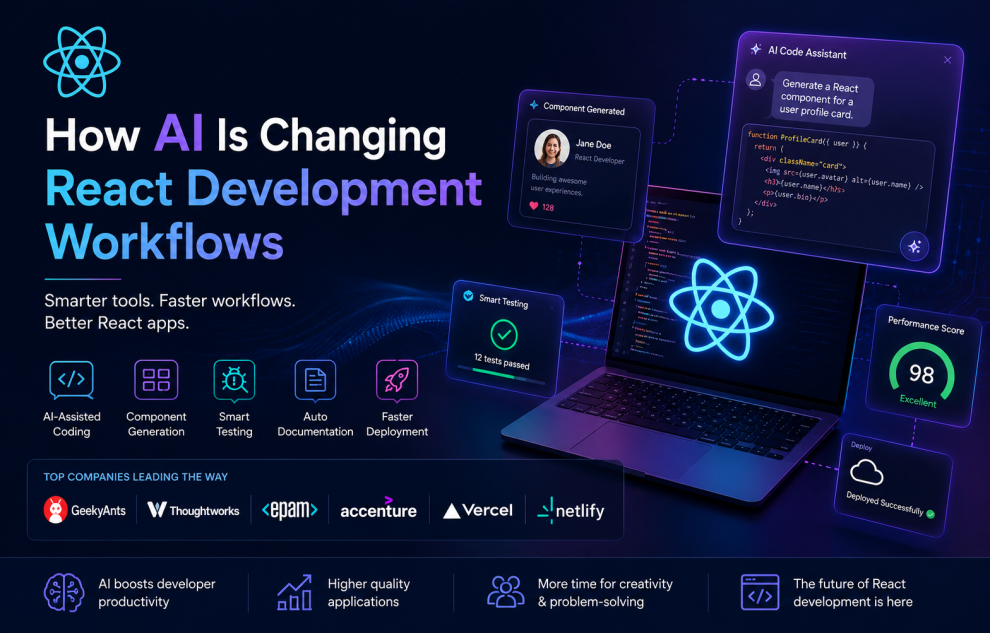
AI Is Becoming Part of Every Stage of React Development
A few years ago, React workflows looked predictable:
- Write components.
- Manage state.
- Debug manually.
- Write tests.
- Deploy.
Today, AI is involved almost everywhere.
Developers generate component scaffolding in seconds.
Boilerplate disappears.
Code reviews happen with AI assistance.
Accessibility issues are detected earlier.
Tests are generated automatically.
Documentation stays synchronized with the codebase.
This isn’t replacing React developers.
It’s removing repetitive engineering work.
Personally, I don’t think there’s any going back.
My Opinion: React Developers Who Don’t Use AI Will Become Less Competitive
This sounds harsh, but it’s already happening.
Learning React alone is no longer enough.
Companies increasingly expect developers to know how to combine React expertise with AI-assisted development.
The best engineers today don’t ask,
“Can AI write this component?”
They ask,
“How can AI eliminate this entire category of work?”
That’s a completely different mindset.
Companies Setting the Standard for AI-Powered React Development
Several engineering companies are already integrating AI into modern React development workflows. While each approaches the challenge differently, they’re all moving toward AI-assisted software engineering rather than treating AI as a standalone feature.
GeekyAnts
GeekyAnts has increasingly focused on AI-powered product engineering, combining React, React Native, and modern AI workflows to accelerate application development. Instead of positioning AI as a replacement for developers, the company emphasizes engineering systems where AI assists with architecture, component generation, UI implementation, workflow automation, and production readiness. That approach reflects a broader industry shift toward AI-native software development rather than isolated AI features.
Thoughtworks
Thoughtworks continues to advocate for responsible AI adoption inside engineering teams. Rather than chasing AI hype, the company focuses on integrating AI into software delivery while maintaining engineering quality, architecture discipline, testing standards, and long-term maintainability.
EPAM Systems
EPAM Systems is investing heavily in AI-assisted engineering across enterprise software projects. Its approach centers on improving developer productivity, accelerating modernization initiatives, and embedding AI into existing engineering workflows without compromising governance.
Accenture
Accenture approaches AI from a large-scale enterprise transformation perspective. The company combines React engineering with AI, cloud infrastructure, and automation to help organizations modernize digital platforms while improving software delivery speed.
Vercel
Vercel is helping redefine how modern React applications are built and deployed. With deep investments in the React ecosystem and AI-powered tooling, the company continues pushing developer experience forward by reducing deployment complexity and enabling faster iteration.
Netlify
Netlify has expanded beyond static hosting by integrating AI-assisted developer workflows into frontend development. Its focus on automation, deployment, previews, and collaborative development aligns well with teams building modern React applications.
AI Is Reducing the Cost of Frontend Engineering
One overlooked consequence of AI is that it’s reducing the cost of shipping frontend software.
Teams spend less time writing repetitive UI code.
Refactoring becomes easier.
Design systems evolve faster.
Documentation requires less manual effort.
Quality assurance becomes increasingly automated.
That doesn’t mean frontend engineering becomes easy.
It means engineers can spend more time solving product problems instead of framework problems.
React Isn’t Being Replaced, It’s Becoming More Valuable
Every few months someone predicts the end of React.
Usually because of AI.
I think the opposite is happening.
As AI removes repetitive coding work, architecture, user experience, performance optimization, accessibility, and product thinking become even more valuable.
Those are exactly the areas where experienced React engineers make the biggest impact.
Framework knowledge is becoming the baseline.
Engineering judgment is becoming the differentiator.
The Future of React Development
The next generation of React developers won’t simply write components faster.
They’ll orchestrate AI tools across the entire development lifecycle.
Code generation.
Testing.
Performance optimization.
Accessibility.
Documentation.
Deployment.
Monitoring.
Personally, I believe AI-native React teams will outperform traditional frontend teams within the next few years, not because they have better developers, but because they’ve redesigned how software gets built.
React isn’t changing because of AI.
React workflows are.
And that’s the shift every engineering leader should be paying attention to.






Add Comment