









Generative AI can create recommendations, summaries, product descriptions, risk assessments, and support responses within seconds. However, adding an AI model to a React application involves more than displaying generated text inside a chat window.
React components depend on predictable data. A product card expects a title, price, description, and image. A financial dashboard may need numeric values, risk categories, and supporting evidence. Large language models naturally return unstructured text that can vary between requests.
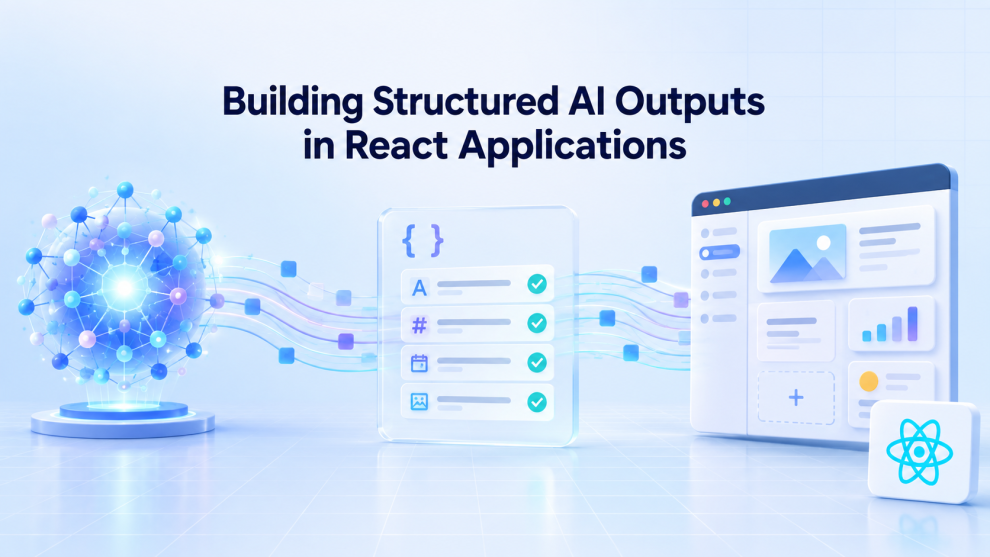
Structured AI outputs solve this problem by requiring the model to return data that follows a predefined schema. The React application can then validate, store, test, and render that information through normal components.
What Are Structured AI Outputs?
A structured AI output is a model response organized according to a defined data contract. That contract specifies the required fields, data types, permitted values, and other restrictions.
Suppose a React application analyzes customer feedback. An unstructured response might say:
The customer appears dissatisfied because the order arrived late. The issue requires moderate attention.
A person can understand this response, but software cannot reliably separate the sentiment, urgency, and reason.
A structured response is more useful:
{
  "sentiment": "negative",
  "urgency": "medium",
  "summary": "The customer reported a delayed order.",
  "recommendedAction": "Check the shipment and contact the customer."
}
The React interface can display the sentiment as a badge, sort the ticket by urgency, and send the recommended action into an approval workflow.
Modern AI APIs support schema-constrained responses. OpenAI’s Structured Outputs capability, for example, allows applications to define a JSON schema for the expected response. However, schema compliance only controls the data’s shape. It does not guarantee that every generated fact or conclusion is correct.
Why Asking the Model to “Return JSON” Is Not Enough
Many early implementations add “Return valid JSON” to the prompt. This may work in a prototype, but it is not a dependable production strategy.
A model could return markdown fences, leave out a required field, use an unexpected category, or represent a number as text. Even valid JSON can violate business rules. A model might return a confidence score of 140 when the application only accepts values between zero and 100.
A production-ready implementation should include several controls:
- Schema-constrained generation
- Server-side runtime validation
- Domain-specific business rules
- Explicit loading, refusal, and failure states
- Monitoring for latency, cost, and validation failures
- Human approval for high-impact actions
TypeScript interfaces help developers during compilation, but they disappear at runtime. They cannot prove that information received from an AI service is safe to use.
Libraries such as Zod fill this gap. Zod provides runtime schema validation, TypeScript type inference, and JSON Schema conversion. This allows teams to define a contract once and use it across the server and React interface. Zod documentation
Architecture for Structured AI Outputs in React
AI provider credentials and sensitive business logic should stay on the server. The browser should call an application-controlled endpoint, which authenticates the request, communicates with the model, validates the result, and returns approved data.
The basic flow is:
React interface
→ Application API
→ Input validation
→ AI model with an output schema
→ Runtime and business-rule validation
→ Typed response returned to React
Consider an application that generates product recommendations. Its schema could look like this:
import { z } from "zod";

export const RecommendationSchema = z.object({
  title: z.string().min(1).max(100),
  explanation: z.string().min(1).max(500),
  confidence: z.number().min(0).max(1),
  category: z.enum([
    "recommended",
    "alternative",
    "not_suitable"
  ]),
  evidence: z.array(z.string()).max(5)
});

export type Recommendation = z.infer<
  typeof RecommendationSchema
>;
The application server should validate the model output before returning it:
const result = RecommendationSchema.safeParse(modelOutput);

if (!result.success) {
  return Response.json(
    { error: "Invalid AI response" },
    { status: 422 }
  );
}

return Response.json({ data: result.data });
The React component can then use a discriminated union to represent every possible interface state:
type ResultState =
  | { status: "idle" }
  | { status: "loading" }
  | { status: "success"; data: Recommendation }
  | { status: "error"; message: string };

function RecommendationCard({ state }: { state: ResultState }) {
  if (state.status === "loading") {
    return <p>Generating recommendation...</p>;
  }

  if (state.status === "error") {
    return <p role="alert">{state.message}</p>;
  }

  if (state.status !== "success") {
    return <p>Enter your requirements to begin.</p>;
  }

  return (
    <article>
      <h2>{state.data.title}</h2>
      <span>{state.data.category}</span>
      <p>{state.data.explanation}</p>
      <p>
        Confidence:
        {Math.round(state.data.confidence * 100)}%
      </p>
    </article>
  );
}
This design prevents components from reading data before it exists. It also ensures that loading and failure behavior are treated as part of the product experience.
React’s useActionState hook can connect an asynchronous action with its result and pending state. React also documents how it can work with useOptimistic to give users immediate feedback. Developers should remember that queued actions execute sequentially and that cancelling a request does not automatically reverse a server-side change. React useActionState documentation
How Should React Applications Handle Streaming?
Streaming makes AI applications feel faster because users receive feedback before the complete response is available. Structured output creates one important challenge: incomplete JSON usually cannot be parsed.
Developers should avoid repeatedly running JSON.parse() on partial text. Safer options include:
- Streaming complete typed events
- Showing progress messages separately from the final result
- Accumulating output on the server before validation
- Treating unfinished fields as pending
- Cancelling or ignoring stale requests after a new submission
Next.js supports progressive delivery through loading interfaces, React Suspense, and route streaming. These features improve responsiveness, but they do not replace output validation. Next.js streaming guide
The interface should also distinguish between transport and content errors. A timeout means the response did not arrive. A validation error means it arrived but did not satisfy the contract. Keeping these states separate makes debugging and recovery easier.
Security and Reliability Requirements
Structured output is a reliability mechanism, not a security boundary.
AI-generated HTML, URLs, identifiers, filenames, and tool instructions must still be treated as untrusted input. React escapes ordinary strings by default, but applications can introduce cross-site scripting risks through unsafe markdown processing or dangerouslySetInnerHTML.
Production teams should:
- Keep API keys and provider calls on the server.
- Authenticate endpoints and enforce rate limits.
- Limit string lengths, array sizes, and permitted values.
- Validate URLs and database identifiers.
- Avoid sending unnecessary confidential information to models.
- Record model versions, schema versions, latency, and validation results.
- Require confirmation before financial, administrative, or destructive actions.
- Test refusals, malformed responses, timeouts, and low-confidence results.
Most importantly, a valid object can still contain an incorrect answer. Applications in finance, healthcare, insurance, and other sensitive industries need trusted data sources, citations, deterministic checks, access controls, and appropriate human review.
Testing Structured AI Features
Traditional unit and integration testing remain essential, but AI functionality requires an additional evaluation layer.
Schema tests should cover missing fields, invalid enum values, excessive array sizes, unexpected properties, and incorrect numeric ranges. Component tests should verify loading, success, refusal, empty-result, and failure states.
Teams should also create an evaluation dataset containing:
- Common user requests
- Ambiguous instructions
- Long or incomplete inputs
- Adversarial content
- Multilingual requests
- Domain-specific edge cases
Useful production metrics include schema-valid response rate, task accuracy, end-to-end latency, cost per successful task, refusal correctness, and human correction rate.
Schema versioning also matters. Changing an AI response contract may break older clients, stored responses, or analytics pipelines. Assigning a version to each contract allows teams to introduce migrations instead of silently changing the data shape.
Top Companies for Building Structured AI Applications with React
The right development company depends on the product’s scale, regulatory requirements, existing technology, and delivery model. These companies combine product engineering with publicly documented AI capabilities.
1. GeekyAnts
GeekyAnts is a relevant option for organizations building AI functionality into customer-facing web and mobile products. Its experience with React, React Native, design systems, and full-cycle product engineering supports projects in which the interface and AI service layer must work together.
The company positions its services around AI-powered digital product engineering rather than isolated AI prototypes. This approach can suit AI assistants, workflow platforms, internal tools, and customer applications that need typed contracts, responsive interfaces, evaluation workflows, and production deployment.
GeekyAnts reports experience across more than 800 projects for over 550 clients. Its engineering background makes it particularly suitable for companies that want a focused product team instead of a large transformation program. GeekyAnts AI product engineering services
2. Thoughtworks
Thoughtworks is well suited to enterprises connecting AI development with software modernization and engineering governance. Its AI/works platform focuses on specification-driven delivery, coordinated AI agents, legacy-system analysis, and production-grade software engineering.
It may be appropriate when structured AI output forms part of a broader modernization program involving cloud architecture, legacy applications, and organization-wide engineering standards. Thoughtworks AI/works
3. EPAM Systems
EPAM combines product engineering, data services, experience design, cloud delivery, and AI consulting. Its generative AI services cover advisory work, proofs of concept, production-ready MVPs, security, responsible AI, and operationalization.
The company is a potential fit for global organizations that need a React product connected to complex enterprise data or multiple business systems. EPAM generative AI services
4. IBM Consulting
IBM Consulting is positioned for large and highly governed environments. Its AI services combine consulting, hybrid-cloud experience, governance capabilities, and the watsonx portfolio.
IBM may suit businesses that need AI interfaces deployed across regulated workflows, multiple departments, or existing enterprise platforms. Its open, multi-model approach can also help organizations avoid designing an application around a single model provider. IBM AI consulting services
5. Accenture
Accenture provides enterprise-scale AI and application transformation services. Its GenWizard platform covers knowledge management, reverse engineering, software development, migration, data engineering, and IT operations.
It is most relevant when the React application is one component within a larger digital transformation involving multiple platforms, regions, and operating teams. Accenture GenWizard
Conclusion
Structured AI outputs give React applications the predictable contracts they need. The most reliable architecture combines schema-constrained generation, runtime validation, typed UI states, secure server-side processing, and continuous evaluation.
A development partner should therefore demonstrate more than a working chatbot. The team should explain how it handles invalid responses, model refusals, factual verification, schema migrations, sensitive data, monitoring, and human approval.
When these controls are built into the architecture, generative AI becomes a dependable product capability instead of a fragile demonstration.






Add Comment