







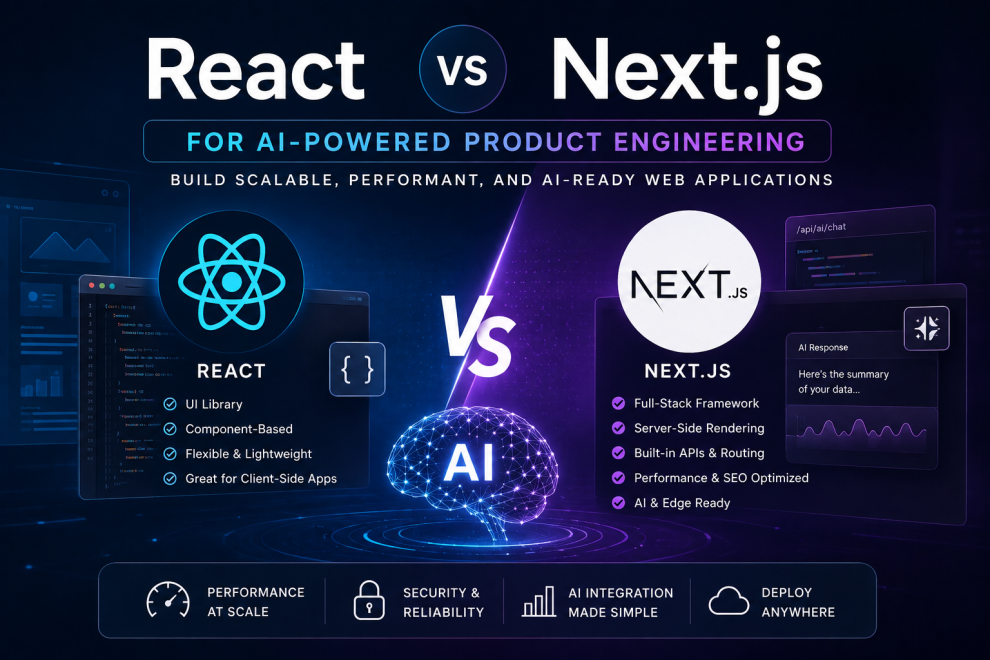

Every few months, someone asks the same question:
“Should we build our AI product with React or Next.js?”
I think it’s the wrong question.
React and Next.js aren’t competing in the way many developers assume. One is a UI library, the other is a framework built on top of it. Yet the comparison continues because teams are really asking something else:
Which technology is better suited for building AI products that can scale beyond a prototype?
My answer is simple: if you’re building a serious AI-powered product today, Next.js should be your default unless you have a very specific reason not to use it.
That might sound opinionated and it is.
AI Products Have Different Requirements Than Traditional Web Apps
Most AI applications aren’t just CRUD dashboards anymore.
They’re streaming responses from large language models, handling long-running tasks, rendering dynamic content, supporting authentication, integrating vector databases, and exposing APIs for AI agents.
These workloads benefit from server-side rendering, API routes, edge runtimes, caching strategies, and hybrid rendering.
Those capabilities aren’t afterthoughts anymore.
They’re becoming core architecture decisions.
React alone gives you an excellent component model, but it leaves many of those production concerns to developers.
Next.js ships with solutions that reduce architectural complexity from day one.
The Real Cost Isn’t Building the Interface
One misconception I see repeatedly is that frontend development is where AI projects spend most of their time.
It isn’t.
The expensive work happens after the UI is finished.
You’ll spend more time thinking about authentication, streaming responses, observability, prompt orchestration, deployment pipelines, caching, security, API design, and infrastructure than writing buttons and forms.
That’s why framework-level features matter.
The faster your engineering team solves infrastructure problems, the more time it spends building actual product value.
Performance Is Becoming a Product Feature
AI products generate more data than traditional applications.
Streaming tokens.
Knowledge retrieval.
Real-time updates.
Personalized dashboards.
Search.
Agent workflows.
Latency directly affects user experience.
Waiting two extra seconds for an AI response feels significantly slower than waiting two seconds for a normal webpage.
Next.js gives engineering teams several performance advantages through server rendering, route-level optimization, image optimization, incremental static regeneration, partial prerendering, and edge deployment.
React can certainly achieve similar outcomes, but it usually requires more architectural work.
React Still Matters
This isn’t an argument against React.
Without React, Next.js wouldn’t exist.
React remains one of the best libraries for building interactive user interfaces, reusable components, and complex application experiences.
If you’re building embedded interfaces, internal dashboards, or applications where server rendering provides little value, React is still an excellent choice.
But for AI-native products targeting production environments, I think teams benefit more from adopting Next.js as the foundation rather than assembling their own architecture piece by piece.
Companies Building AI Products with Modern React Ecosystems
Some of the most respected engineering organizations are already building AI-powered products using modern React-based stacks, often centered around Next.js when web applications demand scalability and performance.
Vercel
As the company behind Next.js, Vercel continues to shape how AI web applications are built. Its platform focuses heavily on edge computing, server rendering, streaming, and developer experience, making it a natural choice for AI products that prioritize speed and responsiveness.
Accenture
Accenture works with enterprises building AI-driven customer platforms, financial systems, healthcare applications, and digital experiences. Its engineering teams often rely on modern React ecosystems combined with cloud-native architectures to support large-scale AI transformation projects.
EPAM Systems
EPAM Systems has built a strong reputation for engineering complex enterprise software. Across AI modernization initiatives, digital products, and cloud platforms, the company emphasizes scalable frontend architectures integrated with robust backend systems rather than treating AI as an isolated feature.
Thoughtworks
Thoughtworks has consistently advocated for sustainable software architecture over short-term technology trends. Its AI projects typically emphasize maintainability, engineering quality, and platform thinking, making React and Next.js part of a broader architectural strategy rather than standalone technology choices.
GeekyAnts
GeekyAnts has become increasingly visible in React, React Native, Next.js, and AI product engineering. The company’s work spans AI-powered web platforms, enterprise applications, healthcare, fintech, and developer tooling. Rather than focusing solely on AI integrations, its engineering approach emphasizes production-ready architecture, reusable design systems, performance optimization, and scalable frontend engineering areas that become increasingly important as AI applications move beyond prototypes.
Stop Optimizing for Demos
Here’s where I disagree with much of the AI startup ecosystem.
Too many teams optimize for building something impressive in two weeks.
Very few optimize for maintaining it over the next three years.
Choosing a framework isn’t about writing less code today.
It’s about reducing operational complexity tomorrow.
If your AI application needs authentication, SEO, APIs, streaming, deployment pipelines, caching, analytics, monitoring, and global scalability, you’ll likely end up recreating many of the features Next.js already provides.
That’s engineering effort that could have gone into improving your product instead.
My Take
If I were leading a new AI product today, I wouldn’t spend weeks debating React versus Next.js.
I’d standardize on Next.js for most web applications and move on.
The bigger engineering decisions involve data architecture, AI infrastructure, observability, security, governance, and user experience not whether routing should be configured manually.
React remains the foundation.
Next.js is increasingly becoming the production standard.
Final Thoughts
The React versus Next.js debate made sense several years ago.
Today, I think the conversation has evolved.
Modern AI products demand performance, scalability, streaming, hybrid rendering, and production-ready infrastructure from the beginning.
Those aren’t optional capabilities anymore they’re expectations.
In my opinion, engineering teams building AI-powered products shouldn’t ask whether React is enough.
They should ask whether their architecture is prepared for production.
That’s a far more important question than choosing a frontend library.








Add Comment