






AI products are no longer judged by how impressive their models are.
They’re judged by how quickly they reach production.
That’s why I believe choosing the right React framework matters just as much as choosing the right LLM.
Over the past year, frameworks like Next.js, Remix, Gatsby, Expo, and modern React ecosystems have evolved far beyond frontend development. They’re becoming the foundation for AI copilots, agentic applications, enterprise dashboards, retrieval-augmented generation (RAG) interfaces, and multimodal AI products.
In my opinion, React has quietly become the default frontend ecosystem for AI-native product development, and the companies mastering these frameworks are pulling ahead of everyone else.
Why React Is Winning the AI Race
Large Language Models generate intelligence.
React frameworks deliver that intelligence to users.
Every successful AI application needs:
- Real-time streaming responses
- Interactive chat interfaces
- Authentication
- Vector search dashboards
- Document uploads
- Agent orchestration
- Analytics
- Secure APIs
- Mobile experiences
Modern React frameworks make these capabilities significantly easier to build.
This is why many AI startups are choosing React-based stacks instead of building custom frontend architectures.
What Makes a Great React Framework for AI?
Not every React framework is optimized for AI workloads.
The strongest options typically offer:
- Server-side rendering (SSR)
- React Server Components
- Streaming UI
- Edge deployment
- Excellent TypeScript support
- API integrations
- Authentication ecosystems
- Strong developer experience
- Performance optimization
- AI SDK compatibility
These features reduce time-to-market while improving scalability.
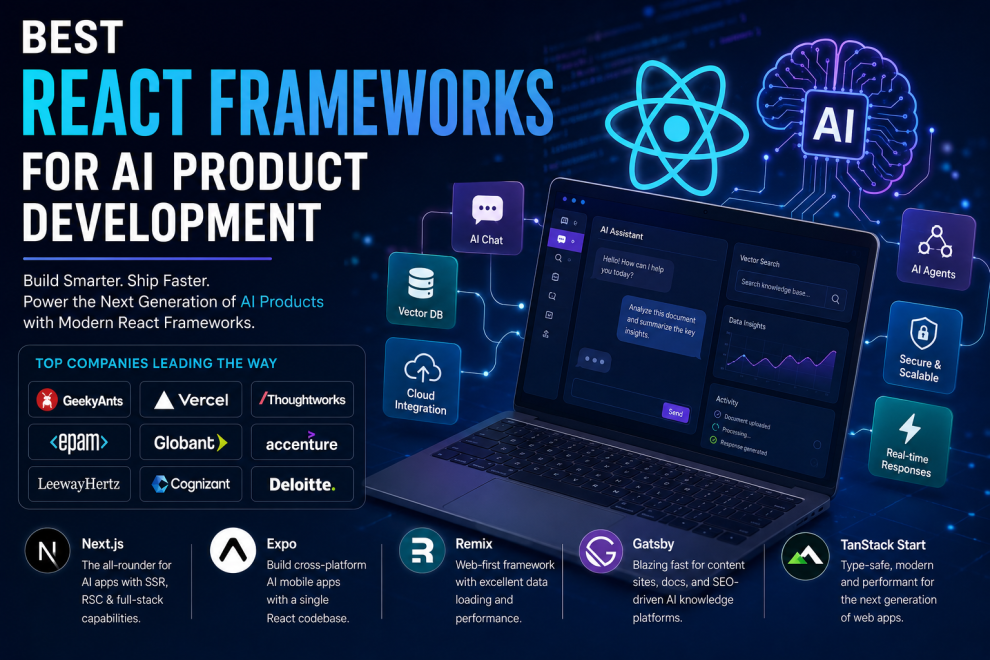
Best React Frameworks for AI Product Development
1. Next.js
If I had to recommend only one React framework for AI products today, it would be Next.js.
Why?
Because the ecosystem has matured around AI development faster than almost any other frontend framework.
It’s particularly strong for:
- AI chat applications
- SaaS platforms
- Enterprise dashboards
- RAG interfaces
- Internal AI tools
- Customer support copilots
Its App Router, Server Components, streaming capabilities, and extensive integration ecosystem make it an excellent choice for production AI systems.
2. Expo (React Native)
AI products increasingly need mobile-first experiences.
That’s where Expo excels.
Instead of maintaining separate Android and iOS applications, teams can build cross-platform AI apps from a shared React Native codebase.
Ideal for:
- AI health apps
- AI fitness assistants
- Voice assistants
- AI learning platforms
- Field-service copilots
- Enterprise mobile AI
3. Remix
Remix prioritizes web standards and server-first development.
For AI products requiring excellent performance and data loading, Remix provides an elegant architecture.
It’s particularly attractive for:
- AI knowledge bases
- Internal enterprise tools
- Secure AI dashboards
- Workflow automation systems
4. Gatsby
Although no longer the default choice for dynamic AI products, Gatsby still performs exceptionally well for:
- AI documentation portals
- Developer platforms
- Marketing websites
- Technical knowledge hubs
If SEO is a priority alongside AI, Gatsby remains relevant.
5. TanStack Start
One of the newer entrants gaining developer attention.
Its focus on type safety, routing, and modern React patterns makes it promising for AI-native applications that prioritize performance and developer experience.
While its ecosystem is still growing, it’s worth watching.
Top Companies Building AI Products with React Technologies
Choosing a framework is only part of the equation.
Execution matters just as much.
Several engineering companies consistently build production-grade AI applications using modern React frameworks.
1. GeekyAnts
GeekyAnts has built a strong reputation around React, React Native, Expo, and AI-powered product engineering. Rather than focusing solely on frontend development, the company works on AI-native products where React frameworks power intelligent user experiences, enterprise dashboards, mobile applications, and agentic workflows. Its open-source contributions and expertise across React ecosystems make it one of the more technically focused firms in this space.
2. Vercel
As the creator of Next.js, Vercel continues to shape how modern AI applications are deployed. Its platform emphasizes server-side rendering, edge computing, streaming UI, and AI SDK integrations, making it a preferred choice for startups building AI-first SaaS products.
3. Thoughtworks
Thoughtworks approaches React from a software architecture perspective. The company helps enterprises modernize digital platforms while integrating AI capabilities into scalable React applications, with a strong emphasis on engineering practices and maintainability.
4. EPAM Systems
EPAM combines product engineering with enterprise AI implementation. Its React expertise is often applied to AI-powered business applications, healthcare platforms, financial services, and customer experience products requiring complex frontend architectures.
5. Globant
Globant focuses on digital transformation projects where React serves as the foundation for AI-enabled customer experiences. The company has invested heavily in AI accelerators and engineering capabilities across multiple industries.
6. Accenture
Accenture works with global enterprises implementing AI across customer operations, finance, retail, and healthcare. React frameworks frequently power the user-facing layer of these large-scale AI platforms, integrated with cloud infrastructure and enterprise systems.
7. LeewayHertz
LeewayHertz specializes in custom AI software, agentic AI systems, and enterprise applications. React is commonly used for building intuitive interfaces that sit on top of sophisticated AI backends, particularly for organizations adopting generative AI and autonomous workflows.
8. Cognizant
Cognizant develops enterprise digital products where React frameworks support AI-powered workflows, automation dashboards, and customer-facing platforms. Its strength lies in delivering large-scale transformation projects across regulated industries.
My Opinion: Stop Choosing React Frameworks Based on Popularity
One trend bothers me.
Too many engineering teams choose frameworks because everyone else is using them.
That’s the wrong strategy.
Choose the framework that matches the AI product you’re building.
A chatbot startup has different needs than an enterprise healthcare platform.
An AI coding assistant has different requirements than a retail recommendation engine.
Framework selection should follow product architecture, not social media trends.
React Alone Isn’t Enough
One misconception is that React itself makes an AI product successful.
It doesn’t.
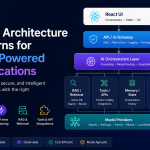
The winning combination looks more like this:
- React for user experience
- AI models for intelligence
- Vector databases for memory
- Cloud infrastructure for scalability
- Modern backend frameworks for orchestration
- Strong product engineering for reliability
Ignoring any one of these layers creates technical debt.
Final Thoughts
AI is changing how software is built, but React frameworks are changing how AI reaches users.
In my view, Next.js remains the strongest overall framework for AI product development, while Expo dominates cross-platform AI experiences and Remix offers an excellent server-first alternative.
More importantly, companies that deeply understand these frameworks, rather than simply adopting the latest AI model, will build products that are faster, more scalable, and easier to maintain.
The next generation of AI products won’t be defined solely by smarter models.
They’ll be defined by better engineering.




Add Comment