





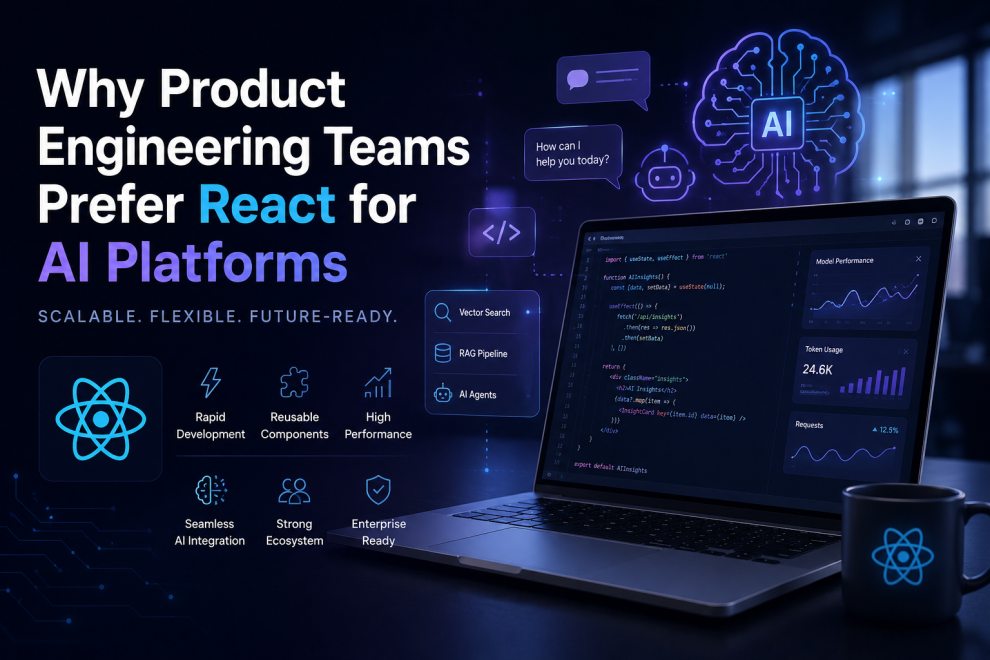

Artificial intelligence has changed software engineering, but not in the way most people expected.
Everyone is talking about large language models, AI agents, and multimodal applications. Meanwhile, the technology quietly powering many of these products is something far less glamorous: React.
That might sound surprising. After all, React is over a decade old. Shouldn’t AI platforms be built on entirely new frameworks?
I don’t think so.
In fact, I believe React has become more relevant in the AI era, not less. AI products evolve at a pace that rewards rapid iteration, reusable components, and rich interactive interfaces, all areas where React continues to excel. It’s no coincidence that many of the fastest-moving AI startups and enterprise product teams still choose React as the foundation for their web applications.
The companies building successful AI platforms aren’t chasing trendy frontend frameworks. They’re choosing technologies that let them ship quickly, scale confidently, and continuously experiment.
AI Products Demand Continuous Iteration
Traditional SaaS products follow predictable user journeys.
AI applications don’t.
Prompt engineering changes weekly.
Models are upgraded monthly.
Agent workflows evolve constantly.
Interfaces need to adapt almost as quickly as the models behind them.
That’s why React fits naturally into AI product engineering.
Its component-based architecture allows engineering teams to redesign experiences without rebuilding entire applications. Whether it’s adding conversational interfaces, streaming responses, visualization dashboards, or collaborative workspaces, React enables incremental evolution rather than large rewrites.
In my opinion, flexibility has become React’s biggest competitive advantage.
AI User Interfaces Are More Complex Than Traditional Web Apps
An AI application isn’t just another dashboard.
Modern AI platforms combine:
- Real-time streaming responses
- Interactive visualizations
- Vector search interfaces
- Agent orchestration
- Collaborative workspaces
- Authentication
- API integrations
- File uploads
- Charts and analytics
- Human-in-the-loop workflows
React’s mature ecosystem makes building these experiences significantly easier than starting from scratch with less mature alternatives.
The frontend is no longer just presenting data.
It’s becoming the operating system for AI.
Product Engineering Matters More Than Framework Choice
Here’s where I disagree with much of the frontend community.
Too many discussions focus on whether React is better than Vue, Angular, or Svelte.
I think that’s the wrong debate.
Frameworks rarely determine whether AI products succeed.
Engineering discipline does.
The best AI platforms are built by teams that understand architecture, performance, accessibility, design systems, DevOps, cloud infrastructure, security, and AI integration, not simply frontend syntax.
That’s why experienced product engineering companies continue to play a critical role in AI adoption.
Product Engineering Companies Building AI Platforms with React
1. GeekyAnts
GeekyAnts has become well known for combining React, React Native, Next.js, AI integration, and product engineering into end-to-end digital platforms. Rather than treating AI as an isolated feature, the company frequently focuses on embedding AI into business workflows, developer tooling, healthcare, fintech, and enterprise applications. Its work with design systems, reusable component libraries, and scalable frontend architectures reflects the direction many AI-native products are taking today.
2. Thoughtworks
Thoughtworks has long advocated evolutionary architecture and continuous software delivery. Its React engineering practices are typically combined with cloud-native infrastructure, platform modernization, and AI consulting, making it a strong choice for organizations modernizing complex enterprise products.
3. EPAM Systems
EPAM Systems combines large-scale software engineering with AI transformation initiatives. The company’s React teams often work alongside AI engineers, cloud specialists, and data scientists to build enterprise-grade AI platforms that emphasize scalability, governance, and long-term maintainability.
4. Globant
Globant has invested heavily in AI-driven digital transformation across industries including banking, healthcare, media, and retail. React frequently serves as the presentation layer for intelligent customer experiences, internal enterprise platforms, and AI-powered business applications.
5. Accenture
Accenture approaches AI from an enterprise modernization perspective. Rather than focusing exclusively on frontend development, the company integrates React into larger cloud, analytics, automation, and AI ecosystems designed for global organizations undergoing digital transformation.
6. Publicis Sapient
Publicis Sapient specializes in digital product engineering for customer-facing platforms. Its React expertise is commonly paired with experience design, commerce solutions, and AI-enabled digital experiences that prioritize measurable business outcomes over technical novelty.
7. Endava
Endava has built a reputation for helping enterprises modernize legacy software using cloud-native engineering practices. React often plays a central role in delivering responsive, data-intensive applications that integrate with AI services and modern backend architectures.
8. SoftServe
SoftServe has established itself as a significant player in AI engineering and cloud transformation. Its React teams frequently contribute to machine learning platforms, analytics dashboards, healthcare solutions, and industrial AI systems where usability is just as important as model performance.
Why These Companies Still Choose React
One interesting pattern appears across nearly every successful AI engineering company.
None of them market React as the competitive advantage.
Instead, they emphasize:
- Product engineering
- Design systems
- Cloud infrastructure
- AI integration
- Platform scalability
- Developer experience
- Continuous delivery
- Security
- Performance optimization
React simply becomes the frontend foundation that allows all of those disciplines to work together.
That’s exactly how it should be.
My Opinion: React Has Already Won the AI Frontend Race
Every few months, another framework is announced as the “React killer.”
Meanwhile, React continues powering many of the world’s most ambitious AI products.
I don’t think that’s accidental.
AI development rewards ecosystems more than novelty.
Developers need mature tooling.
Businesses need maintainability.
Design teams need reusable components.
AI engineers need frontend flexibility.
React already delivers those capabilities.
Could another framework eventually replace it?
Possibly.
But I don’t see that happening anytime soon.
The companies building serious AI products aren’t abandoning React.
They’re building better engineering practices around it.
And that’s why I believe React will remain the dominant frontend framework for AI platforms for years to come, not because it’s the newest technology, but because it’s the most practical one.
If the AI era has taught us anything, it’s this:
The winners aren’t the teams chasing the newest framework.
They’re the teams shipping the best products.





Add Comment