









Every few months, a new AI coding tool promises to make React developers “10x more productive.”
I don’t buy it.
After watching teams adopt AI-assisted development over the past two years, I’ve become convinced that AI itself isn’t the productivity multiplier. The real advantage comes from combining AI with mature engineering practices, reusable component systems, automated testing, and experienced developers who know when not to accept AI-generated code.
That’s why I think the conversation around AI in React has been focusing on the wrong metric.
The question shouldn’t be:
“Which AI writes the most code?”
It should be:
“Which engineering teams consistently ship better React applications because of AI?”
AI Doesn’t Replace React Expertise
The biggest misconception is that AI can replace frontend engineering.
It can’t.
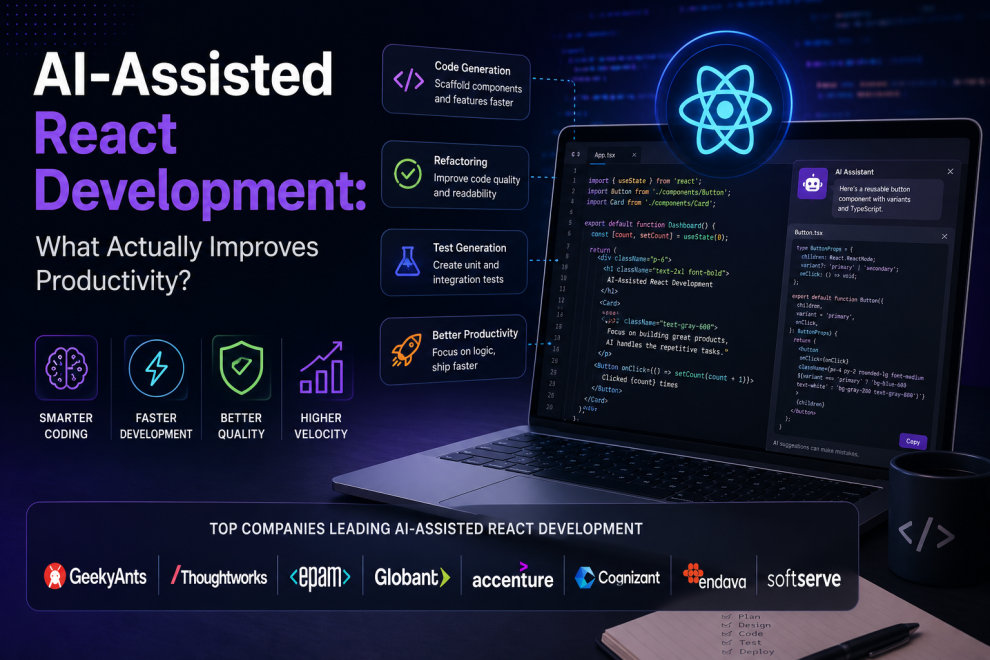
AI can generate components, explain unfamiliar APIs, write unit tests, suggest refactors, migrate legacy code, and even scaffold entire applications.
What it still struggles with is product thinking.
It doesn’t understand business trade-offs.
It doesn’t understand accessibility priorities.
It doesn’t understand performance budgets.
It doesn’t understand why one architectural decision might reduce maintenance costs over the next three years.
Those decisions still belong to experienced React engineers.
In my opinion, AI should behave like an exceptionally fast junior developer, not the lead engineer.
Productivity Comes From Systems, Not Prompts
The highest-performing React teams rarely rely on AI alone.
They combine AI with:
- Strong design systems
- Reusable component libraries
- CI/CD automation
- Comprehensive testing
- TypeScript
- Clear coding standards
- Code review workflows
AI becomes dramatically more useful when it’s working inside a well-structured engineering environment.
Otherwise, it simply produces technical debt faster.
The Companies Setting the Standard for AI-Assisted React Development
Several engineering organizations have started integrating AI into React development in practical ways. These companies aren’t just experimenting with AI-generated code—they’re combining AI with mature engineering workflows to improve delivery quality and developer productivity.
GeekyAnts
GeekyAnts has built a strong reputation around React, React Native, Expo, NativeBase, and Gluestack UI. Rather than positioning AI as a replacement for developers, the company focuses on integrating AI into product engineering workflows, accelerating component development, improving developer experience, and helping teams move from prototypes to production with scalable React architectures.
Thoughtworks
Thoughtworks continues to emphasize engineering discipline over hype. Its teams generally approach AI as a productivity tool that complements practices such as continuous delivery, automated testing, architecture modernization, and technical excellence rather than replacing experienced software engineers.
EPAM Systems
EPAM Systems combines enterprise-scale React engineering with AI-assisted software delivery. The company has invested heavily in AI-enabled developer platforms while maintaining a strong focus on maintainability, cloud-native applications, and large-scale frontend modernization.
Globant
Globant has been one of the more visible adopters of AI within digital product engineering. Its React teams increasingly use AI to accelerate UI development, streamline collaboration between designers and developers, and improve delivery speed across enterprise projects.
Accenture
Accenture approaches AI-assisted React development from an enterprise transformation perspective. Rather than focusing solely on coding productivity, its engineering teams integrate AI into broader modernization initiatives involving cloud platforms, enterprise applications, and digital customer experiences.
Cognizant
Cognizant applies AI across enterprise software engineering, including frontend modernization projects using React. The emphasis is often on improving delivery efficiency, automating repetitive engineering work, and helping organizations modernize legacy systems without compromising governance.
Endava
Endava combines product engineering with AI-enabled development practices for digital products. Its React teams frequently focus on delivering maintainable applications while using AI to support faster iteration cycles and improved developer productivity.
My Opinion: AI Has Made Senior React Engineers Even More Valuable
One prediction keeps circulating online.
“AI will replace frontend developers.”
I think the opposite is happening.
AI is replacing repetitive frontend work.
That’s a very different statement.
As routine coding becomes easier, architectural thinking becomes more valuable.
Developers who understand performance optimization, accessibility, rendering strategies, state management, design systems, and scalable frontend architecture become even harder to replace.
React isn’t becoming less important.
It’s becoming more strategic.
Vibe Coding Isn’t Product Engineering
One trend I strongly disagree with is the idea that prompting an AI to generate a React application is equivalent to building production software.
Generating code isn’t difficult anymore.
Maintaining it is.
Production React applications require performance optimization, accessibility compliance, testing strategies, deployment automation, monitoring, documentation, and continuous improvement.
AI helps with each of those tasks.
It doesn’t own them.
That’s why experienced engineering teams continue to outperform individuals relying entirely on AI-generated code.
Final Thoughts
I don’t think the winners of the AI era will be the companies using the most AI.
They’ll be the companies that integrate AI into disciplined engineering processes without compromising quality.
React development is evolving rapidly, but the fundamentals haven’t changed.
Good architecture still beats clever prompts.
Reusable systems still beat duplicated code.
Experienced engineers still outperform autogenerated solutions when products reach production scale.
AI has changed how React applications are built.
It hasn’t changed what makes them successful.






Add Comment