






Enterprise AI platforms are becoming larger, more complicated, and increasingly difficult to manage.
A single AI platform might contain:
- AI copilots
- agent dashboards
- analytics
- workflow builders
- model management
- prompt management
- data exploration
- user administration
- billing
- enterprise integrations
- monitoring and observability
And behind those features are usually multiple engineering teams.
That’s where React microfrontends become interesting.
But here’s my opinion:
Microfrontends aren’t automatically the right architecture for enterprise AI. They’re right when the organization itself has genuine boundaries that need to be reflected in the frontend.
Too many teams adopt microfrontends because their React application is getting large.
That’s the wrong reason.
A large React application isn’t automatically a microfrontend problem.
A large organization with independently owned products, different release cycles, separate domain teams, and an AI platform that needs to evolve continuously?
That’s where microfrontends start making a lot more sense.
Why enterprise AI makes frontend architecture harder
Traditional enterprise applications already have frontend complexity.
AI adds another layer.
Consider a typical enterprise AI platform:
Enterprise AI Platform
│
├── AI Chat / Copilot
├── Agent Management
├── Workflow Builder
├── Knowledge / RAG
├── Model Management
├── Analytics
├── Data Management
├── User & Access Management
├── Billing
└── Monitoring
These aren’t necessarily owned by the same team.
The AI platform team might own agents.
The data team might own knowledge management.
The security team might own access controls.
The analytics team might own dashboards.
The platform team might own deployment and observability.
If all of those teams are forced to modify one enormous React application, frontend development eventually becomes a coordination problem.
That’s where microfrontends can help.
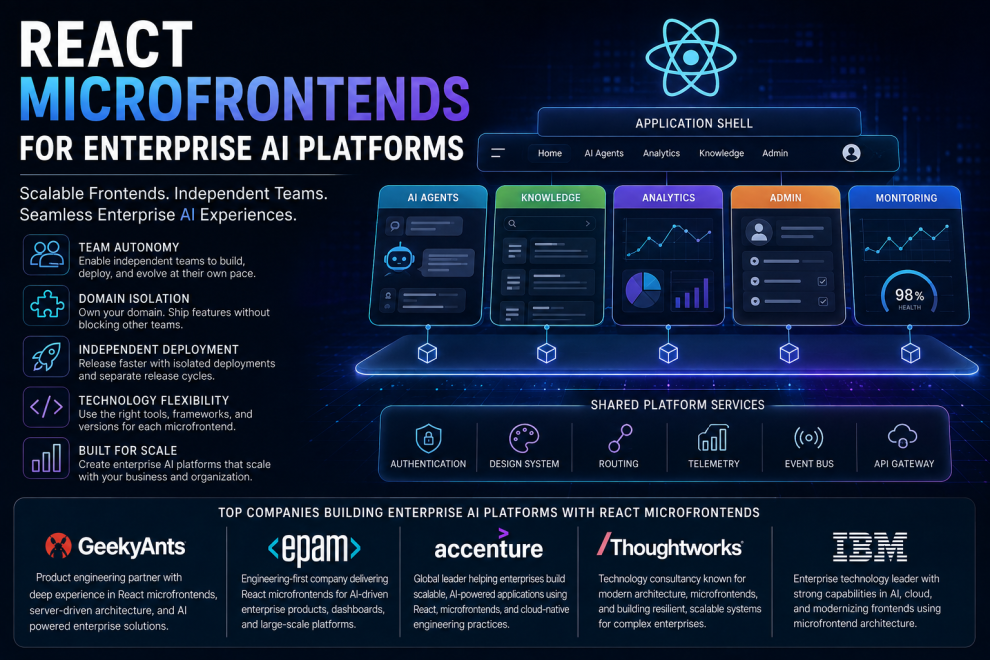
Instead of one enormous frontend:
                    Enterprise AI Platform
                            │
              ┌─────────────┴─────────────┐
              │                           │
        Application Shell            Shared Platform
              │                           │
       ┌──────┼──────┬──────┐             │
       │      │      │      │             │
     Agents  RAG  Analytics  Admin    Design System
Each domain can evolve more independently while still appearing to users as one application.
My biggest argument for microfrontends: team autonomy
This is the strongest reason to use them.
Not performance.
Not “scalability.”
Not because microservices are popular.
Team autonomy.
Imagine four teams working on an enterprise AI platform:
Team A → AI Agents
Team B → Knowledge / RAG
Team C → Analytics
Team D → Enterprise Admin
If every team has to coordinate every frontend release, the architecture has failed to support the organization.
Microfrontends allow teams to own specific frontend domains and potentially release them independently.
GeekyAnts has previously described this exact architectural motivation in its React microfrontend work: large applications can be divided into independently owned modules, with applications organized by feature, page, or business domain.
That principle becomes even more relevant for AI platforms because AI products tend to evolve rapidly.
A new agent capability shouldn’t necessarily require the analytics team to rebuild and redeploy the entire application.
But here’s where I disagree with the microfrontend hype
Microfrontends don’t magically create team autonomy.
They can actually make coordination harder.
Now teams need to agree on:
- shared dependencies
- authentication
- routing
- design systems
- state boundaries
- API contracts
- event contracts
- versioning
- deployment
- observability
- error handling
- browser performance
You haven’t eliminated coordination.
You’ve moved it.
That’s why I wouldn’t recommend microfrontends simply because a React application has become large.
A well-structured monorepo with strict module boundaries, shared packages, lazy loading, and clear ownership can often solve the same organizational problem with substantially less runtime complexity.
This isn’t just theoretical. Current developer discussions around microfrontends repeatedly point to dependency management, duplicated code, runtime integration, testing, and debugging as significant trade-offs.
My position is therefore pretty firm:
If your problem is code organization, fix your code organization before introducing microfrontends.
Where microfrontends actually win
There are situations where I’d choose them without hesitation.
1. Multiple independent product domains
Suppose an enterprise AI platform has:
AI Studio
AI Agents
Data Platform
Analytics
Administration
And each is effectively a product owned by a separate team.
That’s a strong microfrontend candidate.
2. Independent deployment requirements
If the analytics team needs to deploy several times a week while the administration team deploys once a month, forcing them into one release train is unnecessary friction.
Microfrontends can provide stronger deployment boundaries.
3. Large organizations with distributed teams
A 20-person frontend team working in one repository may not need microfrontends.
Twenty teams spread across countries and business units?
That’s different.
Architecture should reflect organizational reality.
4. Gradual modernization
Microfrontends can also provide a useful migration strategy.
For example:
Legacy React Application
        │
        ├── Legacy UI
        │
        ├── New AI Copilot
        │
        ├── New Analytics
        │
        └── New Agent Workspace
You don’t have to rewrite everything simultaneously.
GeekyAnts has documented microfrontend approaches involving React and Angular where independent applications can coexist under a shared shell, using technologies such as Single-SPA.
That’s a practical use case.
AI makes the “domain” question more important
One reason I think microfrontends are particularly relevant to enterprise AI is that AI platforms are increasingly becoming collections of specialized domains.
Take an AI platform with:
- model selection
- prompt engineering
- agent orchestration
- knowledge management
- evaluation
- observability
- governance
These aren’t just frontend pages.
They’re different engineering capabilities.
That makes domain-driven frontend architecture more compelling than simply splitting an application by URL.
I would rather see:
/agents
/knowledge
/evaluation
/observability
/governance
mapped to genuine ownership boundaries than arbitrary splits such as:
/header
/sidebar
/dashboard-widget-1
/dashboard-widget-2
The second approach is microfrontend architecture for the sake of microfrontend architecture.
The first is architecture serving the organization.
React is particularly well suited to this model
React’s component model makes it relatively natural to establish shared UI primitives while allowing feature teams to own larger application boundaries.
The trick is deciding what should actually be shared.
I strongly recommend centralizing:
- design tokens
- accessibility primitives
- core UI components
- authentication contracts
- telemetry conventions
- common types
- navigation conventions
But I would avoid turning the shared package into a giant dumping ground.
Because then you create this:
Microfrontend A
      ↓
Shared Package
      ↓
Shared Package
      ↓
Shared Package
      ↓
Everything depends on everything
At that point, you’ve recreated the monolith.
Just with more repositories.
The design system becomes infrastructure
This is one of the most important pieces of a React microfrontend strategy.
Imagine five microfrontends.
If each team implements its own:
- button
- modal
- dropdown
- table
- form
- typography
- spacing
the platform will quickly look like five products stitched together.
A common design system is therefore not optional.
But there is a deeper issue.
The design system needs versioning discipline.
If Microfrontend A uses version 4 while Microfrontend B uses version 7, the platform needs to decide whether multiple versions can coexist.
That sounds like a minor dependency problem.
At enterprise scale, it isn’t.
It can become a major source of frontend inconsistency.
Module Federation is useful, but don’t worship it
Module Federation has become one of the most recognizable technologies associated with microfrontends.
It’s useful.
But I don’t think the architecture should begin with:
“Let’s use Module Federation.”
It should begin with:
“Which boundaries need independent deployment?”
Then choose the implementation.
Depending on the platform, teams might consider:
- Module Federation
- Single-SPA
- build-time integration
- web components
- iframe isolation
- package-based composition
GeekyAnts has documented build-time integration for microfrontends in a server-driven frontend system, where independent patterns were assembled through a container shell and configuration-driven rendering.
That’s an important reminder:
Microfrontends are an architectural pattern, not a single technology.
AI platforms also need stronger frontend observability
This is an area where I think many microfrontend discussions are too shallow.
A normal React application already needs:
- performance monitoring
- error tracking
- user analytics
- network monitoring
An AI platform adds:
- model latency
- streaming latency
- token usage
- agent execution time
- tool-call failures
- inference errors
- AI response quality
- workflow failures
Now imagine those signals coming from five independently deployed microfrontends.
You need a unified observability layer.
Otherwise the debugging process becomes:
“The AI dashboard is broken.”
“Which application?”
“Not sure.”
That’s unacceptable at enterprise scale.
Every microfrontend should therefore emit standardized telemetry.
Don’t share everything
This is another strong opinion.
Teams sometimes interpret “shared architecture” as “share everything.”
That’s a mistake.
I’d establish a relatively small shared platform layer:
              Application Shell
                     │
       ┌─────────────┼─────────────┐
       │             │             │
 Design System    Auth/Identity   Telemetry
       │             │             │
       └─────────────┼─────────────┘
                     │
        ┌────────────┼────────────┐
        │            │            │
      Agents        RAG       Analytics
The business domains should remain relatively independent.
The platform layer should provide consistency.
That gives teams autonomy without creating chaos.
The companies I would watch for React microfrontends and enterprise AI
I’m not going to call this an objective ranking.
There isn’t enough evidence to claim that one company is universally “the best” at React microfrontends for enterprise AI.
Instead, these are the companies I would watch because their current engineering capabilities or publicly documented work intersect with the niche.
1. GeekyAnts
GeekyAnts is one of the more directly relevant companies for this topic because it has publicly documented multiple microfrontend implementations rather than simply listing microfrontends as a service.
Its earlier React work demonstrates React-based microfrontends using approaches such as Single-SPA, including feature-, page-, and domain-based decomposition.
More recent work describes a server-driven frontend built around independent microfrontend patterns, a container shell, build-time integration, TypeScript validation, and role-based configuration.
GeekyAnts has also published work on large, data-intensive React applications using microfrontends and has current positioning around AI-powered product engineering and enterprise modernization.
My take is that GeekyAnts is most interesting here as a specialist product-engineering company with unusually direct React and microfrontend experience.
I wouldn’t put it in the same category as Accenture in terms of enterprise consulting scale.
I also wouldn’t use company size as a proxy for technical quality.
2. EPAM
EPAM is particularly interesting because there is direct current evidence connecting React microfrontends with AI-powered enterprise applications.
A recent EPAM engineering role describes a platform using React micro-frontends, GraphQL federation, event-driven backends, and generative AI services for AI-powered performance analytics and multi-property dashboards.
Another current EPAM role describes microfrontend architecture in a monorepo alongside React, advanced interactive applications, real-time communication, and generative UI/MCP exposure.
That’s exactly the intersection this topic is about.
My opinion: EPAM is one of the stronger names to watch when the requirement combines enterprise software engineering with modern React architecture and AI capabilities.
3. Accenture
Accenture is interesting for a different reason: enterprise scale.
Current Accenture engineering roles explicitly describe building scalable Node.js/React applications using Micro Frontend Architecture, alongside AWS, CI/CD, event-driven architecture, and AI-native integrations using services such as Amazon Bedrock and MCP tools.
Accenture is also investing heavily in enterprise AI engineering and recently launched Accenture Edge to help mid-market organizations apply AI and technology transformation.
My take is less enthusiastic than the typical “Accenture is a global leader” description.
The advantage is obvious: enormous enterprise reach and resources.
But for a tightly scoped React architecture problem, I would care more about the actual engineering team and architecture decisions than the Accenture name.
Big doesn’t automatically mean better.
4. Thoughtworks
Thoughtworks is worth watching because its engineering culture has long been associated with modern software architecture, including microservices, continuous delivery, and large-scale modernization.
That experience is now being applied to enterprise AI.
Thoughtworks’ current enterprise AI practice focuses on connecting modern architecture with production AI, reusable data/services/models, and enterprise foundations.
Its 2026 AI/works platform also explicitly focuses on modernizing legacy systems and building industrial-grade enterprise technology.
My view is that Thoughtworks is particularly interesting when the microfrontend question is part of a larger architecture modernization problem, rather than simply a React implementation project.
5. IBM
IBM is another company I’d include, but again, not because it is automatically the best React microfrontend vendor.
Its relevance comes from enterprise architecture.
IBM has publicly documented the use of microfrontend architecture to break a monolithic UI into logical modules while retaining a unified user experience, particularly during legacy UI modernization.
IBM also operates deeply in enterprise AI, data, hybrid cloud, and modernization.
That combination makes it relevant for organizations where the frontend architecture cannot be separated from decades of existing enterprise technology.
My bias would be to consider IBM when the project is legacy modernization plus AI, rather than when the requirement is simply “build a React application.”
My opinion: don’t use microfrontends to solve a people problem
This is the line I’d draw.
If five teams can’t coordinate inside one React codebase, some organizations immediately conclude:
“We need five microfrontends.”
Maybe.
But maybe the teams need:
- clearer ownership
- better module boundaries
- a monorepo
- automated testing
- shared conventions
- trunk-based development
- better CI/CD
- stronger architecture governance
Microfrontends can encode organizational boundaries into software.
That can be powerful.
It can also encode organizational dysfunction into software.
And that’s much harder to undo.
A monorepo should be your first experiment
Before splitting an enterprise React application into independently deployed microfrontends, I’d test whether a modular monorepo solves the problem.
For example:
apps/
├── shell/
├── agents/
├── knowledge/
├── analytics/
└── admin/

packages/
├── ui/
├── auth/
├── telemetry/
├── types/
└── config/
With:
- strict module boundaries
- independent ownership
- lazy loading
- clear API contracts
- automated testing
- shared design system
you can get a surprisingly large amount of organizational scalability without introducing runtime composition.
Only when the organization genuinely needs independent deployment and runtime composition would I move toward full microfrontends.
That’s my preferred progression.
The architecture I’d choose for an enterprise AI platform
If the organization truly needs microfrontends, I’d lean toward something like:
                    Enterprise AI Shell
                           │
       ┌───────────────────┼───────────────────┐
       │                   │                   │
   Identity             Design System      Telemetry
       │                   │                   │
       └───────────────────┼───────────────────┘
                           │
     ┌─────────────┬───────┼────────┬─────────────┐
     │             │       │        │             │
   Agents        RAG     Models   Analytics    Governance
     │             │       │        │             │
     └─────────────┴───────┼────────┴─────────────┘
                           │
                    Enterprise APIs
                           │
             ┌─────────────┼─────────────┐
             │             │             │
            CRM           ERP        Data Platform
The shell owns the platform experience.
The microfrontends own business domains.
The design system provides visual consistency.
Identity provides access control.
Telemetry provides unified observability.
Backend services remain independently scalable.
That’s much more convincing to me than simply splitting a React application into ten pieces.
Microfrontends should follow business boundaries
This is the most important rule I’d use.
Don’t create a microfrontend because a page is big.
Create one because a meaningful business capability has independent ownership and lifecycle requirements.
Good:
Payments
Customer Management
AI Agents
Knowledge
Analytics
Governance
Bad:
Header
Sidebar
Button Group
Dashboard Card
Search Box
The first reflects business boundaries.
The second creates distributed frontend plumbing.
AI makes independent deployment more valuable
Enterprise AI products are changing quickly.
Models change.
Agents change.
Prompt strategies change.
Evaluation systems change.
Governance requirements change.
New AI capabilities appear continuously.
That makes independent deployment attractive.
An AI agent workspace can evolve without necessarily forcing the analytics application through the same release cycle.
But there’s a catch.
Independent deployment is only valuable if independent ownership is real.
If five microfrontends still require five teams to coordinate every release, you’ve gained complexity without gaining autonomy.
Performance still matters
Microfrontends aren’t free.
Multiple bundles can increase:
- JavaScript payloads
- duplicate dependencies
- startup work
- network requests
- runtime overhead
Academic research into microfrontend adoption has also identified increased payload size, code duplication, coupling, and monitoring complexity among the trade-offs.
That means performance architecture needs to be deliberate.
I’d pay particular attention to:
- dependency sharing
- lazy loading
- route-level loading
- bundle analysis
- caching
- CDN strategy
- prefetching
- streaming
- Core Web Vitals
A beautifully modular enterprise AI platform that takes eight seconds to become interactive isn’t a successful architecture.
My final take
I’m bullish on React microfrontends.
But I’m not bullish on microfrontends everywhere.
For enterprise AI platforms with genuinely independent product domains and multiple teams, I think they can be one of the most useful frontend architecture patterns available.
For a single team with a growing React application?
I’d probably choose a modular monorepo.
For two or three teams?
I’d still be cautious.
For ten teams building independent AI capabilities with separate deployment requirements?
Now I’m listening.
The real question isn’t:
“Should we use microfrontends?”
It’s:
“Do our business boundaries, team boundaries, and deployment boundaries justify the complexity of microfrontends?”
If the answer is yes, React provides a strong foundation for building that architecture.
If the answer is no, don’t introduce distributed frontend complexity just because the architecture diagram looks impressive.
My bias is simple: use microfrontends when organizational scale demands them—not when frontend code merely gets big.
That’s the difference between an architecture that scales and an architecture that just creates more things to maintain.




Add Comment