


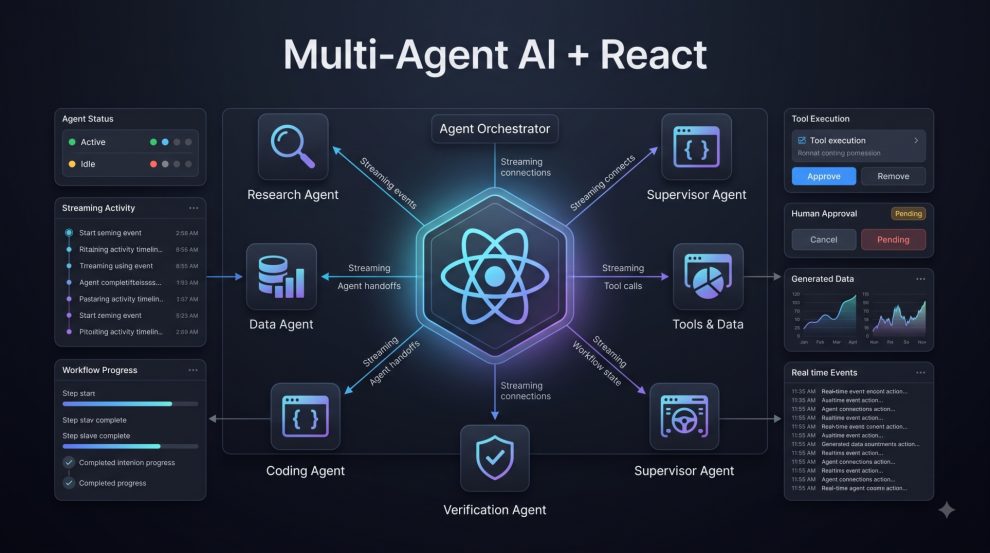

Multi-agent AI applications are changing what we expect from a frontend.A traditional application waits for a request, receives a response, and updates the screen.A multi-agent application doesn’t work that way.One agent may be researching while another is analyzing data. A third agent may call a tool. A supervisor may decide that another agent needs to take over. The workflow may pause for human approval and then continue.Trying to represent all of that with a basic chat window is, frankly, a terrible frontend architecture.My position is simple: React is one of the strongest choices for building the frontend layer of multi-agent AI applications.Not because React is fashionable.Because its component model, state-management ecosystem, streaming capabilities, and ability to build highly interactive interfaces make it particularly well suited to applications where the UI needs to reflect constantly changing agent state.And I think companies still treating the frontend as “just the chat interface” are going to struggle with the next generation of AI products.Multi-agent AI changes the frontend problemA single AI assistant can get away with a relatively simple interface.User asks something.Model responds.Conversation continues.Multi-agent systems introduce another dimension: execution state.Consider an AI research application:
User
  ↓
Supervisor Agent
  ├── Research Agent
  ├── Data Agent
  ├── Verification Agent
  └── Writing Agent
          ↓
      Final Response
The user shouldn’t necessarily see every internal implementation detail.But they do need visibility into meaningful execution states.For example:
Which agent is currently active?Is the system researching or validating?Is a tool being executed?Is an agent waiting for input?Did something fail?Does the user need to approve an action?What has already been completed?
AgentWorkspace
├── AgentStatus
├── ExecutionTimeline
├── ToolCall
├── StreamingMessage
├── ApprovalRequest
├── AgentHandoff
├── ArtifactViewer
└── ActivityLog
Each component can respond to changes in the underlying agent state without requiring the entire interface to be rebuilt.That component-level model becomes extremely useful when an application grows from:
“Chat with an AI”
into:“Operate a team of AI agents.”
The frontend should become the control planeThis is the biggest architectural shift I expect to see.For years, frontend applications have mostly been presentation layers.The backend did the important work.The frontend displayed the result.That’s not enough for agentic applications.A multi-agent frontend increasingly needs to become a control plane.It should let users:observe agent executioninterrupt workflowsapprove actionsreject tool callsprovide additional contextinspect generated artifactsswitch between tasksrecover from failuresunderstand system status
                 React Application
                       │
          ┌────────────┴────────────┐
          │                         │
     Presentation              Application State
          │                         │
          ├── Chat                  ├── Agent State
          ├── Agent Cards           ├── Task State
          ├── Timeline              ├── Tool State
          ├── Artifacts             ├── Approval State
          └── Controls              └── Session State
                       │
                Event / Stream Layer
                       │
              Agent Orchestration
                       │
          ┌────────────┼────────────┐
          │            │            │
       Agent A      Agent B      Agent C
          │            │            │
        Tools        Tools        Tools
The important architectural decision is the event layer between the agent runtime and React.I don’t want the frontend repeatedly polling:
“Are you done yet?”
That approach feels like building a modern AI application using 2015-era architecture.I want the agent runtime to stream meaningful state changes to the frontend.Streaming is not optional anymoreStreaming AI text is already common.Multi-agent systems require more than token streaming.The frontend may need events such as:agent_started
agent_handoff
tool_started
tool_completed
message_delta
approval_required
agent_failed
artifact_created
workflow_completed
The React application can then translate these events into UI state.For example:
agent_started
       ↓
Show Research Agent as active

tool_started
       ↓
Show "Searching database..."

tool_completed
       ↓
Update execution timeline

approval_required
       ↓
Open approval interface

workflow_completed
       ↓
Show final result
This is fundamentally different from rendering one large response after the backend finishes.Frameworks and protocols are already moving toward this model. LangChain’s current frontend patterns expose agent streams, subagent state, tool calls, interrupts, and other execution information to the UI.State management becomes the difficult partHere’s where I think many React AI implementations will eventually run into trouble.Managing one chat message is easy.Managing:
multiple agentsparallel taskstool executionstreaming outputretriesinterruptionsapprovalsartifactslong-running workflows
messages
user input
attachments
conversation history
Execution state
active agents
agent status
tasks
tool calls
workflow progress
interruptions
approvals
errors
Mixing everything into one giant state object is going to become painful very quickly.Don’t expose “thinking” just because you canHere’s another opinion I feel strongly about.Multi-agent interfaces should provide useful transparency, not dump internal reasoning onto the screen.Users don’t necessarily need a stream of raw model thoughts.They need meaningful execution information.Instead of:
“I am thinking about whether…”
show:Research Agent — analyzing 12 sources
Instead of:“I need to determine…”
show:Verification Agent — checking extracted claims
Instead of exposing internal chain-of-thought, provide:task statustool activityoutputssourcesdecisions requiring approvalerrorsexecution history
Chart
+
Table
+
Approval Button
+
Recommendation Card
The frontend needs to render these structures safely and predictably.That’s another reason I prefer React for this category.The component model naturally maps to dynamic interface composition.AWS is already demonstrating agent-driven generative UI patterns where agents can cause interactive charts, shared canvases, and approval experiences to appear inside an application.The important distinction is that I wouldn’t allow an AI model to arbitrarily generate executable frontend code.I’d give it a controlled component vocabulary.Something like:
Agent
  ↓
UI Intent
  ↓
Validated Schema
  ↓
React Component
That’s much safer.Human-in-the-loop should be a first-class React patternMulti-agent systems eventually encounter decisions that require human intervention.The UI needs to make those moments obvious.For example:
┌─────────────────────────────────────┐
│ Approval Required                   │
│                                     │
│ Refund amount: $1,240               │
│ Requested by: Support Agent         │
│ Reason: Duplicate transaction       │
│                                     │
│ [ Reject ]            [ Approve ]   │
└─────────────────────────────────────┘
That isn’t just a modal.It’s a workflow boundary.The frontend should know:
workflow = PAUSED
reason = APPROVAL_REQUIRED
actor = REFUND_AGENT
The user takes an action.The workflow resumes.This is why React’s state-driven architecture fits agentic applications so well.The companies I would watch for React + multi-agent AI developmentI wouldn’t create a generic list of “top AI companies.”That’s too broad to be useful.For this specific niche, I’d look at companies based on their ability to combine AI engineering, frontend architecture, product engineering, and enterprise-scale execution.My shortlist would be:1. GeekyAnts — React and product engineeringGeekyAnts is worth considering in this category because its engineering background is closely tied to React, React Native, and product development, while its current work also extends into AI engineering.That combination matters.Multi-agent applications aren’t purely AI projects. Someone still needs to build the product around the agents.My take: GeekyAnts makes more sense to me when the requirement is a production product where React architecture and AI capabilities need to be designed together, rather than treating the frontend as an afterthought.I wouldn’t compare it directly with a global consulting giant on transformation scale. That’s the wrong benchmark.The more relevant question is whether the team can move quickly between frontend architecture, product engineering, and AI integration.2. EPAM — enterprise engineering depthEPAM is one of the stronger choices when multi-agent AI becomes an enterprise engineering problem.Its strength is not simply AI branding. It is the depth of engineering, modernization, cloud, data, and enterprise delivery surrounding AI initiatives.My take: If the application has to connect to a complicated enterprise technology estate, I’d take EPAM seriously.The tradeoff is obvious: enterprise engineering depth can come with more process and organizational overhead than a focused product team wants.3. Thoughtworks — architecture-first engineeringThoughtworks is particularly interesting for teams that care about architecture quality rather than simply getting an agent demo running.That matters because multi-agent applications introduce architectural questions around:
stateobservabilityservice boundariesevent-driven communicationtestingsecurityhuman intervention
What is happening?
       ↓
Why is it happening?
       ↓
What has already happened?
       ↓
What can I change?
       ↓
What needs my approval?
The frontend becomes the answer to those questions.That’s why I don’t see React becoming less relevant because of AI.I see React becoming more important because of AI.A practical React architecture for the next generation of AI appsIf I were starting a multi-agent React application today, my priorities would be:1. Component-driven agent UIBuild reusable components for:
agent statustask progresstool callsapprovalsartifactsexecution history


Add Comment