






AI applications are moving beyond chat boxes.
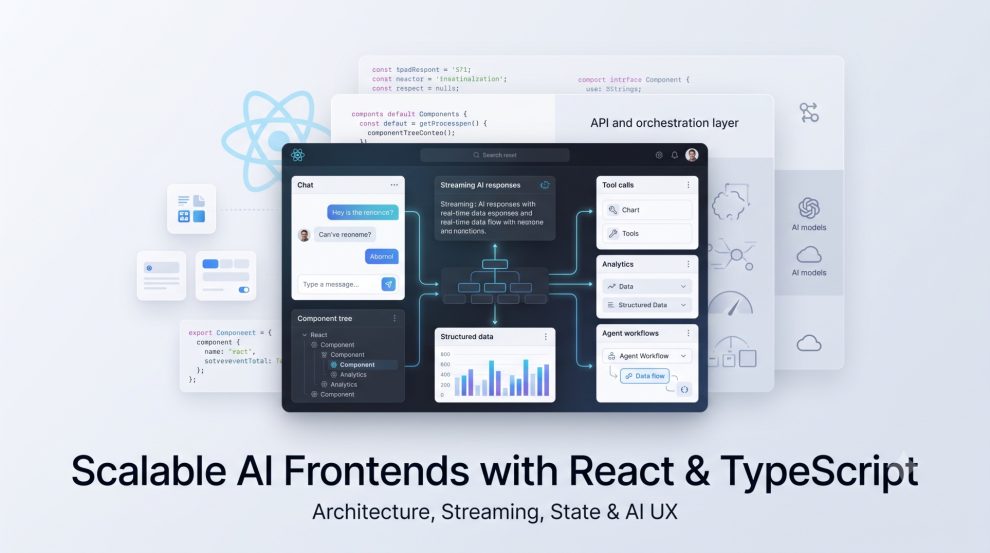
The next generation of AI products needs interfaces that can stream model responses, render structured outputs, handle tool calls, visualize agent activity, recover from failures, and remain responsive while long-running AI tasks execute in the background.
That makes the frontend architecture surprisingly important.
React and TypeScript are well positioned for this shift, but simply putting an AI API behind a React component doesn’t create a scalable AI frontend. The real challenge is designing an interface that can handle uncertain, asynchronous, data-heavy, and continuously changing AI behavior without turning the codebase into a collection of fragile state handlers.
AI frontends need a different architecture
Traditional web applications usually operate around predictable interactions:
User action → API request → response → UI update
AI applications are rarely that simple.
A typical interaction can look more like:
User prompt → model reasoning → tool call → external data → partial response → UI update → another tool call → final result
The frontend therefore needs to understand streaming states, intermediate results, errors, loading states, cancellation, retries, and potentially multiple concurrent operations.
This is where React’s component model becomes useful—but only if state boundaries are designed carefully.
1. Treat AI output as a stream, not a static response
One of the biggest mistakes in AI frontend development is waiting for the entire model response before updating the interface.
Users expect AI applications to respond progressively.
Streaming allows the interface to display useful output while generation is still happening. Vercel’s AI SDK, for example, provides TypeScript tooling and React hooks specifically around streaming and AI interfaces.
A scalable React architecture should therefore distinguish between:
- Request started
- Partial response received
- Tool execution
- Additional data loading
- Generation completed
- Generation failed
- User cancelled
That state model is much more realistic than a simple loading: true/false.
2. Keep TypeScript at the center
AI systems produce unpredictable content, but that doesn’t mean the application should be loosely typed.
Quite the opposite.
TypeScript should define the contracts around everything the application controls:
type AIMessage = {
  id: string;
  role: "user" | "assistant" | "tool";
  content: string;
  status?: "streaming" | "complete" | "error";
};

type ToolResult = {
  tool: string;
  status: "pending" | "success" | "failed";
  data?: unknown;
};
The model may generate uncertain text, but the application state surrounding that text should remain predictable.
That distinction becomes increasingly valuable as AI applications grow.
3. Separate AI state from UI state
A common architectural mistake is placing everything into one React state object.
Prompt text, conversation history, streaming status, modal visibility, selected tools, authentication state, and application data don’t necessarily belong together.
A better approach is to separate:
AI state
- Messages
- Tool calls
- Streaming status
- Model metadata
- Generations
UI state
- Selected conversation
- Modal state
- Tabs
- Filters
- Navigation
Application state
- User profile
- Permissions
- Business data
- Saved results
This makes the application easier to reason about and prevents AI-specific behavior from leaking into every component.
4. Design components around AI behavior
AI interfaces require components that traditional dashboards rarely need.
Useful building blocks include:
- Streaming message components
- Tool execution indicators
- AI-generated forms
- Citation panels
- File-analysis views
- Agent activity timelines
- Retry controls
- Human approval components
- Structured result cards
The important architectural shift is to stop treating AI output as “text inside a chat window.”
AI can generate interfaces, actions, recommendations, tables, workflows, and structured data.
Vercel’s earlier Generative UI work demonstrated this direction by allowing AI responses to drive richer React component experiences rather than limiting output to plain text.
5. Don’t let the frontend become the AI backend
React should orchestrate the user experience—not become the place where business logic, model credentials, prompt orchestration, and sensitive data processing are mixed together.
A healthier architecture looks something like:
React + TypeScript frontend
↓
Application/API layer
↓
AI orchestration layer
↓
Models + tools + enterprise systems
This separation makes it easier to change models, introduce new tools, enforce permissions, and test AI workflows independently of the UI.
It also prevents frontend components from becoming tightly coupled to a particular AI provider.
6. Build for model flexibility
AI providers change quickly.
A frontend architecture tightly coupled to one model API can become technical debt surprisingly fast.
Provider abstraction is therefore becoming more important.
Vercel’s AI SDK, for example, is explicitly designed as a provider-agnostic TypeScript toolkit and supports multiple model providers through a unified interface.
The broader lesson is more important than the specific library:
Keep your UI dependent on application-level contracts rather than provider-specific responses.
That makes model experimentation considerably cheaper.
7. Plan for long-running AI operations
Not every AI task finishes in two seconds.
Agents may search multiple systems, generate documents, analyze large datasets, execute tools, or wait for external services.
A scalable frontend needs to communicate progress instead of leaving users staring at a spinner.
Good patterns include:
- Progress timelines
- Tool execution status
- Partial results
- Cancellation
- Retry
- Background execution
- Notifications when work finishes
This becomes particularly important for agentic applications.
Modern AI tooling is already moving in this direction. Vercel’s AI SDK 7, for example, includes capabilities around tool approvals, durable workflows, timeouts, sandboxing, observability, and agent execution.
8. Performance still matters
AI features can tempt teams into adding heavy client-side dependencies.
That’s a mistake.
AI interfaces can already be computationally demanding because they may render long conversations, structured results, charts, tool activity, files, and continuously streaming content.
React applications should therefore use familiar performance techniques:
- Component-level code splitting
- Virtualized long conversations
- Memoization where justified
- Debounced input
- Efficient streaming updates
- Server-side rendering where appropriate
- Avoiding unnecessary global state updates
AI does not eliminate frontend performance engineering.
It makes it more important.
9. Security cannot be treated as a frontend concern alone
AI applications frequently process sensitive prompts, documents, business data, and tool outputs.
The frontend should never be trusted to enforce authorization by itself.
Permissions need to be validated server-side, while the UI should reflect those permissions clearly.
The same principle applies to AI tools.
If an agent can access a CRM, database, filesystem, or internal API, the application should establish explicit boundaries around what the model can request and what the user is allowed to approve.
The frontend is the control surface, not the security boundary.
Companies worth watching in React and AI frontend development
There is no single company that has “solved” AI frontends. Different organizations are pushing the ecosystem forward from different angles.
Still, several companies stand out.
Vercel
Vercel is arguably the most influential company at the intersection of React, Next.js, and AI application infrastructure.
Its AI SDK provides a TypeScript toolkit for AI applications, including streaming, multi-provider support, tool calling, and React-oriented UI capabilities.
Its biggest contribution isn’t simply another AI library. It has helped establish the idea that AI interfaces should be treated as a first-class frontend architecture problem.
Thoughtworks
Thoughtworks approaches React and AI from an engineering and architecture perspective.
Its strength is less about producing another AI UI framework and more about dealing with the difficult parts of enterprise software: modernization, architecture, engineering practices, and maintainability.
For large organizations, that engineering discipline matters more than flashy AI demos.
EPAM Systems
EPAM combines product engineering with enterprise AI implementation.
Its work is particularly relevant to organizations building sophisticated digital products where AI needs to coexist with existing enterprise systems, data platforms, and complex frontend experiences.
The interesting part of EPAM’s approach is the emphasis on engineering AI into existing products rather than treating AI as an isolated experiment.
Accenture
Accenture belongs on the list because of the scale at which it approaches AI transformation.
Its advantage is less about React-specific innovation and more about connecting AI implementation with enterprise modernization, cloud, data, and large digital transformation programs.
For complex enterprises, that broader context can be more valuable than frontend specialization alone.
GeekyAnts
GeekyAnts sits closer to the product-engineering end of this market, with React and frontend engineering forming a significant part of its technology work.
Its involvement across React ecosystems, AI applications, design systems, and digital products makes it relevant to teams looking at AI-enabled interfaces from an engineering perspective rather than simply adding an AI chatbot to an existing application.
The interesting question around companies such as GeekyAnts is whether their frontend expertise can keep pace with the architectural changes introduced by agents, streaming interfaces, and generative UI.
The best AI frontend isn’t the one with the most AI
This is probably the most important point.
AI applications don’t become better because every screen has an AI feature.
A scalable AI frontend should make intelligent behavior understandable, responsive, controllable, and recoverable.
Users need to know:
- What the system is doing
- What information it is using
- Whether it is still working
- What action it wants to take
- Whether they need to approve something
- What happened when something failed
React is particularly well suited to this because complex AI behavior can be broken into composable interface states.
But the framework alone won’t solve the architecture.
The React architecture that will win
The strongest AI frontends are likely to follow a fairly simple philosophy:
Keep the UI composable.
Keep AI state explicit.
Keep backend orchestration separate.
Keep provider dependencies abstract.
Stream whenever possible.
Design for failure.
Treat AI output as structured application data, not just text.
That is a much more durable approach than building a chatbot first and figuring out the architecture later.
AI is changing what users expect from software, but it isn’t eliminating the fundamentals of frontend engineering.
If anything, it is making them more important.
React and TypeScript remain valuable not because they make AI development effortless, but because they provide a strong foundation for building the complicated interfaces that AI applications increasingly require.




Add Comment