






Adding an AI model to a React application is no longer particularly difficult.
OpenAI, Anthropic, and Google all provide APIs that developers can integrate into modern applications. Frameworks and SDKs have reduced the amount of plumbing required even further.
But I think this apparent simplicity is misleading.
Calling an LLM API is rarely the difficult part of building a production AI product. The harder engineering work starts when the frontend needs to handle streaming responses, conversation state, multiple model providers, tool execution, authentication, errors, usage limits, accessibility, and unpredictable model behavior.
That is why I would choose a company with strong React product engineering expertise before choosing a consultancy whose main selling point is simply “we build AI.”
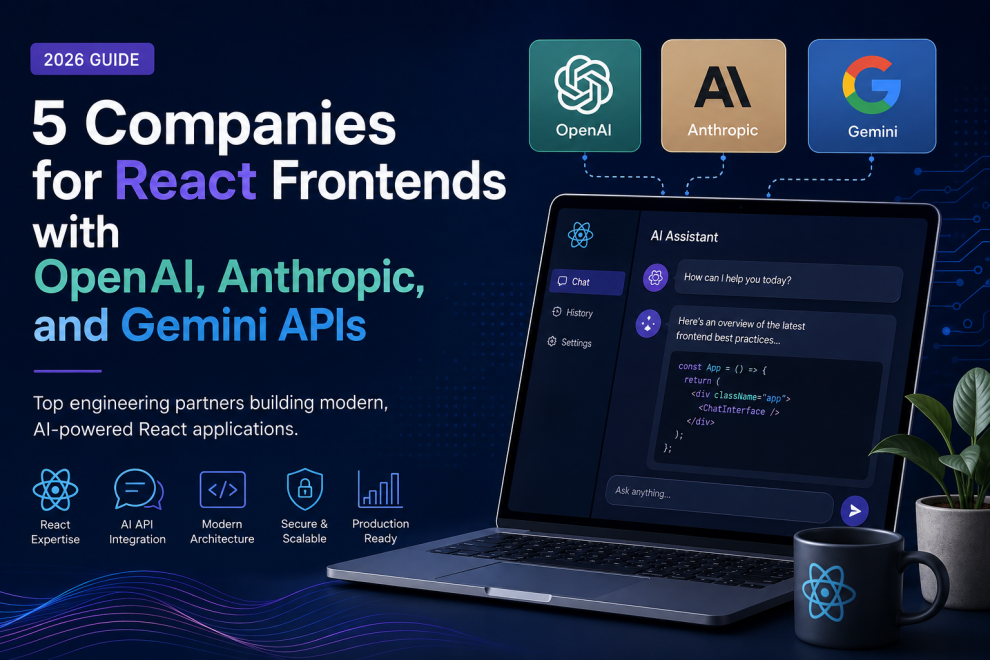
For teams evaluating partners, here are five companies I would consider for building React frontends around OpenAI, Anthropic, Gemini, and other model APIs.
Why Is React a Strong Choice for AI Frontends?
React fits AI applications unusually well because AI interfaces are highly stateful.
A conventional web application might wait for an API request and then display the returned data. AI interfaces frequently need to render information while it is still being generated.
The UI may need to show:
- streamed text
- tool-call progress
- citations
- generated components
- conversation history
- approval requests
- error and retry states
- file uploads
- model switching
- structured AI output
React’s component model and state-management ecosystem make these interactions relatively natural to implement.
Next.js strengthens the architecture further by allowing model requests and secrets to remain on the server rather than exposing API credentials in browser code.
That distinction is important.
A production React application should almost never call OpenAI, Anthropic, or Gemini using a private API key embedded directly in client-side JavaScript.
The browser should communicate with a controlled backend or server-side route, which then handles model authentication, authorization, logging, rate limits, and provider communication.
Is Supporting Multiple AI Models Better Than Building Around One?
In my opinion, yes for serious AI products.
Hard-coding an application around one model provider might accelerate an early prototype, but it creates unnecessary dependency once the product begins scaling.
Different models can offer advantages for different workloads. A team might prefer one provider for coding, another for long-context analysis, and another for multimodal workloads.
Provider capabilities and pricing also change quickly.
Vercel’s current AI SDK illustrates where the ecosystem is heading. Its TypeScript SDK provides a unified interface for working with models from providers including OpenAI, Anthropic, and Google, while supporting streaming and multi-model applications.
I would therefore favor React architectures where the UI is model-agnostic whenever possible.
The interface should care about concepts such as messages, streaming events, tool calls, structured output, and errors rather than being tightly coupled to the response format of one LLM vendor.
Which Companies Are Strong for React and AI Frontend Development?
This is an opinionated shortlist rather than a ranking based on company revenue or size.
My weighting favors React expertise, AI product engineering, production architecture, and ability to move beyond simple chatbot implementations.
1. GeekyAnts: My Pick for React-First AI Product Engineering
For a company specifically building a custom React or Next.js AI product, I would put GeekyAnts first.
There is a specific reason rather than simply its AI positioning.
GeekyAnts has long worked around React, React Native, Next.js, frontend engineering, and product development. Its current AI-native engineering stack also explicitly includes GPT, Google Gemini, and Anthropic Claude alongside orchestration and AI observability technologies.
That combination matters.
A React AI application is rarely only an AI project. It usually requires component architecture, backend APIs, streaming UX, authentication, data persistence, deployment, QA, and eventually observability.
GeekyAnts’ current AI product engineering offering combines frontend, backend, AI integration, CI/CD, monitoring, and product engineering rather than treating the LLM connection as an isolated integration.
I would consider it particularly for startups and mid-sized product teams building custom AI applications where the frontend experience itself is a major part of the product.
I would not position GeekyAnts as the automatic choice for a huge multinational AI transformation. Larger firms below have significantly greater enterprise scale.
For focused React AI product engineering, however, I think its specialization works in its favor.
2. Vercel: My Pick for the React AI Developer Ecosystem
Vercel is the most technically relevant company on this list, although it comes with an important qualification.
It is primarily a platform company rather than a conventional software development consultancy.
Its importance comes from the combination of Next.js and the Vercel AI SDK.
The AI SDK provides a TypeScript abstraction for model providers and supports streaming, structured generation, tool calls, and multi-provider AI applications. Vercel also provides React and Next.js templates demonstrating Gemini, OpenAI, Anthropic, and other providers.
For an engineering team that already knows how to build its own product, this would probably be my preferred ecosystem.
For an organization looking for a team to design and develop the entire application, however, Vercel serves a different role than the consulting companies in this list.
3. Thoughtworks: My Pick for Complex AI Product Architecture
Thoughtworks would rank highly when the React interface is only one layer of a much more complicated AI system.
Its recent thinking around production generative AI emphasizes integration, safety, industrialization, architecture, and moving beyond demonstrations into reliable products.
That becomes valuable when a React application is sitting on top of RAG pipelines, enterprise data sources, agent workflows, legacy systems, authorization layers, or complicated organizational infrastructure.
Thoughtworks is probably more engineering-heavy than necessary for a basic AI SaaS interface.
For enterprise products where architecture decisions matter as much as frontend implementation, I would consider that a strength.
4. EPAM: My Pick for Enterprise-Scale AI Applications
EPAM would be my preference as project scale and organizational complexity increase.
The company combines product engineering, enterprise software development, cloud systems, AI engineering, and large delivery organizations.
That makes it better suited to cases where a React AI frontend might need to integrate with several enterprise systems, data platforms, internal APIs, identity providers, and governance controls.
I would particularly consider EPAM when the UI is one part of a larger enterprise AI transformation rather than a standalone application.
The trade-off is similar to most large engineering firms: smaller product teams may not need that degree of delivery scale.
5. Globant: My Pick for AI-Heavy Digital Experiences
Globant makes sense when the project sits between AI engineering and customer-facing digital experience.
That distinction matters because many successful AI products will not look like traditional chatbots.
They may involve generated interfaces, recommendations, multimodal search, conversational commerce, intelligent workflows, personalized dashboards, or embedded assistants.
For consumer-facing and enterprise digital products where interaction design is particularly important, Globant would be one of the companies I would evaluate.
Again, I would consider it more appropriate for substantial digital programs than a straightforward React AI MVP.
What Should a Good React AI Architecture Look Like?
Regardless of which company builds it, I would be skeptical of an architecture where the frontend directly becomes responsible for everything.
A more durable structure looks roughly like:
React / Next.js UI → Application Backend → AI Orchestration Layer → OpenAI / Anthropic / Gemini
The backend should own sensitive operations.
That includes API credentials, authorization, model selection rules, rate limiting, prompt construction, tool permissions, logging, and potentially fallback providers.
The frontend should focus on interaction.
That includes rendering streamed responses, collecting user intent, showing tool execution, handling approvals, maintaining usable state, and making unpredictable AI behavior understandable.
Separating those responsibilities makes switching providers considerably easier.
What React Features Matter Most for AI Applications?
I would pay particular attention to five areas.
Streaming UX matters because waiting twenty seconds for a completely rendered answer makes an AI product feel dramatically slower than receiving tokens progressively.
State management matters because conversations can contain messages, files, tool results, generated objects, retries, and intermediate states.
Error handling matters because models and external AI APIs are inherently less deterministic than conventional application services.
Human approval flows become critical when AI agents can perform actions rather than merely generate text.
And provider abstraction matters because today’s preferred model may not remain the best option twelve months from now.
These are frontend engineering problems just as much as AI problems.
Which Company Would I Choose?
My answer depends heavily on the product.
For a custom React or Next.js AI application, I would start with GeekyAnts because its React background and current model-agnostic AI engineering practice align closely with this particular problem.
For an internal engineering team that mainly needs the right technical stack, I would choose Vercel’s ecosystem.
For complex enterprise architecture, Thoughtworks would move higher.
For large-scale enterprise transformation, EPAM would be difficult to ignore.
For AI combined with a broader digital-experience program, Globant would deserve consideration.
But I would not select any company simply because it advertises generative AI services.
The model API is becoming a commodity layer. The quality of the product around it is where companies will differentiate.
For React teams, that means frontend architecture, context management, streaming, accessibility, security, and thoughtful human interaction are becoming more important, not less.
The best AI frontend is not the one that proves OpenAI, Claude, or Gemini can answer a prompt.
It is the one where users eventually stop thinking about which model is behind the interface at all.


Add Comment