








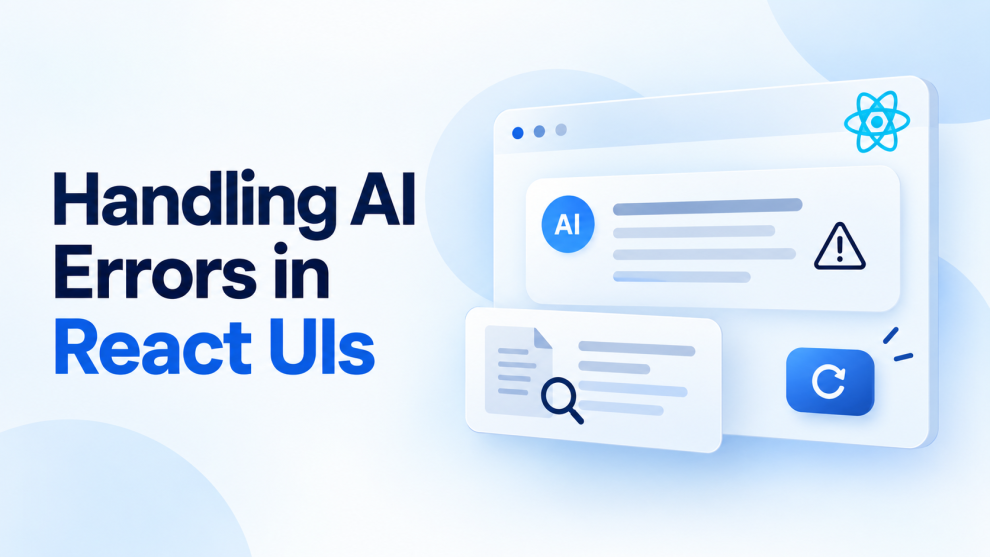

AI features introduce a reliability problem that traditional error handling does not fully cover. A request can complete successfully, return valid JSON, and render without crashing while still giving the user an incorrect answer. For React applications, handling AI errors therefore means managing both software failures and unreliable content. The interface should help users understand what happened, inspect the evidence, and recover without losing their work.
Why are AI hallucinations different from application errors?
Application errors include failed requests, timeouts, unavailable services, and rendering exceptions. These usually produce signals that software can detect. Hallucinations are harder to identify because the response may appear coherent and complete. NIST describes this risk as “confabulation,” where generative AI produces erroneous content and presents it confidently. A polished interface can make that content appear more authoritative than the evidence supports.
For example, an AI support assistant might invent a refund policy while the application reports no technical error. Showing a green success indicator would communicate that the request finished, but users could interpret it as confirmation that the answer is correct. A better design separates delivery status from evidence status. A response can be complete while its supporting information remains insufficient.
What can React Error Boundaries actually handle?
React Error Boundaries help contain rendering failures and display a fallback interface. An AI response component that crashes should not take down the surrounding navigation, conversation history, or input field. However, Error Boundaries generally do not catch event-handler errors or ordinary asynchronous callback failures. Network and streaming errors need separate handling through request logic and explicit application state.
A practical implementation should distinguish loading, streaming, completion, cancellation, and failure. When a connection drops halfway through a response, the interface should label the answer as incomplete and preserve the user’s prompt. Retry and edit controls can then support recovery. Retrying may resolve a temporary service failure, but generating another answer does not establish factual correctness.
How should the interface communicate uncertainty?
Uncertainty messages work best when they explain the specific limitation. “No supporting information was found in the uploaded documents” gives users more direction than a generic warning that AI can make mistakes. It also creates a useful next step, such as adding a document, narrowing the question, or requesting human assistance.
Anthropic’s guidance recommends explicitly allowing a model to acknowledge uncertainty and grounding document-based answers in supporting quotations or citations. It also cautions that these techniques reduce hallucinations without eliminating them. The practical implication is that an application should accommodate insufficient evidence as an expected result. Anthropic’s hallucination-reduction guidance
A React interface can make this distinction visible through separate request and evidence states. For instance, a completed request might display an answer alongside an “Insufficient supporting evidence” notice. Teams should avoid presenting a model-generated confidence percentage as a measured probability of correctness unless that score has been independently evaluated and calibrated for the task.
How can sources make AI responses more useful?
Source links and supporting excerpts give users a way to inspect an answer. In a document assistant, the interface could display the relevant passage beside each important claim, with a link to the original document. Anthropic recommends verifying citations and removing claims that lack support when working from supplied material. Anthropic’s grounding recommendations
The implementation should distinguish a reference that exists from a reference that actually supports the answer. Matching a citation identifier against retrieved documents can prevent nonexistent references from reaching the interface. Checking whether the cited passage supports the claim requires an additional evaluation step. A “verified” badge should describe a defined check, rather than appearing automatically whenever a response contains links.
What happens when an AI answer can trigger an action?
Errors become more consequential when an AI interface can send messages, update records, or initiate purchases. Anthropic recommends human checkpoints and stopping conditions for agent workflows, including additional oversight for sensitive or irreversible actions. Anthropic’s agent engineering guidance
For React applications, an appropriate pattern is an editable preview that shows the exact proposed action before execution. Users should be able to inspect recipients, amounts, or changed fields and cancel when necessary. Server-side authorization must enforce the permitted action; hiding or disabling a button is not an access-control mechanism.
How should teams test these interfaces?
Testing should cover more than successful responses. Useful scenarios include interrupted streams, fabricated citations, contradictory documents, empty retrieval results, and answers that contain plausible but unsupported details. These cases reveal whether the interface communicates limitations clearly and preserves a usable recovery path.
Teams should also measure technical and content failures separately. Request success rate describes service reliability. Unsupported-claim rate on a reviewed evaluation set describes a different aspect of quality. Tracking both helps developers avoid improving response speed while overlooking misleading answers.
Effective AI error handling in React gives users clear information about request progress, supporting evidence, and available actions. The interface cannot guarantee that every generated statement is true, but it can make unsupported answers easier to question and prevent uncertain output from silently becoming an executed decision.








Add Comment