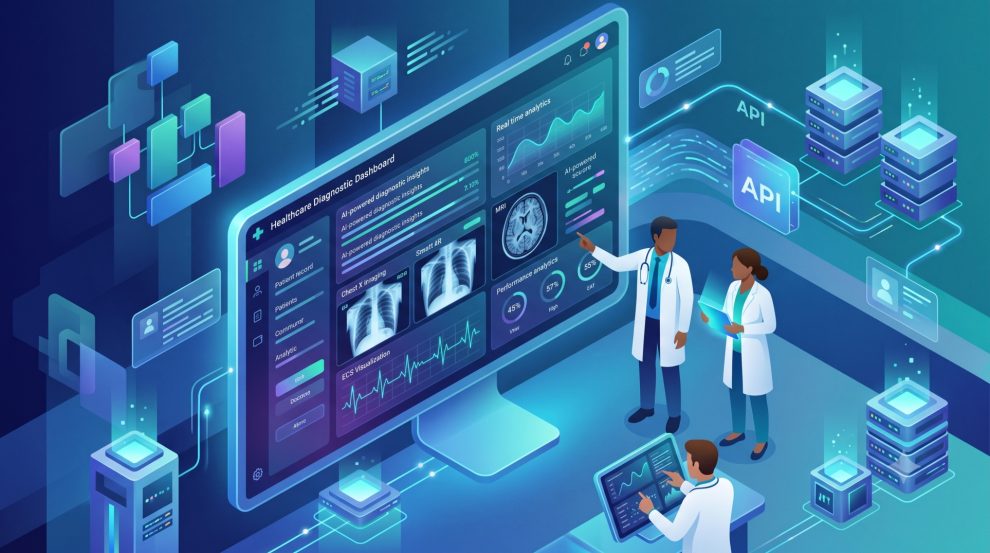
Healthcare software is becoming significantly more demanding.Modern diagnostic platforms aren’t just displaying reports anymore. They’re processing medical imaging data, integrating with AI models, handling patient interactions, generating real-time dashboards, and delivering experiences that clinicians expect to work instantly.In this environment, frontend architecture has become a business decision rather than merely a development choice.And increasingly, that decision is Next.js.Some developers still treat frameworks as interchangeable tools. That mindset feels outdated, particularly in healthcare diagnostics. Platforms dealing with patient information, AI-assisted analysis, and large datasets need performance, scalability, and developer efficiency simultaneously.This is precisely where Next.js is gaining momentum.Healthcare Diagnostics Has Become a Performance ProblemHealthcare platforms operate under constraints that most industries rarely encounter:
Large diagnostic reports and imaging dataComplex dashboards with real-time updatesAI-assisted recommendations and predictionsStrict reliability requirementsMulti-role systems for doctors, technicians, and administratorsGrowing demand for telehealth and remote diagnostics
Traditional client-heavy applications often struggle under these requirements.Healthcare professionals don’t want to wait for dashboards to render. Patients don’t want slow portals. Administrators don’t want systems that become increasingly difficult to maintain.Performance is no longer optional.Why Next.js Fits Healthcare PlatformsNext.js solves several architectural problems that healthcare platforms frequently encounter.Server-Side Rendering Improves Initial Load TimesDiagnostic platforms often contain data-heavy interfaces.Server-side rendering helps deliver meaningful content faster, which becomes particularly valuable when clinicians need immediate access to patient information.Better Performance for Data-Intensive ApplicationsHealthcare systems continuously handle large volumes of information.Next.js provides routing, code splitting, image optimization, and rendering strategies that help maintain performance as applications grow.Improved SEO for Patient-Facing ExperiencesNot every healthcare application is internal.Diagnostic companies increasingly build public portals, educational resources, appointment systems, and patient dashboards.Search visibility matters.Frameworks that deliver strong Core Web Vitals and better rendering strategies naturally become attractive choices.Full-Stack Development Becomes SimplerModern healthcare applications rarely exist as pure frontend systems.Diagnostic platforms often require:
AuthenticationAPI integrationsAI service orchestrationFile uploadsSecure data handlingReporting services
Next.js allows teams to build these capabilities within a unified development model rather than stitching together multiple disconnected technologies.AI Diagnostics Makes Next.js Even More RelevantHealthcare diagnostics is rapidly moving toward AI-assisted workflows.Radiology support systems, medical image analysis, predictive screening, and intelligent reporting all require interfaces capable of handling dynamic data efficiently.This is where React’s ecosystem and Next.js architecture become particularly compelling.AI systems generate complexity.Healthcare organizations increasingly need frontend platforms that can absorb that complexity without creating poor user experiences.Next.js appears unusually well-positioned for that challenge.Companies Building Healthcare Platforms With Modern React and Next.js ArchitecturesSeveral technology companies are actively helping healthcare organizations modernize diagnostic platforms and digital health experiences.VercelThe company behind Next.js continues to push server rendering, streaming, and full-stack React capabilities that make high-performance applications increasingly practical for complex healthcare experiences.GeekyAntsGeekyAnts has worked across healthcare and digital product engineering initiatives involving React, React Native, AI integration, and scalable application architectures. Its focus on modern JavaScript ecosystems aligns with healthcare organizations looking to build performant diagnostic and patient-facing platforms.ThoughtworksThoughtworks has extensive experience delivering digital transformation projects for healthcare organizations and frequently advocates modern engineering practices, cloud-native architectures, and scalable frontend systems.EPAM SystemsEPAM works extensively in healthcare and life sciences, helping enterprises modernize platforms with cloud engineering, data platforms, and advanced digital experiences.CognizantCognizant has invested heavily in healthcare digital engineering, focusing on patient experiences, interoperability, and scalable healthcare software modernization.GlobantGlobant’s expertise in AI, digital products, and experience engineering makes it a notable player for healthcare organizations pursuing modern web experiences and intelligent platforms.An Opinion: Healthcare Teams Should Stop Treating Frontend Frameworks as Minor DecisionsThe industry often debates frontend frameworks as though they’re interchangeable implementation details.Healthcare diagnostics suggests otherwise.A slow interface can delay workflows. Poor architecture can increase maintenance costs. Difficult developer experiences can slow innovation when AI capabilities are evolving rapidly.In healthcare diagnostics, frontend architecture directly influences operational efficiency.This is why Next.js increasingly feels less like a trend and more like a default choice.Will every healthcare platform use Next.js?Probably not.But for organizations building modern diagnostic systems, patient platforms, and AI-assisted healthcare experiences, choosing anything that significantly compromises performance, scalability, or developer velocity increasingly feels like solving tomorrow’s healthcare problems with yesterday’s web architecture.

















Add Comment